
On Aug. 18, pre-freshmen began moving into the Yard for one of Harvard College’s six pre-orientation programs: First-Year Retreat and Experience, First-Year Arts Program, First-Year Outdoor Program, First-Year Urban Program, First-Year International Program, and Leadership Institute for the First-Year Experience. Designed to build connections between incoming students, upperclassmen, and the Harvard community, the ‘pre-frosh’ programming is led by sophomores, juniors, and seniors who return to campus two weeks early to help carry on these historic traditions. About two-thirds of the incoming class typically elects to apply and participate in the pre-orientation programming.
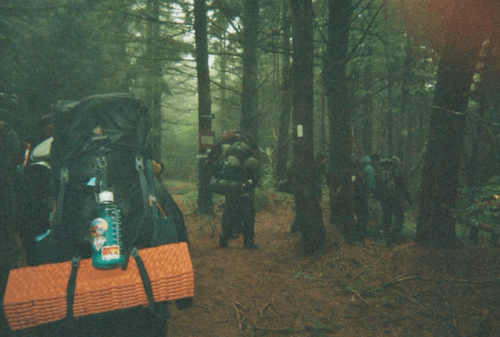
FOP began operating in 1979, bringing thousands of incoming freshmen to the forests and mountains of New England over the years. From backpacking to cabin trips or identity-based outings, FOP offers participants a range of program choices that match different skill levels and interests. Over 300 pre-freshmen participated in FOP last year alongside over 120 leaders.
Last summer, Grayson Caffrey ’28 was one of these lucky so-called “FOPers.” “I can’t imagine a better introduction to the Harvard community,” Caffrey said in an interview with the Independent. “The entire experience made me so excited and comfortable going into freshman fall, from the generous advice on basically every topic from my trip leaders to the shockingly close relationships I formed with the pre-frosh on my trip.”
Lillie Tyrrell ’28 also attested to her amazing experience on FOP 2024. “As a city kid, this was my first experience hiking [and] living in the outdoors. I learned so much thanks to the great knowledge of my trip leaders,” she shared with the Independent. “FOP allowed me to deeply connect with my peers within a matter of days, and I truly cherish the relationships I made with the others in my group.”
One of Caffrey and Tyrrell’s biggest takeaways was the connection and advice that pre-frosh gain from being around their FOP leader.
Zion Dixon ’26, a three-year veteran of FOP and former steering committee member, echoed this sentiment. Following an application and rigorous training process, FOP invites Harvard College upperclassmen to lead pre-frosh on this six-day hiking journey. “FOP leaders have a very incredible role… It’s the first impression that a student has when they come to Harvard. And so oftentimes leaders are the first person that a student intimately gets to know and ask a lot of questions,” Dixon said.
Though many FOP leaders chose to deepen their involvement in the program following personal experience as a FOPer, some do so after hearing about the experience from their first-year peer participants. “I actually didn’t do FOP as a freshman, but I became a FOP trainee freshman spring,” Dixon added.
“Everyone I knew who came back from campus really enjoyed FOP, and honestly, the only thing that made me a little apprehensive [about] being involved in the community was the outdoor component seemed wild to me,” he continued. “I had friends who encouraged me to apply because they thought I would enjoy the leadership and community aspect of it and that I could grow more comfortable with the outdoor aspect.”
FOP is organized into several different tiers. An incoming freshman participant applies to be a FOPer once applications for pre-orientation programming open in May or June. Harvard upperclassmen serve as program leaders, guiding first-years throughout the six-day outdoor expedition. The Steering Committee for FOP manages the organization and its training.
“Steering committee is a group of eight FOP leaders who basically run FOP. There’s a director, but FOP is incredibly student-run,” Dixon explained. “So many of the logistics, the route planning, the gear for like FOPers and FOP leaders, the training for leaders, selections for leaders, and FOPers…all those things happen under steering committees.”
Even for those less comfortable in the outdoors, FOP makes a deliberate effort to ensure the program is welcoming to every participant. FOP makes it clear in its mission statement that one of their values is the “equality and intrinsic worth of all people regardless of gender, age, race, sexual orientation, religion, ethnic or socioeconomic background.”
To Dixon, inclusivity and belonging are core components of the program. “I think it’s also incredible to bring people from different backgrounds [who] share stories and talk about themselves for a few days. I don’t think we really have the opportunity oftentimes at Harvard, and so it really creates a space where you’re forced to learn and appreciate people with differences.”
With his last FOP trip officially behind him, Dixon spoke on the lasting positive influence the program has had on him. “I’ve become more confident in myself as a leader and myself as someone in the outdoors,” he said. “I’ve become just very familiar with a lot of the things that can go wrong, whether it’s medical scenarios, logistical scenarios, weather… I’ve seen a lot and heard a lot of stories, [which] allows me to provide a little bit of insight and comfort to some of the newer leaders.”
First-year FOPers spent the past week hiking with 10 strangers, cut off from the Internet, cell phones, and ordinary conveniences like deodorant. Though the trip itself lasts just a week before formal orientation, FOP groups often stay connected long after. As the program’s mission statement notes: “FOP should be a resource and support system throughout freshman year.” For those shaped by FOP’s enduring community—and for non-participants eager to get involved—students will have the chance to apply to become leaders starting in November 2025.
Kalvin Frank ’28 (kfrank@college.harvard.edu) had no idea FOP existed until he came onto campus last fall.