Protests in the City of Angels: Mass Mobilization Against ICE and the Federal Government’s Response Shake Los Angeles
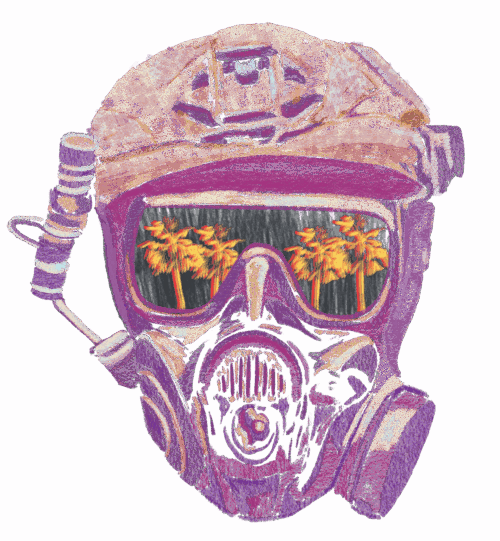
Graphic by Kayla Le

On June 7, accounts detailing immigration raids located in Paramount—a predominantly Hispanic community in southern Los Angeles County—emerged, confirming reports of Immigration and Customs Enforcement arrests that first surfaced on NBC Los Angeles the day before. More than 40 immigrants were detained at a Home Depot and a nearby Ambiance Apparel clothing manufacturer. The news quickly drew hundreds of protestors to the area around 11 a.m. Signs read “ICE out of LA” and “We Are a Nation of Immigrants” as locals condemned the agency’s actions.
Among those watching closely were university students, including members of Harvard’s own community, with 16% of the Class of 2028 identifying as Hispanic or Latino. What began as isolated outrage in one neighborhood has since evolved into a citywide uprising—challenging not just immigration enforcement but the broader role of federal power in Los Angeles.
By 4 p.m., the Los Angeles County Sheriff’s Department had declared the demonstration in Paramount an unlawful assembly, urging participants to clear the scene. Later that day, the FBI released footage capturing individuals hurling rocks at vehicles in Paramount. The footage came amid increasing unrest, as demonstrators continued to flood the streets in protest of ICE’s targeted enforcement actions. ICE confirmed that 118 people had been arrested during immigration raids the previous week. In response to these collective federal actions, protests in downtown Los Angeles continued.
The following day, President Donald Trump deployed the National Guard to Los Angeles with orders to protect federal buildings. This was the first instance since 1965 that a U.S. president deployed the National Guard without a governor’s approval. The last time was during President Lyndon B. Johnson’s tenure when he sent federal troops to Alabama to protect civil rights marchers on their travel from Selma to Montgomery.
Valeria Ruelas, a Los Angeles native and rising sophomore at Columbia University, voiced her concerns about the recent ICE raids in an interview with the Harvard Independent. “It’s really frightening. We’ve seen ICE activity in LA before, but never on this scale,” she said. “The deployment of the military also feels like an overreach. It’s unsettling to drive past familiar places and see tanks filled with soldiers.”
In response to deployment, demonstrators blocked part of the 101 Freeway near the Edward R. Roybal Federal Building and U.S. Courthouse in LA on June 8. Nevertheless, ICE raids and protests continued, and by the following day, the federal government confirmed the deployment of 1,700 National Guardsmen and 700 U.S. Marines to safeguard federal property in the area.
That same day, the State of California filed a lawsuit against the Trump administration, accusing it of illegally federalizing the California National Guard. While peaceful protests continued, reports of looting also surfaced later that night. Several stores across Los Angeles were ransacked overnight, including an Adidas store, two marijuana dispensaries, a pharmacy, an Apple store, and a jewelry store.
“I never had a doubt that the protests were justified,” Nolan Fitzmorris ’28, a University of California, Los Angeles undergraduate, told the Independent. “Growing up in Los Angeles, I’ve seen some of the most hard-working people I know struggle to gain citizenship. The process demands time and money that many people simply don’t have. That’s why it was heartbreaking to hear about the surge in unlawful searches and arrests.”
On Monday night, Trump told reporters it would be “great” if Tom Homan, the acting head of ICE, arrested California Governor Gavin Newsom. In response, Newsom took to social media, denouncing the president’s remarks as “acts of a dictator.” He made the protests a central theme of his public statements, ultimately issuing a call to action against what he described as a threat to democracy posed by the Trump Administration.
Throughout the protests, media coverage has highlighted several instances of peaceful demonstrators being targeted by law enforcement. One notable incident involved an Australian television journalist who was struck in the leg by a rubber bullet while reporting live from downtown Los Angeles. Additionally, a video that has gone viral on social media appears to show a protester being trampled by police officers on horseback.
Throughout the June 6 weekend, ICE agents also conducted coordinated operations targeting farm workers in Oxnard, employees at car washes in Culver City, and staff at clothing warehouses in Downtown Los Angeles—intensifying public outrage and fueling ongoing demonstrations citywide.
“I realized that many people I care about were now in danger,” Fitzmorris continued.
When President Trump deployed approximately 700 active-duty Marines to the Los Angeles area, including Paramount and Compton, it was an unprecedented military mobilization. Estimated to cost $134 million, this decision has drawn sharp criticism from California officials, who argue it represents a federal overreach into state affairs.
A Harvard freshman who requested anonymity echoed similar sentiments as Fitzmorris in an interview with the Independent. “I don’t think the protests are unjustified since LA is home to many diverse communities, and there’s a strong sense of mutual respect here… The ICE raids have definitely impacted the city,” they stated.
During a press conference last Thursday morning, Homeland Security Secretary Kristi Noem referred to the city as a “war zone,” a statement that drew swift condemnation from Democratic leaders.
Another anonymous Harvard sophomore expressed frustration with the media’s portrayal of Los Angeles, especially since the protests began. “It’s upsetting to see the city being described as a ‘war zone,’” she said. “I have friends who attended the protests, and it definitely wasn’t a ‘war zone’—it was people coming together for their communities.”
Fitzmorris agreed, criticizing the media coverage that he felt painted a one-sided picture.
“In an effort to support the Trump administration’s vilification of Latinos in America, the media highlights the raids over the many peaceful demonstrations,” he said. “But regardless of how forceful the protests are, it’s unjust to ignore the stories of people affected by ICE arrests. Instead of seeking flaws in how people choose to protest, the media should prioritize amplifying the message behind their actions.”
Ruelas, whose family owns a small business in a predominantly Hispanic neighborhood, also expressed concerns about how mass deportations affect the makeup and overall sentiment in her environment. “You can feel the deportations,” she said. “It’s not only noticeable by the clear absence of regulars in our shop, but also by word of mouth—hearing from people you are close with that their family members can’t leave the house. It’s really sad.”
As protests persist across Los Angeles, residents are calling not just for temporary relief, but for systemic change. For students like Fitzmorris, the path to de-escalation begins with confronting the root causes of the unrest.
“As long as ICE continues on its path of mass deportation, the fight will continue. Many of their acts are completely unlawful, and people are no longer willing to accept them,” Fitzmorris said. “A major change needs to occur to de-escalate tensions, whether it’s increased accessibility towards citizenship, decriminalizing unauthorized entry, or restructuring ICE itself.”
Nashla Turcios ’28 (nashlaturcios@college.harvard.edu) a student from Los Angeles, writes News for the Harvard Independent.