Restrained But Not Restricted: International Students’ Free Speech On Campus
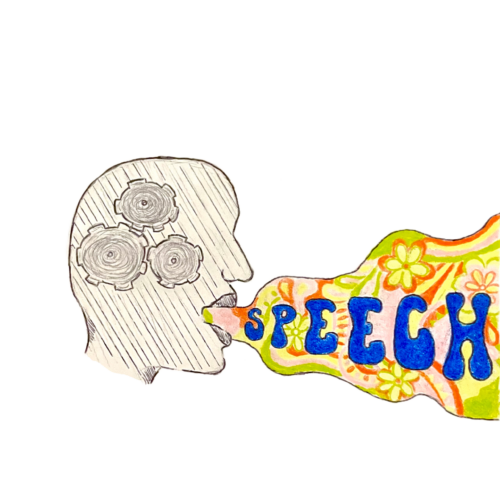
Graphic by James Foss

A Harvard College international student—who chose to remain anonymous due to security concerns—was playing frisbee in the Harvard Yard when a man approached her, introducing himself as a reporter for CNN. He asked if she felt scared or threatened. “I didn’t want to just say yes, because of course I’m scared and of course I’m threatened,” she told the “Independent.”
“If I say I’m threatened, [the headlines are] going to be ‘Harvard International Students Threatened by Harvard,’ and I don’t want to feed that. So I was like, ‘It’s feeling really supportive. They’re very responsive and responsible. They care for us, and I feel pretty safe on campus,’” she continued.
Stumbling across the published CNN article months later, titled “A New School Year Starts at Harvard as Students Live with Lingering White House Threats,” she realized that the reporter presented her as passive. “I look like an unhindered, performatively peaceful [student],” she explained. But her intention was far from wanting to dismiss fears. “I didn’t want to look like a miserable international student.”
Over the past few months, Harvard has been under particular scrutiny as the Trump administration examines higher education. As of the fall semester, 6,749 of the total 24,317 students enrolled at Harvard University were non-U.S. residents. Between threats made by the administration to revoke student visas in Apr. 2025 to current ICE raids throughout the United States, many international students feel they cannot make public statements. In the midst of political tensions and debate, domestic students also feel pressure to be careful about how they articulate themselves and speak out in public spaces and on media platforms.
The series of lawsuits filed by both the University and the Trump administration contributed to this culture of worry. Last May, the Department of Homeland Security tried to revoke Harvard’s authorization to enroll international students. The measure was blocked by U.S. District Judge Allison D. Burroughs after finding that the administration was likely taking illegal actions and violating constitutional rights. Harvard also filed a lawsuit against the government’s cancellation of $2.2 billion in research funding, which accused the university of being non-compliant with antisemitism standards.
Only last month, President Trump requested $1 billion in damages from Harvard. The tense back-and-forth between Trump and Harvard has left international students wondering about the risks of speaking out on social media, in school newspapers, and in certain on-campus events. Many fear jeopardizing their education and take measures to avoid doing so. “My academic career and my life career depend on whether I have to speak out or not,” one international student said.
On Mar. 8, 2025, a Columbia graduate student and Palestinian rights activist, Mahmoud Khalil, was detained despite being a lawful, permanent U.S. resident. The Office of the United Nations High Commissioner for Human Rights commented on this situation just a few weeks later. “We are alarmed that the U.S. authorities are openly weaponising deportation as a tool to censor critical voices, seriously damaging the precious rights of free speech and assembly that the U.S. has long cherished and promoted at home and abroad,” they wrote. Khalil was released in June 2025.
The recent detention of a Columbia undergraduate student, Elmina Aghayeva, sparked national uproar. Aghayeva, an online influencer, was taken into custody on Thursday, Feb. 26, and released nine hours later. ICE agents entered her residential building without a judicial warrant under the pretense that they were searching for a missing child. They later claimed her visa was terminated in 2016 after failing to attend classes.
Several Harvard students also shared that while they have not encountered direct violations of their right to free speech, they experience an atmosphere of restraint. “I don’t really feel threatened, but then I do feel an anxiety that other domestic students wouldn’t have [about] going out of the U.S. or going to immigration courts,” the same international student said. “If I speak against the government or against something that might make me stand out, even if it’s a valid opinion … when my name comes out, what’s going to happen?”
Besides the CNN reporter, the first international student described how media and newscasters have not had a large presence on campus, limiting the moments in which she has to decide whether or not to speak out.
“I haven’t felt the impact of that in our day-to-day conversations. People still talk openly about their opinions; I value that we have a safe space to do so,” the second shared.
Domestic student Juliana Yal ’29 reflected on the campus climate this academic year: “I really haven’t had any instances where I felt particularly about speaking out and not being able to,” she said, citing the recent grading policy where she felt students were able to share the points they agreed or disagreed on.
Students interact differently with free speech depending on how they learned to express themselves in the past. Oftentimes, local communities both inside and outside the United States are more homogeneous than Harvard. Encountering contrasting opinions for the first time may influence whether students feel comfortable enough to take a firm stance on a controversial issue or if they feel that their voice would really contribute to ongoing discussions.
Avani Shah-Lipman ’29 attended a small all-girls high school in Philadelphia. “Everyone agreed on everything,” she said.
The second international student described a similar cultural distinction to her own country that she believed many tend to overlook. “Certain societies believe that protecting the overall social harmony is more important than protecting individual free speech,” she explained.
Yal also explained the unique emphasis that the United States places on expression: “Free speech was always something that was important and something that I always knew was integral to America as a whole.”
Attending Harvard, one of the most widely recognized academic institutions in the world, has also made a difference in how students present their own opinions. For Shah-Lipman, the exposure is new and refreshing. “I feel like I have been confronted with more political debate here, which has been a positive experience for me,” she said.
Concerns over exercising free speech may be less in response to judgment or consequence by others in the Harvard community, but may instead result largely from Harvard’s public profile. Harvard’s Free Speech Guidelines claim that the prominence and character of the University should encourage free speech and contrary views. “Because no other community defines itself so much in terms of knowledge, few others place such a high priority on freedom of speech,” the guidelines state.
Yet many students experience the opposite. The University name also holds students’ opinions to a higher standard, creating pressure to be politically sound and articulate. “It makes people more hesitant to freely speak their minds because of the responsibility of being affiliated with an institution like Harvard,” Yal said.
Shah-Lipman is not critical of Harvard’s intellectual environment, but attributes the pressure to a more general American trend. “This issue of feeling like there is no free speech is not Harvard-specific, because America has become increasingly polarized over the years,” she said.
She also appreciates Harvard’s efforts to create platforms with diverse and contrasting opinions, including “Berg Banter”—a space for first-years to meet every few months and debate contentious topics. “Some of the even more manufactured intellectual vitality events are important to remind people that constructive debate and sharing of ideas are possible, even in this political climate.”
Another fear that the first international student shared was of her words being misconstrued. “Because I don’t know how my opinions are going to be taken, I feel like I’d rather choose not to talk in public,” she said in regards to participating in demonstrations, answering online interviews, or responding to bloggers.
This student further shed light on how her experience may differ from other international students due to factors far from her control—interstate politics. “I feel comparatively less threatened than other countries because [my country] and U.S. relationships are not the worst. But I imagine there are other countries out there that have worse relationships with the U.S.”
Some students argue that fear surrounding free speech amounts to a form of censorship by the Trump administration, an issue scarcely addressed by Harvard leadership, yet students also feel that they have the right to choose how they engage with publicity. “I respect that here at Harvard, here in the U.S., free speech is something that people prioritize … but my not exercising free speech is also me exercising my free speech,” the second international student said.
For some international students, being able to access and engage with their Harvard education is most important. “The situation could be a lot worse, and I’m getting what I would want,” the first international student said. Her choice not to be disturbed by threats from the government is another form of defiance. “I’m generally against this overgeneralized depiction of international students being scared of the government.”
Even if the Trump administration has forced international students to take caution on how they present themselves in public, many refuse to live in fear and are continuing to engage wholeheartedly in their education. The country’s political climate will inevitably continue to shift, and despite the pressures it brings, the voices of Harvard students are still drawing attention.
Olivia Le ’29 (oliviale@college.harvard.edu)is an “Indy”writer and an even better listener.