Sanders Theatre: Down With Dark Academia
Graphic by Kerrie Zhu

As someone who until very recently spent a great deal of time scrolling through TikTok, I know a fair amount about aesthetic subcultures. Cottagecore? I’ve watched more than a few homemade ricotta tutorials. Tomato Summer? Lamented its rise; celebrated its collapse. Office siren? Got called that by Indy Copy Editor Megan Legault ’28.
Suffice it to say, I’ve spent countless hours analyzing microtrends among the chronically online, mentally filing them away in spaces of my mind I ought to use more productively—I could use what precious limited space memory permits, for instance, to house my prerehearsed stance on the whole Fourth of July antipasto debate, or perhaps my assessment of the authenticity of the 24-karat-gold Labubu.
For the concerned few: I’m currently on a TikTok cleanse after misreading an Italian street sign that read “Torre Vanga” as “Tori Vega.”
Anyway, there’s one 2020s Internet subculture I’ve always detested—and, unfortunately, it happens to be one of the most popular: dark academia. Aestheticized melancholy, contemplative gallery strolls, an obsession with Collegiate Gothic architecture, 19th-century English literature, and tweed—it’s all an exhausting spectacle to watch at Harvard.
For starters, at least visually, Harvard is just not the place to live out your “The Picture of Dorian Gray” fantasies. Aside from Swartz Hall, Harvard doesn’t boast much in the way of true Collegiate Gothic. Annenberg Hall comes close, but your average dark academia enthusiast would probably hiss at the use of red brick before retreating to their Byron anthology. I could see dark academics thriving more among Yale or Princeton’s grayer and pointier structures, but can you really imagine a circle of pea coats debating Tennyson in the Canaday courtyard? Have you seen the Cabot Science Library? I’d hardly call its olive-green and bright orange chairs or fluorescent lighting emblematic of dark academia.
A lot of my armchair theorizing about Internet aesthetics hinges on one central dogma: the idea that the aesthetics we choose for ourselves betray a corresponding emptiness within us. Those who romanticize 2020, for instance, are often those who were too young to have meaningfully engaged with the Internet culture of that time—a culture that served as a nursery for a lot of the content we see today: the cleaving of mainstream and alternative TikTok, the surging rise of cringe comedy, and the ascendancy of Gen Z to its current position at the helm of the Internet.
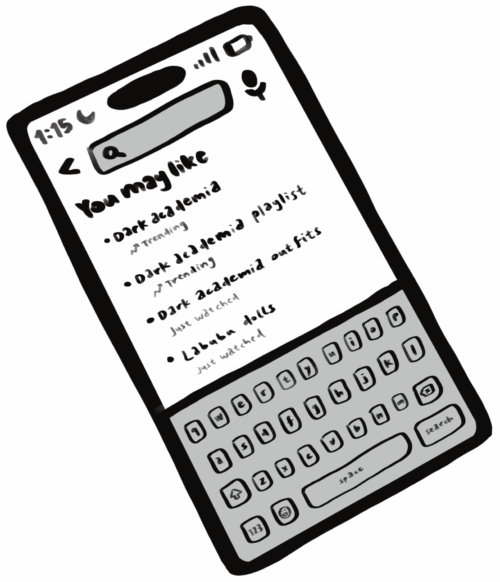
Dark academia, in all its brooding affection for “high literature,” doesn’t own up to the second part of its name. There’s definitely a romanticization of gloomy novels and poetry, but too often it seems like dark academics tend to invest more in appearances than in substance. You can kind of tell that dark academia prioritizes visuals over content by looking up “dark academia ideas” on Google Images and seeing how most of the results are about outfits that fit the aesthetic and not book recommendations.
Further, their canon skews white, Western, and pre-contemporary, eschewing much of the diversity and theoretical richness that define serious literary study today. Ironically, although dark academia emerged in ideologically progressive circles (mid-2010s Tumblr before its popularization by 2020 TikTok), its reading list looks a lot like the ones that conservatives are pushing for in secondary and higher education today.
The discordance in theory and application does not stop there. There’s a dual romanticization at play with dark academia—one for the literary crucible of Regency and Victorian England and another for the mid-20th-century academic culture that exalted works of that time above all else. If anything, dark academia is a sort of pop-academia, craving an old-money, elite-college luster well-documented by “Dead Poets Society” and “The Secret History.” The aesthetic sells because it provides a veneer of high-minded intellectualism over a body of works that might have their own individual merits but are anything but representative of academic literary study when taken as a collective and exclusive canon. Want to make a dark academic really freak out? Tell them that their vibe is really giving “The Tortured Poets Department,” and you’ll see this dissonance play out firsthand.
Even the literary gloom they celebrate lacks catharsis. We read Greek tragedy for relief—the knowledge that the sufferings of Oedipus or Medea will not befall us. The dark academic is consumed by dreary literature with no such relief. This constructed baseline of negativity and the repeated training of the mind on the drab alone denies the dark academic the ability to understand the cathartic aspect of much of the literature that they read. The unabated consumption of gloom does not free the dark academic from worry that they will meet the same fate as the characters they envision but shackles them to an ever-increasing burden of dread.
And like most Internet aesthetics that escape the iPhone (or, in the case of Indy Associate Arts Editor Raina Wang ’28, the Samsung), dark academia suffers from a gaudy artificiality. Adopting an aesthetic, yes, can give one some sense of community, but this comes with the forfeiture of one’s individuality. Rather than presenting themselves as individuals, dark academics present themselves as dark academics. A shared aesthetic is, by definition, inherently not individual. And as with so much of dark academia, the performance feels dated—not in the nostalgic way they likely intend, but in a way that suggests an oddly retrograde desire for sameness.
Communitarianism in 2025—at a time when anybody with Wi-Fi can access millions of combinations of ideas and works by which to define themselves, retreating into a pre-packaged identity feels more like resignation than rebellion. Earlier, I wrote that I know a lot about Internet aesthetics—but I would never, and will never, adopt one.
Jules Sanders ’28 (julessanders@college.harvard.edu) once deleted TikTok for three months in 2024 and was really proud of himself.