Selling Self-Care
Graphic by Clara Lake

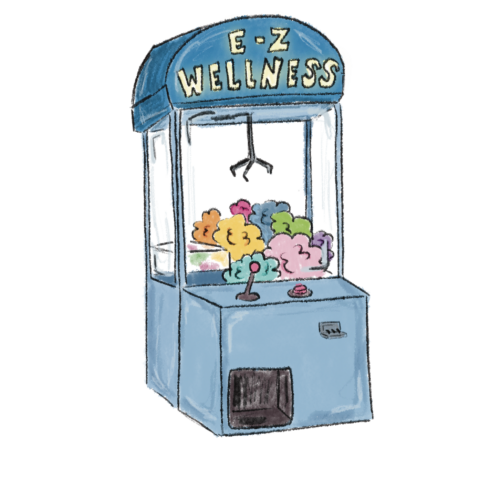
When did wellness stop being a habit and start becoming a trend? When I was younger, it meant staying home with a mug of tea when I had a sore throat, or eating the fruits and vegetables my mom set out with dinner. Now, those small, quiet acts feel insufficient.
Ever since the pandemic, it feels like personal choices are determined by what is trending on social media. Even beyond the highly-curated Instagram posts that plague our screens, the feeds we see regularly impact our time away from screens as well—I know the fated “doomscroll” has shaped my lifestyle.
Especially during the pandemic, when the world shrank to the size of my phone screen, it felt easy to adopt whatever wellness trend appeared on my feed. A morning bowl of ice to depuff my face? Sure. Two-week Chloe Ting workout right before the start of summer? Definitely going to work. I was convinced that I would stick it out, making these “trends” daily habits that would help me become a better version of myself. But sure enough, just a few days in, I would abandon icing my face in the mornings or be too tired to do my 15 minutes of abdominal workouts, bringing my short-lived streak of society-approved wellness to an end.
This nasty habit of capitulating to ever-changing trends under the guise of self-care extends beyond me. It’s ingrained in the capitalist nature of our society and has existed long before we were scrolling on TikTok.
In a podcast on NPR, author of “How to Be Well: Navigating Our Self-Care Epidemic, One Dubious Cure at a Time,” Amy Larocca notes that wellness has been sold to us since the 1800s. Rooted in industries’ desire to turn a profit, Larocca explains how wellness is marketed the same way luxury goods are: as an accessory to the perfect woman who is pure, whole, and seemingly effortless. In looking through the diaries of young girls throughout history, she finds a recurring theme: a constant need for self-improvement. It’s clear that toxic wellness culture is embedded in our society—it has been from the very beginning.
However, with the digital connectivity of our world, the enduring idea of wellness culture has been exacerbated. Our algorithms make us question whether we’re eating in the “right” ways, doing the “correct” routines, and matching the socially accepted definition of wellness. But instead of making us feel better, our fixation on this constantly evolving trend culture makes it impossible for us to be truly well, both on and off camera.
In this way, wellness culture asks us to perform for ourselves even when others aren’t watching. I have caught myself doing that on more than one occasion, feeling the need to look effortless and put together when all I’m doing is spending a Saturday morning cleaning my dorm. “The idea of wearing a matching set at home is a part of the capitalist construct that asks us to perform in our own homes,” Harvard first-year Hafsah Khan ’29 said in an interview with the “Independent.”
Being at home should mean being your true self and not feeling pressured to put on an appearance for others. For me, that looks like having makeup and jeans off, sweatpants and a baggy shirt on.
The pressure to embody a socially constructed version of our “best selves” reflects the constant messaging around us. And our collective desire to perform perpetuates the wellness culture that none of us can catch up with.
Wellness is so much more than juice cleanses, multi-step skincare routines, and workout fads. All of these are idealized concepts, sold to us by the industries that profit from our need to buy into what is trendy. But what is trendy doesn’t really do much for us. Buying the next gua sha or making the newest green juice again and again isn’t necessarily making us feel better and is impossible to maintain in our everyday lifestyles. And the influencers who sell me their various products don’t know who I am or what I do daily. They have no understanding of what is essential to me and, therefore, what wellness looks like for me. So how could they ever know what makes me feel my best?
I’ve realized that the best way for me to practice wellness is to find time in each day to do something for myself. I have found that it is really easy to get sucked into the workaholic culture that tends to define our campus. Instead of letting it control me, I make conscious choices to support my own wellness. Whether that’s by spending a day in Boston or reading a book that isn’t required for my next section, making time for these things is a small but simple way I can take care of myself.
Spending time with people for whom I don’t feel the need to perform is self-care, too. My family, roommates, and closest friends are living reminders that wellness does not require me to be the perfect woman that Larocca describes. They remind me to do what is best for me.
And wellness is just that—what is best for you. It is the cup of tea when you’re sick and a comforting movie when you’re sad. I’ve found, on my many trials of wellness fashions, that the best things for me aren’t what everyone deems as flashy and cool. Instead, I find comfort in the things I know will make me feel good: afternoon naps, cafe study breaks, and walks outside as spring (hopefully) approaches.
Miriam Tsegay ’29 (miriamtsegay@college.harvard.edu) is finding wellness in journaling and dance parties this semester.