Sex in Books
Graphic by Neshama Ryman

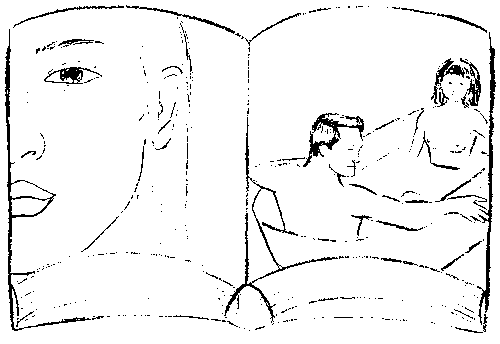
As a 19-year-old college student, I’d like to think I’ve finally reached that age where it’s okay for me to read books that contain erotic scenes scattered throughout. As much as I’ll slouch into my seat when reading explicit content in public, I can accept that sex is just a normal part of life, and should also be a normal part of books. What I cannot accept, however, is sex used as pornographic bait for a horny audience.
I’ve recently started reading “Intermezzo” by Sally Rooney, and the writing instantly blew me away. Rooney’s narration is difficult to follow, but remarkably clever and strangely fitting for her two protagonists: Peter and Ivan, two brothers navigating inappropriate relationships with women in the aftermath of their father’s death.
Peter, a 32-year-old lawyer, straddles two relationships—one with Naomi, a young, broke, and carefree college student, and the other with Sylvia, the ex-girlfriend he’s still desperately in love with. Ivan, a 22-year-old chess prodigy, sneaks away on weekends to see Margaret, a 36-year-old divorcee.
What shocked me most, despite Rooney’s reputation for writing sex-filled novels, was just how explicit the sex scenes were—and right from the second chapter, at that! Rooney doesn’t hesitate to dive into the vulgar details (for five very. long. pages.): “he touches with his fingers the black cotton of her underwear, damp,” which elicits “another high moaning sound, closing her eyes.” Or: “her mouth, wet, open in that way, he wants, and to make her come.” And then: “it’s nice. Throbbing inside her and wet she says this.” It feels like I’m reading porn.
With so much narrative imagery, these sex scenes seem to serve a purpose more akin to entertainment than story-building. I simply can’t imagine how the inclusion of this much detail drives the plot forward or develops a character’s complexity for readers.
Rooney redeems herself in some instances, though, when she includes in sex scenes—like when Peter bathes with Naomi—dialogue and inner thoughts that reflect a broader theme of isolation and human company as a means of coping with loneliness. As she “rests still against him, the weight of her, fragrance of her dark hair,” he tells her, “I just want you to be happy,” and memories come back to him: “after the funeral, crying alone in a locked bathroom cubicle. And now the blocked number, [remembering telling Ivan] I’ve always hated you.” He compares the “cold, desolate emptiness of the city outside. And in here… warmth of her body against him, sound of her voice, her laughter.” In these moments, I can see the merit of using the intimacy of a shared bath to evoke Peter’s complicated feelings of love, lust, and self-hatred all mixed together.
But at a rate of almost one sex scene per chapter—and not all of them as emotionally substantive as the bath scene—Rooney’s novel cannot justify all of its overt eroticism with some notion of narrative depth. I cannot come up with any other reason to justify the excessive sex other than to draw the attention of adult audiences indulging in the erotic nature of sexual fantasies.
Now, I am certainly not a prude. I’m not so stuck-up that I can’t accept the carnal nature of humans in art. Instead of sexual tension serving as the driving force of a plot, I’d rather the sex be used delicately and masterfully to add substance. Take, for instance, Haruki Murakami’s “Norwegian Wood.” While Murakami’s portrayal and sexualization of women are problematic (and deserve their own separate article), his strategic placement and development of sex scenes add not only to the plot but also to character development.
Murakami’s coming-of-age story centers on Watanabe’s unfulfilled love for Naoko. Their relationship is complicated with the memory of Naoko’s dead ex-boyfriend, Kizuki—who was also Watanabe’s best friend. So when Watanabe and Naoko finally sleep together, it stirs up complicated feelings for both.
Right before it happens, Naoko is crying in Watanabe’s arms. Then, after a line break, sex is introduced abruptly: “I slept with Naoko that night.” Followed up with: “Was it the right thing to do?” Although Murakami details their sex (“I kissed her and enfolded her soft breasts in my hands. She clutched at my erection”), he quickly steers the narration right back to both characters’ emotional and physical pain, as the sex is tainted with the memory of Kizuki—“Naoko tensed with pain. Was this her first time?… I had assumed that Naoko had been sleeping with Kizuki.” Although they’re having sex, the moment feels more mechanical, with little arousal mentioned; instead, we can’t escape the guilt they carry for betraying the memory of Kizuki. The scene even ends with: “her cry was the saddest sound of orgasm I had ever heard.”
Murakami isn’t writing to arouse; he’s writing to explore the psychological and emotional weight that lust can elicit. In a story that addresses desire and companionship as a means of escape, it makes perfect sense for sex scenes to be written this way. The sex adds a fresh layer of emotional complexity to the familiar feelings of sadness, since in “Norwegian Wood,” Murakami centers the narration around characters’ reflections on sex rather than graphic descriptions of their carnal escapades. I really don’t need to know about everybody’s wetness, hardness, and lust.
To compare Murakami’s first sex scene to Rooney’s: his only spans one page, compared to five; his focus on Naoko’s complex relationship with sex following her boyfriend’s death, whereas Peter’s scenes lean into the purely sensory aspects of sex; and most importantly, his doesn’t read like uncomfortable smut. Though both books explore characters who use sex as a coping mechanism for loss and grief, Murakami illustrates it more tastefully by omitting the unnecessary, erotic details that Rooney depends on.
After reading both books, I much prefer how Murakami folds sex naturally into his pages. Murakami mentions sex just as much as Rooney, if not more, but he treats it as a matter-of-fact part of life (which it is), while Rooney glorifies sex as a solely lustful, pleasing, and agreeable act—which isn’t realistic. Read Rooney’s books anyway, since the characters are worth enduring the occasional five-page sex interludes, but be warned: I find the sex incredibly uncomfortable, and much prefer Murakami’s more realistic portrayal over the more romanticized, perhaps even pornographic, depiction you’ll find in “Intermezzo.”
Raina Wang ’28 (rainawang@college.harvard.edu) highly recommends “Norwegian Wood,” first the song then the book.