The Charles Knows Too Much
Graphic by Jordan Wasserberger

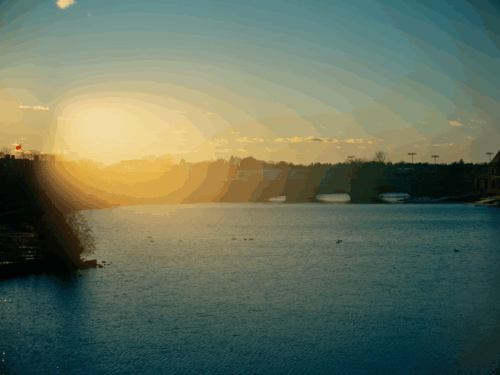
Late at night, I get the urge to ponder. It’s like my version of the munchies, but rather than drug-induced, it’s born from a degree of sobriety that’s almost painful. Instead of my mouth watering for a $2 smashburger or a slice from Joe’s Pizza, I crave meaning—hot, fresh, and preferably delivered in under 30 minutes. It’s just as greasy and just as likely to fill me with regret the next morning, anyway. So, I do what any self-respecting overthinker would: I walk to Weeks Bridge.
Bridges, I think, attract ponderers. They invite drama. Just as there are different types of drunks, I’ve deduced that there are different types of ponderers. Romantic ponderers overanalyze the duration of eye contact to the millisecond. Existential ponderers question why they bother keeping the receipt from CVS. Sentimental ponderers yearn for the same euphoria of a moment that seemed unimportant at the time, the type of joy that refuses to repeat itself.
I’ve been each at least once. Sometimes all three on the same night.
It’s odd how I need scenery to validate my introspection—that I can’t simply stop to think anywhere. In the chaotic pace of campus life, pausing isn’t just counterproductive; it can be fatal. Gazing over the side of Weeks Bridge grants me the rare permission to be so present that I can share with someone a conversation or moment that the universe decreed to stay private. The wind carries sound away, and the water seems to cleanse my soul. The only ones to hear my inner ruminations are the Charles and the athletes gliding past me on their scooters.
I feel both deeply known and anonymous—grounded in the world and unseen within it.
German philosopher, Martin Heidegger, once wrote that a bridge doesn’t just connect two sides of a river; rather, it “gathers” the world and becomes a place itself. Maybe that’s why I keep returning. Weeks Bridge doesn’t just lead me somewhere. It’s where I stop “becoming” for a moment. It’s where I’m reminded that life’s most formative moments don’t happen in a rush, but instead during the pauses between.
Weeks Bridge was built to extend steam tunnels, its hollowed interior just large enough to carry pipes across the water, and occasionally a handyman. Its purpose was invisible. The bridge’s meaning wasn’t in its design, but in what slowly gathered around it. The people who stopped, stayed, and looked out over the Charles are what turned the bridge from a place of function to a place of pause. That’s what I love about it.
To me, the other bridges get people somewhere. Weeks let them stop.
My first week of college, I stopped at the bridge for a Mid-Autumn celebration where I would meet the people who would become my roommates. Over one-eighth of a mooncake and a half-cup of Calpico, we found that we shared the same affinity for “your mom” jokes and took a series of disposable photos where, miraculously, all three of us but Audrey dodged the mid-blink curse. Maybe Heidegger was onto something when he said that the bridge gathers. It gathered us, even if not photogenically.
Then, in January, I didn’t just come back to an entropic work-life balance. I returned to blankets of white. Each step in the snow sank deep. Dislodging my feet from shoe-shaped pits felt like fighting my own inertia—the quiet fear of being left behind as everyone forged ahead, finding their place and purpose.
There were days when I didn’t want to lift my foot out of the snow, not out of laziness but because I wasn’t sure which way was forward. Snow isn’t contiguous like ice. It doesn’t hold the same way. It crumbles under pressure, glides with the wind, and doesn’t resist its own undoing. Standing on Weeks Bridge, I felt like the stonework beneath understood, quietly, with ice below and snow above—that stability and change could coexist.
Do I continue seeking what I love, or commit to what I’m mildly good at and call that fulfillment?
Is it truly enough to be pleasant to be around, or should I at least have a niche talent like juggling?
Do I actually like chemistry, or am I just in too deep to admit I’ve been seduced by the hexagons?
Maybe it was just easier to embrace the frostbite and let Earth hold me in place.
One night, I found myself back at the bridge again. I must have looked especially broody because a stranger asked if I was okay. I felt, for the first time in a while, the will to take a step out of the snow. After hearing my anxieties, he grinned and proposed a snowball fight. It was a small thing, but once again, the bridge gathered something warm out of the cold.
No one but us, the wind, the ice—just enough to remind me that slowing down isn’t the same as falling behind.
Most of the time, modern life pulls us away from dwelling. We hurry, we cross, we use places as means to an end. But every so often, we stumble upon a space that lets us simply be.
I keep pondering at Weeks Bridge, not in the pursuit of answers, but for the pause. In a world that worships constant motion, I’m reminded to have faith in stillness, to believe that being here is already enough.
Maybe Heidegger, too, just needed somewhere to think too hard by the river.
Kayla Le ’28 (kaylale@college.harvard.edu) is probably—you guessed it—pondering at Weeks Bridge.