The Class of 2028 Makes it Official
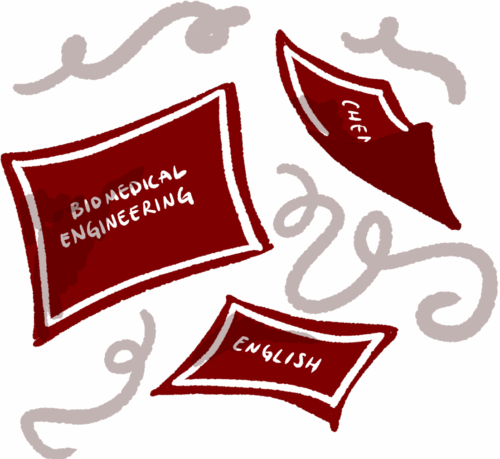
Graphic by Emma Crago
On Friday, Oct. 10, Widener’s steps were packed with sophomores posing with concentration banners beneath the cloudy sky, trying to get a photo before their flag disappeared into the crowd. Along with most life sciences concentrators, I went straight from Chem 17 lecture to snap a photo with my roommates holding the “Concentration Declaration Day” sign. Banners for the most popular concentrations, like Economics or Government, were snatched up instantly, with students waiting in lines that stretched across the library.
At Harvard, students choose their field of study, called a concentration, halfway through their third semester—later than at most schools. My sister, who goes to the University of Michigan, declared her major at the end of her freshman year. So did most of my friends from home.
The extra time is meant to give us space to explore. Harvard offers over 50 concentrations, plus the option to design your own, and more than 3,700 courses. But that flexibility can make the decision more difficult, too. That’s why declaration day feels so significant—it’s a shift from exploration to commitment, from “undecided” to direction.
Last year, I thought I wanted to pursue biomedical engineering—until Math 1b happened. If I had to declare before taking a second semester of math, I probably would’ve stuck it out. Luckily, I realized early that I didn’t want to spend the rest of my time here struggling through equations in even harder math classes.
For most of last year, I wasn’t sure what direction I wanted to go in. I knew I was interested in medicine, but I didn’t know how I wanted to get there. I tossed around a few life sciences options and made about a million calls to my parents and sister, hoping one of them could just tell me what to do.
Eventually, last spring, I decided I wanted to go to medical school. That still left me with a slew of life science classes, but at least it gave me a starting point. I started reading through the requirements for different concentrations, trying to figure out which topics I was genuinely curious about—and what I’d actually enjoy spending time learning.
When I mentioned to a friend that I was picking a concentration as a premed, she suggested I look into Human Developmental and Regenerative Biology. I read into it, and it sounded fascinating, so I made an appointment with the HDRB advisor, Amie Holmes, to talk about the upper-level courses offered by the concentration. Of course, we also discussed SCRB 10: “Stem Cell and Regenerative Biology,” the foundational course for HDRB.
SCRB 10 is notoriously difficult, and our class average of 64% on the first midterm this year speaks for itself. But despite the challenge, I’ve found myself enjoying lectures and sections because the material is so engaging.
HDRB classes explore how humans develop from a single cell, maintain and repair their bodies throughout life, and eventually age. The coursework helps us understand how the body works—and what happens when it doesn’t. Many HDRB classes, including SCRB 50: “Building a Human Body: From Gene to Cell to Organism,” incorporate hands-on research, and one semester of independent research is required for all concentrators.
Students can fulfill their upper-level requirements through a wide variety of classes on topics like tissue engineering, the pathology of human disease, brain development, and mental illness. When I read through the course list, I realized I could find almost all of them interesting.
So to anyone unsure of what to study, I’d encourage you to explore your options and find something that excites you. Because when the coursework gets hard, and it will, it’s a lot easier to push through when you genuinely care about what you’re learning.
Declaring didn’t feel like a life-altering moment, but it did feel relieving. Not because the process was hard—the form takes about five minutes—but because it was satisfying to finally say out loud: this is what I’m studying.
It was also a relief to tell people with certainty that I want to go to medical school. That idea has always been in the back of my mind—both of my parents work in medicine. My mom is an ICU nurse, and my dad is a physician assistant who was a paramedic before that.
My mom works in a hospital unit where most patients are in critical condition. She often talks about her day when she gets home from work, and although it is a demanding job with long hours, she keeps doing it because she is part of a team that can keep critically ill patients alive. Growing up, I remember hearing two separate times my dad performed CPR on strangers in public—when he wasn’t even on duty—and both people survived. Hearing stories like that makes it hard not to be inspired.
I saw firsthand how challenging and emotionally demanding my parents’ work could be, but also how deeply rewarding. That combination of compassion, resilience, and the ability to truly help people is what first inspired me. In particular, hearing about the minor surgeries my dad performs in the office he works at has helped me realize what path I want to follow.
Surgery has always fascinated me—I think it’s incredible that someone can arrive at a hospital in critical condition and, through the skill and precision of a surgical team, walk out with a new chance at life. Medicine is collaborative; many professionals often work on one patient, each contributing their expertise. Declaring my concentration made me feel one step closer to that goal, so snapping a picture with my HDRB banner felt like a small but meaningful milestone.
It’s hard to know exactly what you want to do with your life when you’re still so young. The pressure to have it all figured out can feel especially intense at a place like Harvard, where it sometimes seems like everyone around you already has a perfectly mapped-out five-year plan. But the truth is, most people are still figuring it out—even if it doesn’t always look that way.
When I wasn’t sure what I wanted to do, I found that following my curiosity—joining a club, trying a new class—often led to unexpected clarity. For me, taking Gen Ed 1027: “Human Evolution, Human Health, and Climate Change” was one of those moments. It surrounded me with many students who were pre-meds and further along in their college experience than me. Talking with them helped me confirm that I wanted to be pre-med. It’s through that kind of exploration and uncertainty that real growth happens, and you can end up on a path you never saw coming.
Although I’m confident about wanting to go to medical school, that doesn’t mean I have every step planned. There are moments when I think about everything premeds have to juggle—prerequisites, research, shadowing, the MCAT—and I feel like I’m already behind.
It’s easy to get caught up in comparisons. One of my friends submitted her plan of study at 11:30 p.m., just half an hour before the deadline, and immediately started talking about switching. Luckily, nothing is permanent—and even when it feels like everyone else has it figured out, trust that they usually don’t.
At the end of the day, declaring HDRB wasn’t about having all the answers. It was about finding a field that makes me want to learn, even when it’s hard. This process of uncertainty, curiosity, and self-discovery is part of what Harvard’s liberal arts education is all about. I might not know exactly how I’ll get to my end goal, but I have a starting point—and a real answer when someone asks, “So, what are you studying?”
Olivia Lunseth ’28 (olivialunseth@college.harvard.edu) knows that the picture of her holding the “Human Developmental and Regenerative Biology” banner will almost certainly end up on her parents’ Christmas card this year.