The Fallout of the Funding Cuts
Graphic by Kerrie Zhu

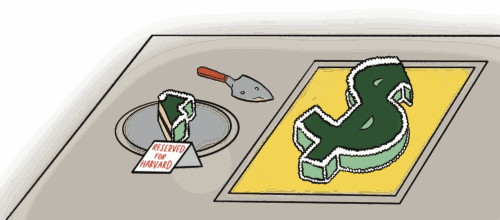
“Ideas to Enterprise,” reads the recently updated front page of the official Harvard University website. “Across Harvard’s campus, our students, scholars, and faculty turn ideas into ventures that solve problems and create value.” A series of executive orders and lawsuits in recent months have left the institution struggling to actualize such values. With nearly $3 billion in federal funding cuts made between April and May 2025, organizations and programs that rely on those funds are being forced to shutter their efforts or scramble to find new sources of funding.
After April 14, Harvard received seven stop-work orders associated with awards totaling approximately $76 million. A little less than a month later on May 6, Harvard received over 950 federal award terminations which summed around $2.4 billion. This included over 570 subwards to institutions across 32 states, according to a University administrator.
Many of Harvard’s research grants include collaborations with outside institutions around the nation country—when funding is awarded, not all of the involved researchers have to be affiliated with the same University. In other words, peer institutions working on Harvard-affiliated projects may have been impacted by the recent executive orders.
The loss of these federal grants came after Harvard declined to meet a list of demands from the Trump administration, prompting the University to file suit on April 21.
On May 6, the Department of Education announced that Harvard would no longer be eligible for any new federal grants. Education Secretary Linda McMahon advised that the University “no longer seek grants from the federal government, since none will be provided.”
In response, the University released a statement condemning the move, saying that “today’s letter makes new threats to unlawfully withhold funding for lifesaving research and innovation in retaliation for Harvard’s decision to file its lawsuit.”
Research at Harvard spans disciplines from medicine and life sciences to engineering and public health. “The University currently employs approximately 1,800 research faculty and staff whose positions are partially or wholly supported by federal research grants and contracts. Additionally, approximately 730 graduate students and 790 postdoctoral researchers receive stipends, tuition support, or salary from federally funded research projects,” Harvard’s lawsuit states.
That research is funded partly by the University—$526 million in 2024—but mostly by hard-earned grants and contracts that researchers apply for. Grants provide researchers with more freedom, while contracts have a set list of requirements overseen by the government as the researcher conducts work.
In Fiscal Year 2024, federal, foundational, and industry sponsor funding totaled $1 billion—$686.5 million of which was solely federal. Ivy League schools received a total of $6.4 billion in federal funding, with Columbia receiving $1.3 billion and Yale getting $898.7 million. However, as federal funding cuts are enacted at universities nationwide, the research that this funding sustains is increasingly at risk.
Harvard has recently established a webpage to post updates and resources regarding the lawsuits against the Trump Administration—the research funding section outlines what critical work is in imminent danger.
“For 75 years, the federal government has partnered with academic institutions, fueling discoveries that have transformed medicine, saved lives, and positioned the United States as a global science leader,” the page reads. “If this funding is halted, it interrupts work on tuberculosis, chemotherapy, pandemic preparedness, Parkinson’s disease, and Alzheimer’s disease.”
In cancer research, research funding at risk includes the introduction of bortezomib, a first-in-class proteasome inhibitor for treating multiple myeloma. In cardiology, scientists have been tracing imbalances in activated molecular units that can cause excessive heart muscle contractions, leading to the organ’s thickening and eventual failure.
Threatened research also includes work on infectious diseases, such as studies identifying vulnerable structures in the deadly Nipah virus that could lead to treatment. Additional areas at risk span neurodegenerative diseases, obesity, and diabetes.
Specific schools across the University have been affected by cuts on varying levels.
The Harvard T.H. Chan School of Public Health has been among the hardest hit, with 46% of its funding previously coming from federal research grants and reporting that 130 researchers had to terminate projects. “Our partnership with the federal government has powered discoveries that have saved tens of millions of lives around the world,” said Dean Andrea Baccarelli.
“The funding has enabled breakthrough research on deadly diseases from cancer to Alzheimer’s to stroke to HIV. Our faculty’s research into environmental pollutants, occupational hazards, and the relationships between diet and health have shaped policies and programs that protect the health of every American—and so many others around the world,” Baccarelli continued.
One of the projects mentioned by the Trump administration’s stop orders is run by a T.H. Chan School faculty member, Dr. Sarah Fortune. Fortune’s work totaled $60 million in tuberculosis research, investigating potential disease immunity in the hopes of producing a vaccine. Shortly after receiving the stop-work order, Fortune made several appearances on national news, as this project was the National Institutes of Health’s single largest investment in tuberculosis research.
During an interview with MSNBC, Fortune shared that if Open Philanthropy had not donated $500,000 to the project, enabling the research to be moved to the University of Pittsburgh School of Medicine to complete a tuberculosis vaccine study, the macaque monkeys used in the study may have needed to be euthanized.
Harvard Medical School has also experienced a significant number of research setbacks. HMS and Harvard John A. Paulson School of Engineering and Applied Sciences Professor Donald E. Ingber lost just under $20 million in contracts for research on the development of drugs to combat long-term radiation exposure and to study the effects of microgravity and radiation in space on human cells. “The salaries of almost 20 students, fellows, and staff are at risk if this stop order is not reversed soon,” Ingber said in an April interview with the Harvard Gazette.
Scientific research is not the only category under threat. The humanities are also in danger of losing critical research. Harvard Graduate School of Education Professor Elizabeth Bonawitz lost a $1.5 million grant for research that studied cognitive mechanisms of guided instruction in the early elementary years.
Many undergraduates at Harvard participate in research—a little over half of Harvard’s students complete a senior thesis. Despite research efforts being shuttered in many departments, undergraduates seem to be protected for the moment.
“Our office does not support undergraduate research with federal funds. Rather, much of our office’s financial support for undergraduates is the result of the vision and generosity of far-sighted donors: alums and their families, friends of the College and University,” shared Dr. Jonna Iacono, Director of the Office of Undergraduate Research and Fellowships, in a statement to the Harvard Independent.
“Because faculty members have mostly been able to continue their work, we have not seen large adverse and cascading effects on the capacity of our undergraduates to pursue faculty-mentored research projects,” she continued.
“We do not know what the future holds, but we are certain that research is and will continue to be central to the mission and identity of the University, as will be supporting the next generation of researchers, scholars, and creators of new knowledge and practice at the undergraduate level,” she added.
Harvard is one of 60 institutions that received letters from the U.S. Department of Education’s Office for Civil Rights in March. The majority of these institutions are now facing the consequences of federal funding cuts. Columbia University, for example, has lost $400 million in federal funding. 180 researchers have received termination or non-renewal notices for their funding.
The ripple effects of Harvard’s $2.4 billion funding loss are still unfolding, with more labs, scholarships, and jobs in danger of being lost.
Olivia Lunseth ’28 (olivialunseth@college.harvard.edu) writes News for the Harvard Independent.