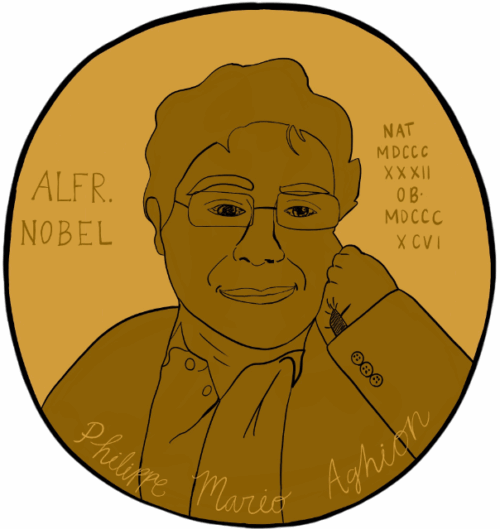
The Harvard Economist Behind the 2025 Nobel Prize in Economic Sciences
Graphic by Mia Stewart

On Oct. 13, the Royal Swedish Academy of Sciences awarded the Nobel Prize in Economic Sciences to Dr. Philippe Aghion, former Robert C. Waggoner Professor of Economics in the Department of Economics at Harvard and one of the world’s leading scholars on innovation.
Aghion shares one-third of this honor with colleague Professor Peter Howitt of Brown University for their contributions to the theory of sustained economic growth driven by what they refer to as “creative destruction.” Creative destruction explains how newer technologies—like automation and renewable energy platforms—and firms such as Tesla and Amazon can push innovation by continually replacing older industries. Professor Joel Mokyr of Northwestern University was awarded the other third of the prize for his research explaining how innovation, when combined with the widespread circulation of scientific discoveries and formal education, fueled centuries of economic growth.
Together, the three researchers have redefined economic progress to be a process that is driven by constant competition and creativity.
“I was totally surprised. I assume I would not get it this year, totally sure. Because they gave it last year to a subject which was not so far from our subject,” Aghion said in an interview with the Harvard Independent. But despite his astonishment, his journey to this honor has been decades in the making.
Born in Paris in 1956, Aghion’s passion for studying economic change started early. “I wanted countries to become more prosperous,” Aghion explained. “I knew that to get countries out of poverty and to get prosperity, you needed to have more growth… The only source of growth, permanent growth, is technical progress, which comes from innovation.”
Once he earned his Ph.D. in Economics at Harvard in 1987, supervised by Nobel Laureate Eric Maskin ’72, he went on to teach all across the world—from MIT to Oxford, even extending to the European Bank for Reconstruction and Development.
In 2006, Aghion decided to return to Harvard and spent nearly a decade teaching and researching the exact forces that shape innovation. Now, he is a professor at Collège de France and the Institut Européen d’Administration des Affaires in Paris, as well as the London School of Economics.
Aghion’s work focuses on theories that have real-world policy applications, even regarding artificial intelligence, where he influences a range of governments, like France and South Korea. “With AI, there is the fear that AI will destroy all jobs. So you have to harness it to make sure you deal with that problem. And that’s why it’s very important…to make sure that you won’t have a few firms that will take advantage of AI to prevent new firms,” he stated.
“You need a good flex security system like in Denmark. In Denmark, when you lose your job, you get very generous unemployment insurance, and the state helps you find a new job,” Aghion added.
Policy models he has created have applications in fields ranging from entrepreneurship and education, to the environment. For instance, in “Path Dependence, Innovation and the Economics of Climate Change,” Aghion examines how the entry of new businesses and the exit of outdated ones, competition, and innovation all have a role in addressing environmental constraints and guiding the global economy’s transition toward clean technologies. In another paper, “Higher Education and Innovation,” Aghion and his co-authors explore how investing in higher education directly gives more people skills to participate in an innovation-driven economy, leading to an increase in equal opportunities. His growing body of research laid the groundwork for the theoretical breakthroughs that would later earn him global recognition.
The Nobel Committee particularly credited Aghion and Howitt for their formalized concept of creative destruction. Joseph Schumpeter, an Austrian-American economist known for his work on capitalist change, originally introduced the term in his 1942 book “Capitalism, Socialism, and Democracy.” In his book, Schumpeter argued that capitalism is driven by a “process of industrial mutation,” where innovations like digital communication continually replace older technologies and business models like mass production are overtaken by new ones like e-commerce.
When Aghion and Howitt met at MIT in 1987, they were both early-career economists. However, by 1992, they realized similarities in their professional interests and evolved Schumpeter’s original theory through their paper, “A Model of Growth Through Creative Destruction.” While Aghion and Howitt never formally collaborated with Schumpeter, their model is a direct mathematical extension of Schumpeter’s ideas.
The publication demonstrated mathematically how newer technologies, such as digital production platforms and updated clean energy systems, negatively impact large manufacturing corporations and industrial producers that depend on older production methods. Workers in these firms, whose jobs depend on being assemblers in a factory with twenty-year-old machines, can become displaced. Aghion and Howitt, however, argued that this phenomenon is essential to making room for newer industries and growing opportunities.
“I was trained in microeconomics. I studied [Industrial Organization] a lot, and Peter was more [into] macroeconomics,” Aghion said in reference to his working dynamic with Howitt. “It was very natural to combine our skills.”
Ultimately, Aghion and Howitt formed one of the most influential partnerships in economics. “Together, we constructed this new growth theory, which now is currently referred to as ‘Jupiter’ in growth theory, and we did that together during the one year he was visiting MIT, which was ’87-’88. It was my first year there as an assistant professor,” Aghion said. Their joint efforts in researching growth theory redefined what productivity and innovation meant in relation to economic growth.
Mokyr’s research on the history of innovation has complemented Aghion and Howitt’s model. He traced how cultural and institutional change can shape technological revolutions regarding modern prosperity. In other words, societies can create conditions, like sharing knowledge freely and allowing open debate, that help their economies progress. Essentially, Mokyr’s work focused on the historical conditions that let innovation flourish, while Aghion and Howitt examined the modern implications.
For Aghion, Mokyr, and Howitt, innovation acts as the cornerstone of success, but inequality can become a necessary byproduct when institutions fail to adapt. Aghion’s later work, in particular, builds on this idea by examining how governments can promote creativity while simultaneously supporting obsolete businesses.
“Creative destruction entails social mobility, because with creative destruction, the new replaces the old,” Aghion said. “But for it to work well, you need a good education system…you need educational opportunities for everybody…a financial ecosystem of innovation that will allow any talented entrepreneur to grow…and competition policy to make sure that as firms grow, they don’t prevent new entry.”
Through this framework, Aghion illustrates that innovation alone is not sufficient to sustain progress. Societies must also choose to invest in education, competition policy, and access.
This belief in collaboration also shaped how he worked with students. During his time at Harvard, Aghion taught both undergraduate and graduate students in macroeconomics, economic growth, and policy design. “I interacted with other students and with professors, and I realized we could ask a question more easily. In France, it was a very [bounded] system where you would not dare to ask a question to the teacher. In the U.S., you would because professors would treat you as a future colleague,” Aghion said.
His influence also extends to colleagues across a range of fields. Fellow Nobel Laureate Oliver Hart, who studied contract theory at Harvard, reflected on Aghion’s impact. “I was delighted to hear that Philippe had won the prize. He has not only done path-breaking work on growth but also seminal work in my own area, the theory of contracts and organizations,” he wrote in a statement to the Independent.
Other Nobel Laureates, such as Amartya Sen, Alvin Roth, and Claudia Goldin all also worked in Harvard’s Department of Economics. Aghion continues the department’s legacy for global academic excellence.
Even after leaving campus, Aghion’s influence at Harvard continues through both the students he mentored and the frameworks he built. His books, “Endogenous Growth Theory”—written with Howitt, and “The Power of Creative Destruction”—with Dr. Céline Antonin, a senior economist at the Economic Research Center of Sciences Po, and Professor Simon Bunel, an Economist at the Banque de France, are now used as standard economic references in courses globally.
In past interviews, Aghion emphasized the importance of upholding an innovation mindset for the future. “We have to wake up. Because you know who will win in this competition? Those who innovate,” he stated at a press conference following the announcement of the 2025 Nobel Prize in Economic Sciences at the Royal Swedish Academy of Sciences in Stockholm. His call to action reflects his belief that society must heavily rely on collaboration for future growth.
As the world continues to wrestle with rapid technological change, Aghion shows no signs of slowing down. “I want to push my research so that we, I hope, will encourage more young people to work with us and will help expand the lab,” he said.
Aghion plans to expand his research in his innovation lab at the Collège de France and continue to work on research and development policy, artificial intelligence, and green innovation. He is focused on nurturing the next generation of thinkers through his work, ensuring that the drive for discovery continues.
“I will push young people, because the creative destruction is also there. There are young generations, and they’re supposed to do better than we did. And so I apply the creative destruction idea to my own life and then just grow some new talents everywhere,” he promised.
Hailey Kim ’29 (haileykim@college.harvard.edu) writes News for the Independent.