The NCAA House Settlement: Paychecks, Principle, or a New Path?
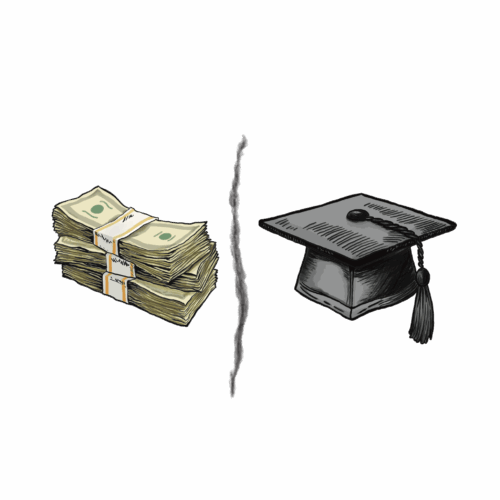
Graphic by Cara Cronin

College athletics have entered a new era. On June 6, the final approval for the House v. NCAA settlement was signed, changing the landscape of collegiate sports. Moving forward, college athletic programs will be able to directly pay their athletes. This ruling will apply to the Atlantic Coast Conference, Big Ten Conference, Big 12 Conference, Pac-12 Conference, and Southeastern Conference, in addition to other schools across the NCAA. However, the Ivy League will not be joining, opting instead to prioritize education and a balanced student-athlete experience.
The $2.8 billion settlement signaled the end of amateurism in major college sports. College athletes can now receive compensation not tied to education or third-party endorsements, extending the potential for revenue generation beyond the profits from the legalization of NIL payments.
The agreement includes two major components: back pay and revenue sharing. As part of the settlement, the NCAA has agreed to distribute up to $2.8 billion over the next 10 years to former college athletes who competed between 2016 and 2024 in ‘back pay,’ compensating them for revenue they were previously denied under the old amateurism rules. Following the settlement, many athletic programs have begun developing revenue-sharing models to compensate their athletes directly. For the 2025-26 academic year, schools are permitted to distribute up to $20.5 million—roughly 22% of their revenue—annually to athletes. This cap is expected to rise incrementally each year by approximately $1 million, paving the way for high-level college sports to closely resemble professional leagues in structure and compensation.
Ivy League Executive Director Robin Harris was confident in the decision to opt out of the settlement. He argues for the “Ivy League model,” “one that offers student-athletes an option with world-class academics and an opportunity for personal growth while yielding consistent national athletics success.”
With cash now flowing to athletes in other conferences, is this vision still realistic? For revenue-generating sports like football and men’s basketball, the Ivy League may face its steepest challenge yet. Already at a recruiting disadvantage because of its long-standing ban on athletic scholarships, the Ivy League now finds itself unable to offer athletes something even more valuable: a paycheck. With Power Five schools now legally able to pay players, top recruits are even less likely to choose Ivy programs, no matter how prestigious the academics.
The decision to opt out of the House v. NCAA settlement is predicted to further erode the Ivy League’s competitiveness. In the immediate aftermath of the ruling, players like Penn’s former star running back Malachi Hosley have already begun transferring from Ivy League programs to schools offering direct compensation. This trend is leaving teams that are struggling to retain talent and rosters capable of contending at the national level.
It is estimated that over 70% of revenue-sharing funds will be directed toward football programs at power-conference schools. Concentrating a sizable portion of their budgets in just a few sports, many athletic departments will be forced to make cuts elsewhere, most likely to low-revenue sports like swimming, tennis, rowing, and golf. The Ivies historically untraditionally thrive in many of these sports. By opting out of the revenue-sharing model, they may avoid the financial pressures prompting other schools to cut teams. As a result, student-athletes in low-revenue sports who are seeking both competitive opportunities and academic rigor may increasingly look to Ivy League schools as their best option.
As the landscape of college athletics shifts rapidly, one question looms large: Will Harvard—and the Ivy League—stay their course, or eventually adapt? By opting out of the House v. NCAA settlement, Ivy League schools have doubled down on tradition, emphasizing academics, balance, and pure amateur competition. By doing so, they may be carving out a separate, isolated identity.
With Power Five programs embracing a professionalized model, collegiate athletics may soon split into two distinct cohorts: one where athletes are paid to perform, and another where athletics are treated as a complement to education. If Harvard and its peers remain firmly in the latter, they risk falling behind in national standings and losing top-tier talent to schools that offer not just playing time, but real money.
The Ivy League model of a world-class degree, access to elite career networks, and a campus culture that prioritizes academic rigor is a powerful recruiting tool. But how long can they compete with six-figure paychecks, NIL deals, and media exposure? The conversation is no longer just about incentives—it’s about values, priorities, and long-term vision.
Above recruiting battles and championship banners lies a deeper meaning: identity.
What kind of institution does Harvard want to be in a changing world? As the college sports landscape shifts toward professionalism, will Harvard evolve with it or stand firm in its tradition? The House v. NCAA settlement has forced every school to reckon with this choice. For now, the Ivy League is betting on pride, purpose, and prestige. But as the stakes grow higher, the question remains: Will that be enough to keep it in the game? Or will schools like Harvard need to create new options, such as a model where athletes spend four years focused on academics, then use a fifth year to fully capitalize on NIL and professional opportunities?
In a world of shifting incentives, maybe tradition and innovation don’t have to be at odds.
Paige Cornelius ’28 (paigecornelius@college.harvard.edu) is part of a low-revenue-making team at Harvard.