Thoughts from New Quincy: Getting Experimental
Graphic by Lucie Stefanoni, Chau Nguyen

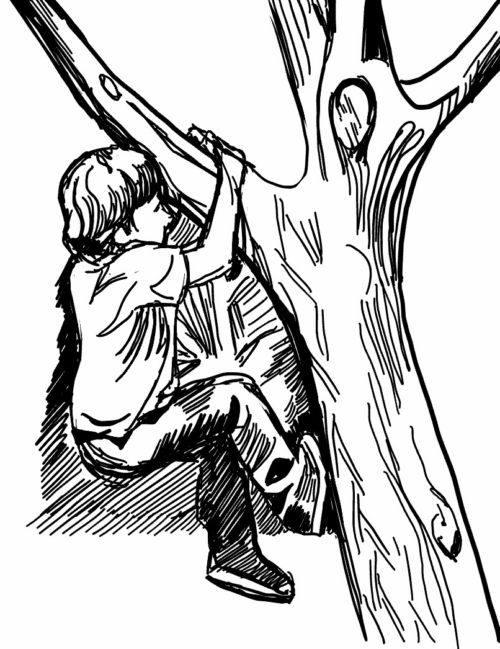
Sir Galahad: Growing up, my dad had one rule for tree-climbing: if you can get yourself up, you can get yourself back down. I would scurry up branches as they bent under my weight until I sat perched too high on limbs too thin; the ground looked impossibly far away. When it came time to climb down, my dad never helped. He’d stand on the grass with his hands in his pockets, calling up only once: figure it out. Sometimes I did—inching down backward, the skin on my palms rubbed raw, my stomach swaying each time I trusted my weight to a bough that creaked in protest.
But sometimes I fell. Not far enough to break anything, but far enough for the air to vanish from my chest in one violent gasp. I’d sit up dazed, a hot scrape burning down my arm, tears held back more by embarrassment than pain. In that moment, the lesson was already etched into my limbs: don’t step where you can’t stand, don’t grasp what you can’t hold. My dad would walk me home, dab at my cuts with rubbing alcohol, and slap on a Band-Aid before sending me back to the park to climb again. Only this time, I’d think about the possibility of climbing too high, remembering how it felt to hit the ground.
Luke: Failure doesn’t work like that anymore. As kids trade climbing trees for dropping tilted, they lose the experience of making tangible mistakes and learning from them. In Fortnite, a fall is just a reset—the screen flashes, your squad rolls their eyes, and thirty seconds later, you’re back on the battle bus, ready to make the same mistake again. No scrape, no rubbing alcohol, no Band-Aid. Just a cartoon thud and a painless do-over.
A fall from a tree leaves something behind—a bruise, a limp, the feeling of bark giving way beneath your hand. It reshapes how you climb next time. A fall in the game vanishes as soon as it happens. You don’t climb differently. You don’t pause at the weaker branch. You never get the lesson. Today, kids grow up falling without ever learning what it means to fall. What’s missing is the experiment: the awkward risk that leaves a bruise, the test of whether a branch will hold. Without those experiments, failure becomes hollow, and so do we.
Sir Galahad: At Harvard, students run from the mere chance of falling or failing. When was the last time you signed up for a seminar that didn’t fulfill any of your requirements, just to check it out? Odds are, the refrain rattling in your head is one all Harvard students know by heart: I don’t remember. And then, we do the most Harvard thing of all: blame the environment instead of our own footsteps—complaining that clubs are closed, courses are capped, and the could-be-suitors are, for lack of a better word, chopped.
It’s easy to chalk this up to anxiety, but that misses the point. Kids have always been anxious—what’s different now is that they’re out of practice. They’ve been trained to avoid the kinds of small stumbles that once built character. A scraped knee, a bad joke in the cafeteria, a swing and a miss answering a question. Those were safe failures—you walked away bruised but wiser.
Now, instead of stumbling through, people sidestep. It’s not just that failure feels worse; it’s that failure never arrives at all. And without it, you don’t get the scar tissue that teaches you how to get up after you fall.
Maybe the fix is to climb again.
Luke: In other words—get experimental.
Getting experimental means stepping into unscripted territory—romantic, social, even sexual—and putting yourself at risk of humiliation. It’s clumsy, unrehearsed, and probably ill-advised. But it leaves a mark. Not on the body, but on the memory.
Most experiments fail. They fail spectacularly, embarrassingly, in ways that replay themselves in your head years later. But those failures aren’t wasted. They’re how you figure out who you are, what you want, and how far you’re willing to go. Without them, people become brittle. They don’t just avoid risk—they lose the muscle memory of how to survive it.
Sir Galahad: But what does getting experimental look like? Maybe it’s smaller than we think. Getting experimental doesn’t mean dropping everything to move to San Francisco to launch a startup. It can be as ordinary—and as terrifying—sitting down at the table full of strangers in the dining hall, as sending the text you’ve drafted three times and deleted twice. These aren’t grand leaps; they’re branches you’re just not sure will hold your weight. But you won’t know until you try.
That’s the trick: experiments aren’t about certainty, they’re about curiosity. They’re about pushing just past the point where your grip feels steady, not because you know you’ll land it, but because you want to see what happens if you don’t. Some of those moments leave you scraped up—an awkward silence, a rejection email, a date gone flat. But they also leave you with something else: evidence. Proof that you can fall, dust off, and climb again.
Luke: That’s why the most formative stories are never the polished ones. They’re the messy ones, the ones that make you cringe when you tell them, but also remind you that you were brave enough to try. Embarrassment is resistance in a world that trains kids to avoid risk. It’s practice for all the other kinds of failing life is going to demand later.
Sir Galahad: Most of the experiments I can think of weren’t really about the substances. They were about the people. The drink, the pill, the smoke—those were just shortcuts, props in a bigger gamble: could I step closer to someone I wanted? Could I look like I belonged in a moment I didn’t quite trust myself to handle?
One morning stands out. I was already a seasoned smoker by then, and getting high before flights had become a ritual to make the time pass faster. Riding to the airport with my best friend, we shared a bag of edibles. She popped gummy after gummy, and I—more concerned with keeping pace than keeping balance—matched her bite for bite. By the time we boarded, I’d taken 60 mg. I spent the flight gripped by the slow, unrelenting panic of a body gone sideways. It wasn’t inexperience that undid me; it was pride.
That morning, I wasn’t experimenting for myself—I was shadowing someone else’s threshold, pretending it could be mine. With drugs, that’s a dangerous substitution. The line between curiosity and collapse is already thin, and it narrows to nothing when you start chasing someone else’s limits instead of learning your own.
This time last year was different. A group of us drove down to Newport with the sole purpose of tripping together. I weighed out five grams for myself, not really knowing or asking what anyone else was taking. That was part of the ease—there was no scoreboard, no performance, just a quiet trust that everyone would find their own way. We talked about other things as we measured our portions, the shrooms almost incidental between beer, die, and bong rips.
When we finally ate them, we didn’t hover or compare. We drifted off—some to the beach, some to the couch, and some, I’m still not sure. The silence wasn’t awkward; it was spacious. For once, getting experimental didn’t mean shadowing someone else’s limits. It meant carrying myself and letting the experience unfold on its own terms. And in that space, the lesson was gentler than panic and stronger than pride: that the only experiments worth keeping are the ones that belong to you.
Luke: The most lasting experiments don’t just bruise the body—they bruise the ego. That’s where embarrassment comes in. Unlike pain, which leaves visible scars, embarrassment resists translation. You can tell a story about pain, and people will nod along, see the scar, and understand it. But embarrassment doesn’t work that way—it doesn’t shrink into a neat anecdote. It swells in the mind, plays on repeat, warps in memory until it becomes larger than the moment itself. That’s why embarrassment is so powerful.
This is the lesson kids aren’t getting anymore. They’re taught to seek safety in every domain: no bruises on the playground, no slip-ups that go unmediated, no hazing in clubs, no experiments without pre-approval. Every failure is padded or erased. And the irony is that this kind of safety makes people fragile. They don’t lose the fear of failure—they lose the ability to metabolize it. Without those scrapes of the ego and the unguarded humiliations, they never build the capacity to keep moving after you fall.
Embarrassment, then, is not just the last safe risk—it’s the last democratic one. Everyone encounters it, everyone dreads it, and everyone carries it forward in different ways. If embarrassment is the last honest experiment, then the task isn’t to avoid it. It’s to treat it the way kids once treated bruises: not as proof you were broken, but as evidence you had the nerve to try.
The strange thing is that embarrassment works in two directions. It shapes you as an individual, teaching you what you can survive—but it also shapes groups. Shared embarrassment is one of the oldest tools of belonging. Everyone remembers the moment they stumbled, not just privately but together, and that memory hardens into community.
Sir Galahad: Of course, nowhere does embarrassment feel riskier—or more inevitable—than in romance. If embarrassment is the last honest experiment, then love is the lab where it gets tested daily. Every text, every glance across Annenberg, every pause before you speak feels like climbing onto a thinner branch than the last.
This summer, an internship with a classmate turned into something more complicated—the slow unfolding of a crush I couldn’t ignore. I found myself lingering at my desk, long after my work was done, just to keep her company while she finished hers. Conversations stretched until our computers slept and our monitors went black, following us home when we went our separate ways.
One night after dinner, with more drinks than judgment, we wound up back in my apartment, talking until the clock slipped past two. At some point, she rested her head on my shoulder, and I—armed with misplaced confidence—leaned in. She pulled back, and I was left sitting in the kind of silence that makes you wish you could sink into the couch and stay there until morning.
The kiss didn’t land, but the world didn’t end. The silence passed, the conversation resumed, and by morning, it was just another fallen branch. Romance isn’t about waiting for certainty; it’s about stepping forward without it. You risk the stumble, you risk the flush of embarrassment—and most of the time, you discover you can keep climbing anyway.
Every climb carries the chance of a break, and the fall always leaves its mark. Mine did—spectacularly. But it turned out not to matter. Bruises heal, and now—somehow—we’re dating.
Luke: Right—and what you’re describing with romance is the same pattern I see in the rest of college life. Embarrassment is the condition of risk, whether it’s leaning in for a kiss or standing up to sing a song off-key in front of strangers. What matters isn’t whether it lands cleanly but that you tried—and that you risked enough to find out.
The University, though, treats those marks as damage. Risk is recoded as liability, embarrassment as harm. So they sanitize: swap messy rituals for official ones that leave no trace. On paper, it looks like protection. In practice, it hollows things out. A club becomes a résumé line instead of a crucible. Community turns administrative instead of lived.
That’s why romance feels so bracing—because it’s one of the last places we’re still allowed to fail without a form to file. Love ends up doing the work that college pretends to: teaching us how to stumble, how to laugh it off, how to keep climbing even when the branch cracks.
Sir Galahad: This year—a victory lap capping off the last six semesters—I’m trying to take my own advice. To get more experimental. Not in the grand, romanticized sense, but in the small, shaky ways that still scare me. I’ve signed up for my first English class, a seminar on consciousness; I’ve resolved to be more mindful about smoking, allowing myself to be present rather than stoned; and I’ve made a point to spend days alone in Boston, often without any semblance of a plan.
I’ve had my fair share of missteps. References to obscure authors have left me lost to my classmates’ comments; hours I used to pass with weed have been less entertaining; and just last week, I was caught in a downpour while wandering the South End. But that’s the nature of it. To climb is to risk falling, to experiment is to risk looking foolish.
Getting experimental hasn’t made senior year cleaner or calmer; if anything, it’s made the climb feel less certain. But it’s also made the days feel less scripted, and if embarrassment really is the last honest experiment, then maybe maybe the point is to keep stepping forward—even if your footing isn’t certain.
Luke: Exactly—and that’s the part that matters. What you’re calling foolish is what I want to call practice. Each misstep, each soaked walk through Boston, each blank stare in a seminar is a reminder that risk is the condition of being alive. Getting experimental doesn’t make the path cleaner; it makes it real.
That’s the challenge for us—not to wrap every corner in padding, not to retreat to screens where mistakes vanish with a click, but to keep stepping where the ground feels unsteady. The earlier stumbles—the bike crashes, the tree falls, the awkward silences—left bruises you could carry forward. Ours too often disappear.
If embarrassment is the last honest experiment, then the task isn’t to erase it but to lean into it: to treat it like a bruise, proof you tried, proof you’re still climbing. Because standing safe at the bottom of the tree might spare you the fall, but it also means you never leave the ground.
So, climb higher. Say the thing you’re afraid to say. Risk looking foolish. Get experimental—not because the world makes it easy, but because the world ahead will demand it.
Luke Wagner ’26 (lukewagner@college.harvard.edu) is the Managing Director of the Harvard Independent. Sir Galahad will float into the mystic.