Thoughts from New Quincy: Seamless Surfaces
Graphic by Chau Nguyen

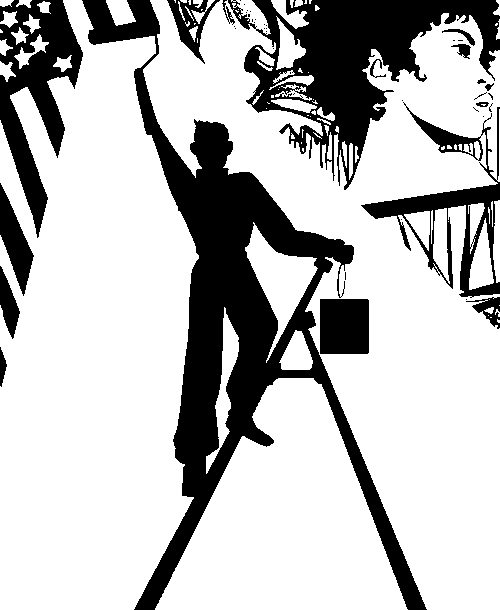
Each morning this summer, I passed the same wall on my way to work. Behind me, the brakes of a bus hissed, and a gust of warm air carried the smell of exhaust and garbage. The wall changed constantly—first a movie poster, then a perfume ad, then a mural commissioned by a sneaker brand. Each new layer hid the last, though traces remained: dried glue, uneven color, the faint outline of an older slogan. The city is always painting over itself, practicing renewal without ever beginning anew.
After streets opened the city to movement, walls gave it order. They kept danger out and value in, separating the visible from the unknown. To live within the walls was to belong; to stand beyond them was to be foreign. When the polis emerged, public stone became a surface for inscription—laws, decrees, rituals. A wall defined not only where the city ended but who could speak within it.
In the medieval and early modern city, the wall evolved once more. Long before the factory or the poster, it served as a noticeboard between rulers and the ruled. Edicts, proclamations, and broadsheets were fastened to stone; the street became a managed forum. Power spoke through architecture, and the wall was its clearest voice.
With industrial modernity came a subtler language of control. The wall no longer shouted decrees from the crown or the church; new voices spoke through print instead. The press multiplied words, and the factory multiplied eyes. Posters replaced proclamations; the city learned to steer through desire instead of fear. Yet the wall’s purpose endured: to regulate what could be seen. The modern city replaced surveillance with spectacle.
The citizen had always watched, but now the gaze itself became a kind of labor—measured, exploited, endlessly renewed.
In the cracks of that transformation, people began to answer. The handbill, the wheatpaste, the graffiti tag—all emerged as unsanctioned acts of speech. A wall might hold a missing cat poster, a strike notice, or a name written in marker. These were gestures toward a different kind of publicness—one collectively improvised by residents.
A blank wall could briefly turn into a democratic medium. Each addition redefined the city’s surface: layered, contested, alive. Even when officials scrubbed the paint clean, traces of rebellion lingered beneath the surface. The city was still legible to those who walked it.
Eventually, that legibility was noticed. The raw energy of street expression became something that could be imitated, sponsored, and sold. Developers discovered that a mural could raise property values faster than new plumbing. Brands discovered that ‘rebellion’ sold better than obedience. Corporate campaigns adopted the handwriting of graffiti, the visual noise of protest, and the authenticity of local voice.
Walking through Manhattan, it is hard to distinguish between protest and product. The same fonts that once shouted “NO WAR” now whisper “NEW ARRIVAL.” The same aesthetic of urgency—grain, blur, collage—circulates across luxury campaigns. Public art is rarely public anymore; its rebellion has been rehearsed. The wall hasn’t gone silent—it speaks in a voice so smooth it’s mistaken for our own.
Now, what was once printed begins to glow. Digital billboards ripple across façades, their light spilling into the street—Times Square as the logical afterlife of the poster. The wall no longer ends at brick or glass; it continues inward, reflected on every screen.
From the street, this all still reads as life—motion, color, texture. But look long enough and the vibrancy flattens into a sensed choreography. Every surface solicits the gaze, measures it, calculates its ROI. Cameras track who looks up; algorithms predict who will. The wall no longer displays; it performs. It sells you back to yourself, tailored and responsive.
Inside, another wall glows. My feed updates as quickly as the street below—new campaign, new face, new message.
The promise of infinite expression hides a perfect enclosure. I scroll, but I do not wander. The walls of the feed, like the walls of the city, have become selective mirrors. The illusion of freedom depends on the visibility of the frame.
There are no blank surfaces left. Every wall—concrete, glass, digital—has been conscripted into production. Even silence is monetized. A clean façade is an ad waiting to happen; an untouched screen, lost engagement. The city no longer breathes between messages. What once passed for rebellion now shows up in luxury campaigns: Dior written in graffiti, Netflix ads painted to look like murals.
Still, sometimes, it slips. A tag half-erased. A poster torn by rain. A digital ad that fails to load, leaving a rectangle of grey on your Instagram feed. These ruptures feel sacred—reminders that the world beneath the overlay still exists.
I think about how fleeting that openness once was—the decades when a wall could still belong to the street. You could read the city then: paper softening in the heat, ink bleeding through layers of paste, slogans half-buried beneath the next campaign. A wall was a commons—shared, contested, alive.
The graffiti writer, the passerby, the maintenance worker—each left a trace, deliberate or not. Groups like the Guerrilla Girls turned that visibility against the city itself, posting protests where billboards usually spoke. That fragile ecosystem of expression has since hardened into a circuit of consumption. The wall remains, but the forum is gone.
Sometimes I think about the edges of cities—the industrial towns and forgotten blocks that haven’t yet learned to speak this new language. Their walls still bear half-faded signs on brick, phone numbers painted in cursive, and graffiti that no one bothers to scrub away. There, the wall is still a commons—layered, contradictory, alive. You can tell time by the fragments and space: an old soda logo, a political sign from an election no one remembers, a poster announcing a concert.
There, the wall still holds memory instead of Nike’s newest campaign. It still carries an argument, not branding. But those spaces are dwindling. Developers arrive, or the ads find a digital substitute, and the texture flattens. The blank wall becomes a placeholder for what’s coming—a banner or a QR code.
Sometimes I imagine those places surviving longer: a slower city, less optimized, where surfaces stay open to contradiction. In Athens, old brick and sun-worn concrete are covered with decades of graffiti, political slogans fading beside hand-painted signs. It would be uneven, maybe even ugly. But it would be public in a way that my city isn’t. Conversation, not campaign, would determine what endures.
That city feels impossible now. Each morning, workers arrive before sunrise to paste a new layer. By eight, the wall is reborn. The rhythm is precise: remove, replace, repeat. The surface glows with novelty, though the logic beneath never moves.
As I pass the wall again, the mural is gone. In its place, a LOEWE bag stretches across the brick, each panel pressed flat, the seams invisible. It looks clean, almost weightless.
Power depends on that illusion—on the ease with which the new layer feels natural. The wall has always been a tool: to enclose, to display, to extract. What’s changed is its texture. It no longer hides or protects; it flatters. It teaches us to mistake visibility for freedom.
A gust of wind catches one corner of the ad, lifting it for a moment. Beneath, a fragment of the older mural flickers through—a face, half-erased. For a moment, it looks like the wall I first noticed, when the panels were still being pressed flat and the bubbles worked out by hand. The illusion is the same: each new layer pretending to begin again. The wall exhales. Then the corner drops, and the city resumes its performance.
Luke Wagner ’26 (lukewagner@college.harvard.edu) is the Managing Director of the Harvard Independent.