Thoughts from New Quincy: Why Higher Education Is Failing Students
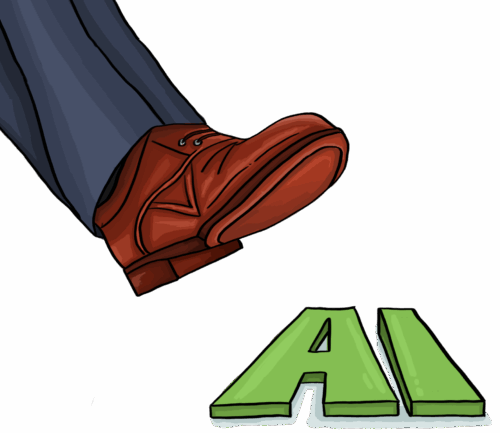
Graphic by Miranda Chao Hwang

During the last week on campus in Sever Hall, I spotted a fresh sheet of printer paper taped beside the door of a freshman expository‑writing class. In bold Helvetica, it warned: “No ChatGPT, no Claude, no Copilot—ALL work must be entirely your own.” The sign wasn’t just a classroom rule; it was proof that Harvard’s current stance on AI is one of outright denial, ignoring the ways AI already shapes the professional and educational worlds its students are entering.
Step outside Sever’s doorway, and the campus already hums with Silicon co‑authors. Students lean on large‑language models to untangle Kant; iLab startups build GPT wrappers for lab research; faculty test-drive AI Sandboxes for next semester.
Beyond the Yard, the hum grows louder still: a Bain & Company survey of 600 U.S. executives, released in May, found 95% of American firms now use generative AI somewhere in their workflow—an increase of 12% in just one year. McKinsey’s global tally, published four months earlier, puts AI adoption at 78% across 24 industries—a jump of 55% in only eighteen months. Yet inside the classroom, policy runs in reverse.
Since August 2023, the Office of Undergraduate Education has offered faculty three sample AI policies—encouraging, mixed, or outright ban. In theory, instructors choose their modality. In practice, most professors copy and paste the nuclear option: “We specifically forbid the use of ChatGPT or any other generative AI tools at all stages of the work process… Violations will be treated as academic misconduct.” The result: a de facto blanket ban dressed up as faculty discretion—an institutional reflex that already feels as dated as a “No Calculators” sticker from the 1970s.
The gap between rule and reality is vast. A February survey from the Higher Education Policy Institute found that 92% of students now use AI in some form, and 88% have used it for assessed work, nearly double last year’s rate.
An internal Harvard poll of 326 undergraduates, published on arXiv, found that almost 90% of students already use generative AI, with a quarter saying they sometimes use it instead of office hours. A blanket ban, then, functions less as a moral stance than as an inequality amplifier: students who follow instructions abstain; those who don’t, benefit. Academic integrity becomes a tax on honesty.
Administrators defend zero-tolerance policies on cognitive grounds, arguing that overuse will erode student skills. They’re partially right. In June, an MIT Media Lab study had 54 volunteers write SAT-style essays while wearing EEG caps. Those using ChatGPT showed the weakest neural connectivity across prefrontal and parietal regions and produced the least original prose. When the tool was removed, those same students “consistently under-performed at neural, linguistic, and behavioral levels,” a drift the researchers called “metacognitive laziness.” In other words, it can dull your brain, and the dulling sticks.
But Harvard’s policy does not prevent that risk—it intensifies it. When AI goes underground, it also evades critique. Students copy AI output directly because no one is teaching them how to question a probabilistic sentence generator. Faculty, lacking access to prompt histories, cannot trace hallucinations or stylistic flattening and detection software is not a fix. UK universities report accuracy as low as 22% in adversarial tests, and Turnitin’s own marketing team admits to high false-positive rates. The result is a game of academic whack-a-mole where everyone loses track of actual learning.
We’ve seen this movie before. In the 1970s, schools attempted calculator bans for algebra exams, fearing the death of mental arithmetic. A decade later, the National Council of Teachers of Mathematics publicly endorsed integrating calculators, arguing they enhanced student understanding and problem-solving without undermining basic arithmetic skills—a shift widely reported at the time.
The calculator didn’t make math easy; it expanded the frontier of what could be asked in a fifty-minute class by offloading routine work and letting students delve deeper, prompting more creative thinking. Today, that expansion is institutionalized: the College Board’s 2025 AP policy not only permits graphing calculators on Calculus exams—it requires them. Nobody’s banning them. Instead, we’ve kept mental arithmetic drills while pivoting toward Laplace transforms, because the machine handles the grunt work.
The deeper flaw in Harvard’s stance lies in what it forecloses. Generative AI isn’t just a plagiarism engine; it’s a cognitive exoskeleton. Used well, it frees the mind for higher-order thinking—just as the calculator once did. Before Texas Instruments shrank transistors onto plastic, students spent superfluous hours on long division and by-hand integration.
The problem was never the tool; it was the pedagogy. Word processors went through the same rite of passage. Then search engines. Then Wikipedia. Across disciplines, the pattern holds: in STEM labs, AI parses data sets and designs molecules; in humanities seminars, it drafts translations and surfaces archival sources—yet the pedagogical puzzle is identical. Generative AI is just the latest guest star in a decades‑long debate over introducing new instruments into the classroom.
Peer institutions are already pushing forward. Stanford’s Teaching Commons advises faculty to permit AI use “whenever internet sources are otherwise allowed,” provided students attach a full prompt log as an appendix. The Organization for Economic Co-operation and Development—no techno-utopian think tank—urges governments to embed AI literacy across all education levels so graduates can thrive in data-saturated labor markets.
Even within Harvard, contradictions abound. The University touts its AI Sandbox, which gives faculty secure access to GPT-4, Claude, and PaLM for course design. But only instructors—never students—get to experiment. The message to most undergraduates is bizarre: play with the future, but only after you’ve graduated—and certainly not in my class.
Meanwhile, industry has moved beyond the “whether” phase to the “how much.” At Carlyle Group, 90% of the firm’s 2,300 employees now use ChatGPT or Microsoft Copilot, cutting due diligence research from weeks to hours. Whether in law, pharma, consulting, or advertising, the adoption curve will look the same. Students trained in AI-free classrooms will soon join teams where AI prompting is already a second syntax.
Harvard can close the gap—but only by shifting focus from prohibition to institutional practice.
Start with transparency. Require a prompt appendix, just as bibliographies are required, and mandate that students submit assignments with version history enabled—for example, sharing Google Docs or Word files that show tracked changes and edit histories. This would allow instructors to review not just the final product, but the full process: the original prompts or queries used, human edits, fact-checks, and rewrites along the way.
By making the evolution of the work visible, educators can assess how students engaged with AI tools, where they intervened, and how they refined the output, shifting focus from mere outcomes to intellectual process.
Embed “adversarial reading” drills in the core curriculum, where students must fact-check or rebut AI-generated outlines line by line, learning to detect statistical nonsense. Equip English-language learners with AI grammar coaches—but require them to annotate every suggestion, so support never slips into ghostwriting. Publish departmental rubrics that assess critical engagement with AI as a skill, not a sin.
None of these steps lowers standards. They raise them, making intelligible the intellectual work that current rules push into untraceable chatbot DMs.
If Harvard insists on a moral frame, it should consider equity. Blanket bans harm the very students the University pledges to support: working students who rely on summarization tools to manage heavy reading loads, international students who use AI for idiomatic clarity, and neurodivergent students who brainstorm more effectively when given a starting point. A policy that treats every prompt as cheating denies them legally available accessibility technology while rewarding classmates who quietly break the rules.
Harvard loves to remind donors that it pioneered the case study method and the open-courseware revolution—both initially met with hand-wringing before becoming brand-defining. In the early 1980s, critics warned that word processors would erase handwriting skills. By the mid-1990s, they were ubiquitous across higher education.
Generative AI now sits at the same hinge. If the nation’s richest university clings to digital abstinence, it will fail its students twice: first by withholding a literacy they urgently need, and again by failing to teach the judgment that makes that literacy meaningful.
The sheet of printer paper outside that classroom may survive the semester. But the world it imagines—where thinking happens in walled gardens, untouched by predictive text—already belongs to the past. Harvard can keep policing the gate, or it can train its students to navigate the wider landscape with discernment.
Zooming out, Harvard’s choice is less of an Ivy League quirk than a bellwether for U.S. higher education. Public flagships like Arizona State University are already rolling out campus‑wide AI training modules, while Miami Dade College is embedding prompt‑engineering basics into its general‑education core. If only elite enclaves teach AI literacy, the digital divide widens into a chasm: a Harvard or Stanford grad joins McKinsey fluent in prompt chains, while a state‑school peer is relegated to low‑leverage tasks the model has already automated.
So what exactly does an AI‑literate graduate look like? Someone who can frame a question in machine‑readable language; iterate and debug prompts; audit outputs for bias, hallucination, and missing citations; and know when an answer warrants human review. They track provenance like a chemist logs reagents, and they understand the social stakes of algorithmic error. These are the competencies admissions offices love to call “future‑proof”—and they’re the very skills Harvard’s sweeping prohibition leaves off the syllabus.
Luke Wagner ’26 (lukewagner@college.harvard.edu) thinks Harvard should change their AI policy and start adopting it across all undergraduate courses.