To Sleep or Not to Sleep
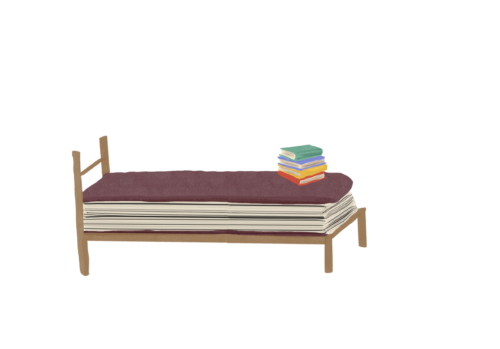
Graphic by Sophia Rascoff

As midterm season draws closer, sleep can be the last thing on many students’ minds—except for those taking Gen Ed 1038 “Sleep.” This classic Harvard College course has been running since 2009, reaching around 400 enrollees each semester. Taught by Dr. Charles Czeisler ’74 and Dr. Frank A.J.L. Scheer of the Harvard Medical School Division of Sleep Medicine, the course is one of the most well-known on campus, providing students a comprehensive look at everything from the biology of sleep to cultural attitudes surrounding it.
Throughout the semester, Czeisler and Scheer discuss everything from the problems with snoozing alarms to the science of circadian rhythms. For them, the real-life effects of sleep matter just as much as the science behind it.
“Gen Ed 1038 ‘Sleep’ is really designed to provide students with a foundational understanding of the science underlying our understanding of why we sleep, and how we can use the benefits from research on sleep to apply that to our lives,” Czeisler explained to the “Independent” in an interview alongside Scheer.
The course, which provides the “foundational understanding” Czeisler describes, was prompted by student interest—and ignorance—of the science behind sleep.
After Harvard University Health Services invited Czeisler, alongside other sleep experts, to give a one-time lecture in Boylston Hall, the sheer number of student attendees surprised the College’s faculty and administration. “As we talked about the importance of sleep for memory consolidation, some of the students were angry—” Czeisler said.
“—That they weren’t told this before,” Scheer interjected.
“Sleep” is now one of the most popular General Education courses on campus.
Instead of a midterm exam, students track their own rest patterns through their “Sleep Tracking Case Report.”
“It’s for the students to really get a feel of their own sleep habits and how their behaviors impact it. This makes the theory they learn concrete,” Scheer explained.
“What is sleep, how do we study it, and what are the consequences? … How does it impact one’s physiology, including in real life? How does it affect your alertness in school and occupational settings?” Scheer continued.
Most enrollees voiced positive feedback about the course, with 79% of 240 respondents disclosing that they would either “recommend with enthusiasm” or were “likely to recommend” the class to prospective peers. Primary critiques about the course stemmed from the large quantity of assigned readings, though the consensus nonetheless stressed that the work was very manageable and enjoyable.
Avery Mizrahi ’28, a neuroscience concentrator, took Gen Ed 1038 last semester. “I think the teaching staff was really passionate about their work, but I wouldn’t call it a remarkable class,” she explained. “Overall, I did not find lectures particularly engaging, but there definitely were takeaways to apply to one’s life,” Mizrahi noted.
Dr. Tony Cunningham, a former teaching fellow of “Sleep” and now the Director of the Center for Sleep and Cognition at Beth Israel Deaconess Medical Center, emphasized how valuable Czeisler’s teaching was in an interview with the “Independent.” “One of my favorite parts about Chuck is he always has some really good anecdotes. He teaches through stories sometimes, and he’s full of them. There are still stories of his that I now use in my teaching, in my seminar,” Cunningham explained.
But despite the course’s popularity, its lessons have not reached many Harvard undergraduates. The Centers for Disease Control and Prevention recommends at least seven hours of sleep per night for adults aged 18 to 60. Most college students fall short; according to the University of Georgia, the national average is just six hours.
Many professionals in the field recognize the issue. “I think there’s an awareness that sleep is important, but not necessarily a knowledge of what to do about it,” Cunningham said.
Jia Michel ’29 shared how she usually gets five to six hours a night. “If a test is coming up, I make sure to prioritize sleep so that I have at least eight hours,” she said. “I think less sleep has been fine for me, honestly … If I sleep, I won’t be able to study enough.”
Czeisler critiques getting different amounts of sleep each night, however. “Many students are squandering the time they spend sleeping because it’s so inconsistent that the brain can’t anticipate when they will be sleeping,” he added.
Sleep is just one factor of wellness in students’ lives, but it has a big impact on everything else.
“It’s not just a sum gain, it’s a multiple gain,” Cunningham said. “Let’s say you’re worried about your physical health, and so you want to diet and exercise. Well, not only does getting good sleep help maintain your hunger levels better and optimize your recovery from workouts, it also increases your motivation to engage in both of those things.”
Elle du Pont ’29 (edupont@college.harvard.edu)writes for the “Independent”and hopes to finish this article soon so she can get to sleep at a reasonable hour.