Transcending Borders: International Students Are a Cornerstone of Harvard
Graphic by Allyson Xu

Every Sunday night, my suitemates and I crowd onto one of our twin XL beds, blankets in hand and worries from the week forgotten, to watch the latest episode of “The Summer I Turned Pretty.” The snacks laid out on the bed perfectly encapsulate Harvard’s global community: maple sea salt popcorn from Trader Joe’s, licorice candy from the Netherlands, and chocolate-covered peanuts from Mongolia. I remember looking around and realizing that this wasn’t just any ordinary movie night—it was the world contained within our shoebox of a dorm.
I came to Harvard from a private high school in Austin, Texas, where most people, myself included, had grown up within a few miles of each other and could recall 18 years of Red River Rivalry football games. Although my community back home is beloved and familiar, it was, admittedly, not very diverse. When I arrived at Harvard, the culture shock was immediate and profound. Over our Caesar salads, my first meal at Annenberg Hall meant sharing stories of high schools, family expectations, and even the quirks of local politics from the Philippines to Puerto Rico. Fleeting conversations between classes or drawn-out discussions over dinner pulled me out of my quaint corner of Texas and into a far larger conversation, one that spanned continents and perspectives.
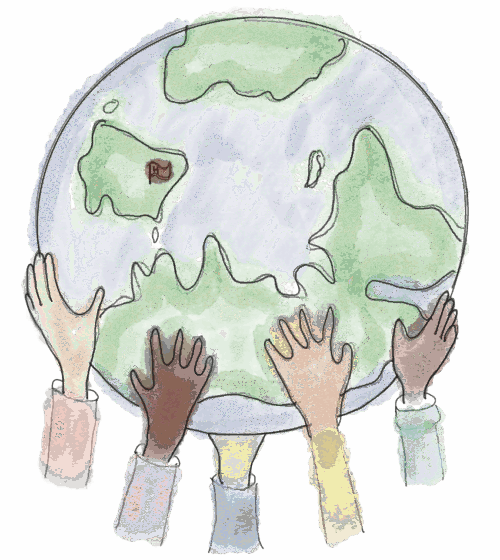
Harvard is a living atlas. With students from more than 150 countries, the campus compresses countless experiences, languages, and worldviews into 209 acres. In a single day, you might overhear a debate in Spanish about trade policy, a discussion in Mandarin about AI ethics, or a story in Arabic about cultural traditions. I recall one seminar on global development where a classmate from Singapore challenged my inherent assumptions about economic aid. She described how certain foreign interventions, although well-intentioned, often overlook local systems and knowledge. Her perspective reshaped how I think about policy: not as a set of universal solutions, but context-sensitive choices that must respect lived experience. That density of perspective transforms the University into something unique: a vibrant microcosm of the world.
Global issues here aren’t abstract—they’re personal. A seminar on democracy gains new depth when an international classmate connects it to their country’s political climate. A Gen Ed course on environmental policy feels different when someone shares firsthand experience with natural disasters. These encounters turn the world-class liberal arts education Harvard is known for from an academic ideal into a lived reality.
Coming from Austin, I hadn’t realized how much geography can shape empathy. My small high school in Texas reflected only a fraction of the American experience, and I rarely questioned how opportunity or identity might look elsewhere. Harvard changed that. My international peers didn’t just tell stories about their homes; they challenged how I thought about systems and assumptions I had taken for granted. That’s why international students aren’t simply part of Harvard’s community; they are a cornerstone of it.
The liberal arts depend on dialogue, and dialogue depends on difference. When policies threaten to limit student visas or restrict access for international scholars, the consequences extend beyond immigration. They strike at the heart of what Harvard represents: the free exchange of ideas across borders.
Earlier this year, as Harvard entered a tense standoff with the federal government over its ability to sponsor student visas, the mood shifted. Uncertainty rippled throughout the community, especially among international students, whose ability to attend the University suddenly depended on a policy battle far beyond their control. One night, a classmate from Vietnam shared their anxiety about whether they would even be able to attend Harvard as a first-year.
The fear lingered through the turmoil: students were caught between regulations and the academic futures they had worked for years to reach. Listening to their story, I saw that policy decisions can shape not only schedules and coursework, but the very sense of belonging and security on campus. For many of us, this debate isn’t just political—it’s personal. The presence of international students isn’t merely an institutional value; it defines Harvard itself. International students continue a long history of global inclusion and engagement that makes the University a place where learning perseveres not in spite of, but because of, our differences.
The lessons I’ve learned from conversations with my suitemates and other international students have been as meaningful as anything from the classroom. Through them, I’ve come to see that the liberal arts aren’t just about connecting disciplines—they’re about connecting people. Harvard may be a university, but more often it feels like the world distilled in all its complexity and interconnectedness. The essence of a Harvard education is not just learning about the world, but learning with it.
Every Sunday, we still gather on one of our twin XL beds, snacks spread out, trading stories from home while debating whatever show we’re watching next. Though these snacks are small tokens, they tell a larger story—one of shared space, curiosity, and humanity at Harvard, with international students’ voices at its core. Their presence not only enriches daily life on campus but also reminds us that Harvard, and institutions like it, can serve as a model for higher education worldwide: a place where learning, dialogue, and understanding bridge differences.
Elle Huang ’29 (michellehuang@college.harvard.edu) believes a global education starts with a good conversation and better snacks.