
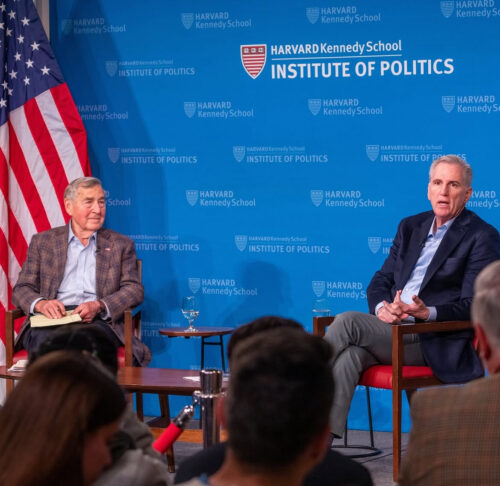
On Nov. 17, Harvard Kennedy School’s John F. Kennedy Jr. Forum hosted a conversation between Kevin McCarthy (R-CA), the 55th Speaker of the U.S. House of Representatives, and Graham Alison ’68, the Douglas Dillon Professor of Government and former Dean of the Harvard Kennedy School.
Together, they examined how Donald Trump’s political tenure has reshaped the Republican Party—its internal power struggles, electoral strategy, and governing agenda—while debating what a post-Trump future might mean for both the GOP and American democracy.
Trump 2.0 and a Political Comeback
McCarthy opened the discussion by distinguishing Trump’s two presidencies. “Timing is everything when you serve. Trump 2 is different from Trump 1,” he said.
According to McCarthy, Trump’s first term was the story of an outsider improvising his way through Washington without an established political network. “When he got in, he didn’t have a lot of people that were with him. He had to fill spaces, not having been a governor or a congressman or a senator before,” he said.
This assessment aligns with similar studies from Trump’s 2016 presidency. For instance, analysts at the Brookings Institution noted that Trump’s first-term White House experienced unusually high staff turnover, as Trump cycled through chiefs of staff, cabinet officials, and advisers in search of loyalists at a higher frequency than any other recent administration.
“He felt as though he had people in his own administration work against him and not know his philosophy,” McCarthy continued.
At the same time, Trump’s core issues—immigration and border enforcement, aggressive use of tariffs, and attempts to pressure drug companies over prescription prices—became such defining features of his brand that he was slowly able to attract a new political staff entirely aligned with this new understanding of conservatism.
McCarthy stressed that Trump’s political identity did not just center around his in-office priorities, but also grievance and resistance against both institutions in Washington and investigations that marked his first term. “He feels he kind of got cheated in the first term. Russiagate wasn’t true about him. It bogged him down. They fought him instead of working for him. He never got a honeymoon…COVID came and restricted what he was able to do. When he was out, he got persecuted,” McCarthy recounted.
In McCarthy’s view, Trump’s 2024 return to the White House only intensified that sense of grievance-fueled strength. He described a second term defined less by party infrastructure and more by personal mandate. “When he came back and won the second time, he had to fight through his own primary, and he became stronger as he went. And when we won the second term, he won the popular vote, which is a very big deal for a Republican.”
Trump’s 2024 victory did indeed make history: Republicans had not won the American popular vote in a presidential race since the reelection of George W. Bush in 2004. In 2024, Trump won roughly 49.8% of the vote to Kamala Harris’s 48%, a narrow margin, but enough to secure both the Electoral College and the popular vote for the first time in his three presidential bids.
To McCarthy, this ability to upset political trends is a characteristic of “Trump 2.0’s” unique coalition—one that can also break the usual alignment between presidential results and down-ballot performance. Recent presidential elections have typically seen Senate races move in lockstep with the top of the ticket, and 2020 was notable for unusually stable partisan patterns across states. McCarthy used his own reading of those trends to argue that Trump operates as a political force distinct from the Republican Party itself.
“In the last election—this is my personal belief—the Democrats lost, the Republicans lost, and Trump won. If you analyze the last 70 races for the Senate in a presidential year, however they vote for the president, they vote for that party,” he noted.
“If that was the case, the Republicans should’ve won four more states. Trump carried it, but they didn’t….they underperformed, so that tells you that once Trump is on the ticket, he brings a coalition of people that won’t [necessarily] follow the party.”
And though Trump is now serving his last possible term as president, McCarthy argued that this position only sharpens Trump’s leverage over Republicans who hope to succeed him.
“He knows he only has one term left, but that is also unique in that it makes him different from somebody else. He will troll the press and say, Oh, a third term. Why does he do that? Because he doesn’t want to become a lame duck… He is so politically strong, no one is going to run until he says it’s okay,” McCarthy said.
The Democrats’ Electability Problem
Turning from Republican politics, McCarthy sketched a sharply critical view of the Democratic Party’s internal dynamics. He focused on the age of its leaders and the growing tension between its moderate and left-wing factions.
“What’s going to happen now is people who are from a more socialist wing of the party will challenge the 80-year-olds. The moderates will be respectful to the incumbents, and what’s going to happen is the [80-year-olds] are going to get beat. Then, the party is going to swing further left,” he said.
His comments echoed a broader debate within the party about what some critics now call a Democratic “gerontocracy.” In recent years, top figures such as Joe Biden, Nancy Pelosi, Steny Hoyer, and Jim Clyburn—all in their eighties or late seventies—have faced pressure to make room for a younger generation of lawmakers. At the same time, progressive challengers backed by groups like the Democratic Socialists of America have successfully unseated long-serving incumbents in safe blue districts.
Looking ahead to the next presidential cycle, McCarthy framed that choice in stark terms.
“If they nominate a Mamdani, I think they will lose. If they nominate a governor that’s kind of in the middle and is going to govern, it’s going to be a very competitive race,” he said.
Zohran Mamdani, a New York politician and longtime member of the Democratic Socialists of America who rose from the state assembly to the New York City mayoralty, has become a symbol of the party’s ascendant democratic socialist wing, campaigning on housing reform, expanded social services, and criminal justice changes.
McCarthy also offered one last bit of unsolicited advice for Democrats, this time aimed directly at the party’s 2024 experience. “If they had let the primary play out, Kamala would never have been the nominee, and they would’ve had a stronger chance,” he said.
But when the conversation turned back to Republicans, he sounded less certain about what comes after Trump. “This is my personal take,” McCarthy said. “I don’t think MAGA transfers. I don’t think Trump can say he is the next person. Trump is built on Trump. The reason why Trump is different from other elected officials is because we learned decades before about him.”
Long before he entered politics, Trump was a nationally recognizable brand in his own right: a New York real estate developer who turned his name into a marketing asset for luxury towers, casinos, golf courses, and assorted businesses. Beginning in the 1980s, he cultivated a tabloid persona as a billionaire dealmaker, and later reached an even wider audience as the host of “The Apprentice,” where his “you’re fired” catchphrase became a staple of reality TV. By the time he launched his first presidential campaign, voters had already spent years encountering Trump as a character in American popular culture, not just as a political newcomer.
“We elected him because we wanted a disruptor. No one can survive things that Trump has done politically. Since we already knew about him, when you attack him, you’re attacking us. So I don’t think it transfers from that standpoint,” McCarthy concluded.
Nashla Turcios ’28 (nashlaturcios@college.harvard.edu) writes News for the Harvard Independent.