
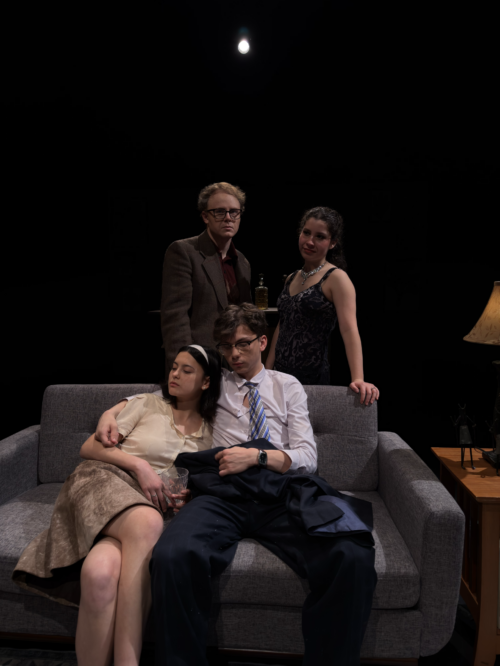
From Feb. 26 to March 1, the Harvard-Radcliffe Dramatic Club performed Edward Albee’s 1962 play “Who’s Afraid of Virginia Woolf?” in the Loeb Experimental Theater. The play contains dark themes and explores the deepest recesses of human behavior, including multiple screaming matches, copious drinking, glass smashing, profanity, and violence. Though it takes three acts and roughly three hours to perform, the show does not feel long at all—the actors skillfully build tension and drama until it bursts.
“[The show] just gets crazier and crazier and crazier, and then at the end, we’re left with this kind of deep, emotional core,” director Ben Arthurs ’27 said in an interview with the “Independent.”
Before the house lights dim and the actors take the stage, the audience is invited to survey the set as part of the Loeb Ex’s layout. The time—around 2 a.m.—is projected onto the back wall, the seconds ticking ominously.
The set, designed by George Atkin ’28, is both familiar and eerie. The wooden furniture and Persian rugs are exactly what one would expect in the living room of a middle-aged couple, yet there are jagged figurines and a human skull on their side table. Behind their couch is a bar table covered in liquor bottles, wine glasses, and decanters filled with amber liquid from which the actors constantly drink throughout the show. The audience is seated on three sides of Martha and George’s living room. The entrance of the Loeb Ex and one of the theater’s side doors are used to represent the house’s front door and an exit from the living room, shaping a fully immersive setting.
Act One: Fun and Games
The play begins with George (Vander Ritchie ’26), a history professor struggling to climb the academic ladder, and his wife Martha (Natalie Bernstein ’28), the daughter of the college’s president. According to the characters themselves, George is “40-something but looks 55,” and Martha is six years older than him. They enter, arguing about a trivial detail from a movie, and Martha compulsively adjusts the decor in their home, physically creating tension in the space. George walks with a bit of a slouch, embodying a bitter man so disappointed with his life that he can only make fun of it.
In an interview with the “Independent,” Bernstein described how she uses her character’s walk to convey meaning. “Walking as a woman in her 50s who’s very weighed down by life is very different than walking around as a 20-year-old,” she said. “And so for me, I literally just walk around and get weighed down, feel heavy, get the combination of intoxication and just try and physically embody that around the space.”
The opening scene oscillates between tense, uncomfortable quarreling and moments of relaxed humor. George is, at times, a familiar character—a sarcastic, eccentric history professor in tweed, reminiscent of Robin Williams’ “Dead Poets Society” Mr. Keating—and at other times, unrecognizably cruel with his words, frustratingly passive-aggressive. The heated argument between him and Martha is suddenly interjected with a moment of earnest laughter.
As Ritchie describes these opening moments, “we’ve got this dynamic of playful arguing. We’ve got real humor, real affection for each other, and it’s truly just one of the most profound scenes of the entire show.”
Martha sings, “Who’s afraid of Virginia Woolf?”—a pun on “who’s afraid of the big bad wolf?” The name fits into the meter of the original song and is a nod to the strenuous relationship between the author Virginia Woolf and her husband, Leonard. Ostensibly, the tune came from a joke song that a guest at the faculty party sang, which George does not find amusing.
Martha tells George that a young couple—Nick (Theodore Ansell ’29), a biology professor at the College, and Honey (Oona Yaffe ’28)—are visiting their home for a drink. George is upset that Martha invited the couple without his knowledge, and every subsequent interaction among the four is filled with awkward laughter and tension. Though it initially seems like a normal conversation, subtle details in the actors’ body language make the scene extremely off-putting. For example, Honey drinks her brandy with both hands, grimacing after every sip.
The cast’s costumes, designed by Emily Kuang ’29, blend in with the neutral and beige tones of the set, except for Honey’s sky blue blazer, which she deposits on the couch when she enters and does not move until the end of the play.
Again, the character dynamics alternate between normalcy and enmity. In a scene in which George and Nick converse alone, George is genial, offering advice to the younger professor. Then, suddenly, he asks about Honey’s weight, calling her “slim-hipped,” and accusing Nick of being a eugenicist. Nick, sitting on the couch, fumes as George paces the room, his fists clenching and shoulders twitching. The tension dissipates when Nick responds with an eerily calm, “Are you finished?”
Ansell described the link between speech and character when playing Nick. “I’ve been watching a lot of ‘Mad Men’ recently. It’s been making me think about how people talk. And so the way I approach my character was through speech. I am British, so I’m doing an American accent,” he said.
“I kind of went to the accent first, and then came out through it, and developed a character from the accent,” he added.
The situation escalates when Martha and Honey return to the living room, as George grows ominously perturbed at the mention of his son. Martha begins to taunt him relentlessly, mocking his lack of ambition, as he was supposed to rise to become the president of the college. In rage, George smashes a bottle and loudly sings “Who’s afraid of Virginia Woolf?” to drown out Martha’s voice.
Act Two: Walpurgisnacht
“Walpurgisnacht,” which is the German word for an annual witches’ meeting, begins in several seconds of silence as George reflects on what he has just done. He talks to Nick candidly, telling a humorous story about a boy who was mocked for mispronouncing “bourbon” as “bergin.” Nick reveals that Honey had a hysterical pregnancy and married her because he believed she was pregnant. George mentions that Martha’s father’s second wife looks like a witch, connecting to the title of the act.
The women return to the room, and Honey suggests they put on music to dance. George initially puts on a record of Beethoven’s Symphony No. 7.
Yaffe spoke about the importance of music in developing her performance. “I did a private moment in my room, which is where you pretend that you’re your character alone, and you try to do things that if someone walked in, they would stop doing. And so I put on Beethoven’s Seventh, which plays in the play, and I just tried to behave like Honey for 20 minutes,” she said.
Honey dances to the symphony in a frenzied manner, as if possessed. This is put to an end when Martha replaces the music with a sultry jazz song and begins to dance sensually with Nick. George reveals to the group that Nick told him about Honey’s hysterical pregnancy through an ostensibly fictional story. Once Honey realizes that the story is about her life, she breaks into devastating sobs.
Throughout the play, but especially in these scenes, there is a sickness motif. Honey is constantly vomiting off-stage and clutching her stomach. As they hurl insults, Martha and George call each other “sick” and “disgusting.”
The act ends with Martha threatening to have sex with Nick, and George acting completely indifferent, reading from his history book about the fall of a civilization. As Martha and Nick kiss, they hit the windchimes in the entryway, filling the theater with a cacophony of noise before plunging into silence once again.
Act Three: The Exorcism
“The Exorcism” begins with a monologue from Martha, in which she pretends to speak directly to George and her father. Bernstein’s gaze, fixed on the armchair, is thoroughly convincing—it is unclear whether Martha is only pretending to be in dialogue, or if she is actually hallucinating. Nick joins her in a moment where the audience is allowed a glimpse into Martha’s sorrows. She talks about herself in the third person, saying “Martha is abandoned,” and describes feeling like she is “suffocating.” She genuinely believes George makes her happy, but constantly pushes him away, denying herself joy. “George and Martha, sad, sad, sad,” she repeats.
“It really touches on this theme of stagnation and this fear of my life not being as I wanted it to be. And I think that on a human level, I very much fear stagnation and not moving forward in the way I want to,” Bernstein reflected.
George returns with a bouquet of snapdragons for Martha, which seems to genuinely impress her. However, he quickly begins throwing them on the ground and at Martha, yelling, “Truth or illusion?”
He demands that Martha and the guests sit down and play a game, which escalates into Martha and George screaming at each other, “I want you mad!” He insists that Martha tell an elaborate, detailed story about how they raised their son, calling it a “recitation.” As she does so, George chants in Latin.
The eerie chanting, which none of the other characters seem to acknowledge, conveys the exorcism. However, it is unclear who is getting exorcised. Martha’s recitation of her son’s childhood is nostalgic and motherly, seemingly purging her of her pent-up sorrows. Honey breaks into sobs and curls up into the fetal position on the couch. Nick convulses in his chair, clutching his chest.
After Martha’s recitation, Honey sits up and exclaims, “I want a child!”
“I love the Honey-Martha connection,” Bernstein said about this touching moment.
“[This connection] doesn’t exist before [this point in the show],” Yaffe added. The play’s commentary on societal expectations, especially the nuclear family, is illuminated in this moment.
George then tells Martha that he received a telegram saying that their son is dead, using the same wording from a story he told Nick earlier. Nick recognizes this and slowly comes to realize that Martha and George have made up a story about an imaginary son because they discovered they were infertile. Martha, distraught, desperately repeats, “You can’t kill him,” to George. But he does not seem to feel any remorse for Martha, as she broke the only rule of their game by mentioning their son to Honey.
Nick and Honey leave—finally taking her blue blazer off the couch, reminding us of just how much has happened in the past three hours—leaving Martha and George collapsed against the couch in emotional and physical exhaustion. Perhaps, then, it was the illusion and game dominating their life that was being exorcised. In the play’s final moments, all the lights dim except for a lamp and a spotlight with a shadow in the pattern of a window.
“It was very important to Ben that the setting be as realistic as possible. And so there were a lot of little things that I did try to do,” co-Tech Producer and Lighting Designer Alex Nugent ’28 said.
The cool-toned spotlight looked exactly like moonlight streaming through a window (so much so that I almost believed there was a glass pane in the theater). Martha and George sit next to each other, grieving the death of their fictional son. George begins to weakly sing “Who’s afraid of Virginia Woolf?” to which Martha responds, “I am.”
On the title of the play, Albee said in 1965: “Who’s afraid of Virginia Woolf means who’s afraid of the big bad wolf … who’s afraid of living life without false illusions?” Perhaps this connects to the original story of “The Three Little Pigs,” as the big bad wolf blowing down the pigs’ straw and stick houses could symbolize the destruction of life’s illusions in Albee’s play.
The production’s realism drew attention to the significance of its themes despite the tumultuous, uncanny context of the play.
“This is hopefully something that leaves people thinking about their own lives and what fulfills them, sort of what we tell ourselves to make ourselves happy,” Arthurs said.
The clock projected at the beginning of the show is also displayed during both intermissions, showing the time creeping into the early hours of the morning. We get the sense that the play happens in real time—no time skips or flashbacks—so we experience every minute alongside the characters. The Loeb Ex setting enhanced the experience, giving the impression of being a silent spectator, watching the play’s events unfold directly in front of us. The ambiguity of the fourth wall in the play reminds the audience to reflect on the lies they tell themselves.
“With student actors too, it kind of is like a warning of what can become,” Arthurs added.
Despite the inebriation and drama, the characters are more similar to ourselves than they seem. “[I asked myself] How would I actually react in this situation? Well, that might be actually how my character reacts in a slight variation of some sort,” Ansell said.
This play was an ambitious production—as Arthurs wrote in the program notes, they had “so little time that a professional theater company would be legally forbidden from performing the play with a timeline like this.” Despite this challenge, the cast and staff worked together to produce a devastatingly beautiful performance. Each character had their own distinct set of fears, regrets, and aspirations that I could see in myself.
“Who’s Afraid of Virginia Woolf?” is a play that pushes everything to the extreme. But in doing so, it provokes us to question the stories we tell ourselves.
“I think that this idea of the illusions that we convince ourselves are true in our lives, like what we buy into to satisfy ourselves or to fulfill ourselves,” Arthurs said. “Maybe it’s on a smaller scale, but I think that’s something that everybody kind of has in their lives. And it’s not necessarily a bad thing, but this is a show that exposes that in the most forward way.”
Ellie Guo ’29 (eguo@college.harvard.edu) is the Associate Arts Editor for the “Independent.”