We Can’t Read, and It’s Not Because of that Phone
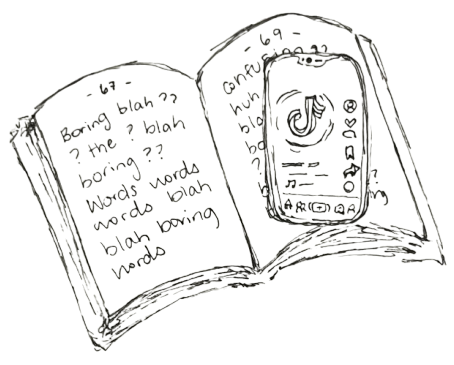
Graphic by Annabella Burton

“Do the readings.”
I open Canvas to see what my assigned reading is for the week. A 35-page research paper, a chapter from a book written in 19th-century jargon, and a seemingly endless textbook excerpt on convoluted theory.
Professors, TFs, upperclassmen, even Dean Amanda Claybaugh in the freshman training modules, repeat this mantra: “Do the readings.”
The temptation to skip them is admittedly very appealing. In most cases, no one—least of all your professor—will notice. Readings take hours and dry out your eyes, and your professor will likely cover most of the content in lecture anyway. Experience proves you can survive a seminar discussion armed only with SparkNotes or a ChatGPT summary.
But there’s a reason the warning keeps coming up: we’ve gotten bad at reading.
A 2017 study found that only 32% of college freshmen read at a 12th-grade proficiency level. More recently, 54% of U.S. adults were found to read below a 6th-grade proficiency.
These statistics sound like they’d belong to regions with struggling education systems, not to states that house elite universities. Surely Ivy League students can read—right?
Maybe not. In The Atlantic, Columbia professor Nicholas Dames admits that even his students struggle to finish or comprehend books. Professors at Georgetown and UC Berkeley voiced similar concerns.
And the experts agree: it’s not entirely our fault. It’s not even our phones’ faults. The issue isn’t laziness; it’s conditioning. We’ve been taught not to read properly.
In recent years, as the New York Times reports, initiatives like the Common Core have reoriented curricula toward nonfiction, based on the belief that most college and workplace reading is factual. Consequently, students now read far fewer novels than in decades past.
But cutting fiction has consequences. Fiction builds reading stamina. It demands patience, empathy, and imagination—the very muscles required for sustained engagement with any complex text, fiction, or nonfiction.
Storytelling is innate to the human experience. By emphasizing practicality over narrative, Common Core standards have denied many students a crucial part of childhood. When students are disconnected from what they’re reading, they don’t just lose interest; they never build the motivation to read independently.
When children are never allowed to discover the imaginative aspect of reading, they will naturally grow to resent it. Without that motivation, students miss out on the practice and repetition required to develop reading fluency and efficiency.
Over time, reading becomes a chore, as tedious and mechanical as solving arithmetic worksheets. Assigned texts, both fiction and nonfiction, grow more difficult to understand and slower to finish. Eventually, it just becomes much easier to give up.
This is not the first time reading instruction has failed a generation. In the late 20th century, educators clashed over the best mode to teach reading—a debate often referred to as the “reading wars.”
The argument was between phonic and whole-word instruction. The traditional method emphasized phonics—teaching students to decode words by sounding them out. Whole-word instruction, which emerged in the 1980s, focused on helping students recognize words by sight and understand them through context. This method relied heavily on flash cards showing a picture and its corresponding word.
California adopted whole-word instruction in the 1980s and ’90s. The results were troubling: studies of students who went through the program revealed alarmingly low literacy rates. The problem with whole-word instruction lay in its reliance on context and interactive approach. Without phonic awareness, students failed to become independent readers. They were unable to read words they had never seen before.
After the disastrous results of whole-word instruction, educators are shifting to a mixed mode of instruction. By teaching both phonics and contextual meaning, instructors hope to encourage an independent yet intuitive way of reading.
However, California still has the lowest literacy rate in the nation despite being home to some of the best-funded schools and most prestigious universities. The issue is not whether students have access to education; it’s how they’re being taught to read—with an emphasis on efficiency and ease instead of developing long-lasting skills.
Reading education has failed students nationwide, even within the ivy-covered walls of elite institutions. These methods have fallen short in instilling lasting reading habits or building the stamina required for higher-level comprehension.
Although we associate technology use with shorter attention spans and lowered interest in reading, it isn’t the only culprit. Research shows that socioeconomic status and early reading instruction in schools have a greater impact on adult literacy than computer usage.
In fact, literacy rates started declining before the widespread usage of digital technology. Reports find that U.S. adults born between 1988 and 1996 show significantly less reading proficiency than people born just 10 years prior.
To reverse this, reading culture must make a comeback, starting with schools and state-mandated curricula. Parents continue this process by encouraging reading at home. Individual adult readers can make efforts to normalize reading in their lives and in society, making reading more accessible to everyone.
In an increasingly competitive and career-focused world, it’s easy to dismiss creativity in favor of efficiency. But what is most “efficient” in the short term does not always yield the best long-term outcomes.
Creativity has always had a purpose. Fiction doesn’t just help young readers build reading skills; it also teaches empathy and offers a greater understanding of human experience.
To illustrate this, I would like to share a quote from “The Swerve” by Stephen Greenblatt, which talks about the importance of books in shaping world history. He writes:
“There are moments, rare and powerful, in which a writer, long vanished from the face of the earth, seems to stand in your presence and speak to you directly, as if he bore a message meant for you above all others.”
Literacy relates to more than passing a college-level class or becoming a good employee. When students are denied the opportunity to explore fiction, they are denied connection with other people across time and space. The purpose of education is to promote knowledge—not just facts, but lessons on how to coexist with other people.
Do your readings. Though our early instruction may have missed the mark, it’s never too late to rediscover how to read deeply—and how to enjoy it. Read not only to succeed in your next midterm, but to take part in a centuries-old intellectual tradition.
Ellie Guo ’29 (eguo@college.harvard.edu) would like to take a class taught by Stephen Greenblatt.