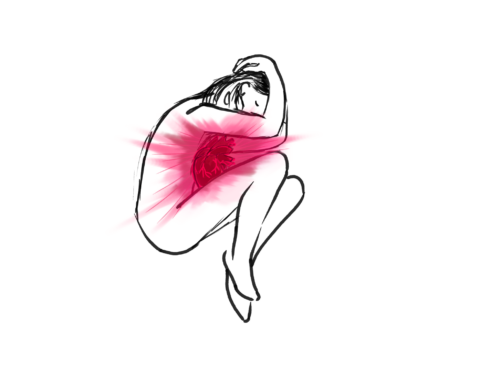
We Should Love, Even When the World is Decaying.
Graphic by Emma Crago

“We accept the love we think we deserve.”
I vividly remember the moment I heard those words while watching the television screen. I hated Stephen Chbosky’s “The Perks of Being a Wallflower,” but that sentence stuck, even more than a big spoonful of honey when sick: slow, heavy, impossible to swallow. Those words dwelled because, at that time, I believed with a quiet certainty that I was not entitled to be loved.
Love was tailored for a body that was not mine. Love was the warm colors of dusk, the pinks melting into burnt orange, warming the pale blue sky. I could view that painterly sky from a distance, almost touch it; lift my arm, my cold fingertips brushing the syrupy warmth of the paint. But then I would look back at my hands.
Empty.
I was still standing far away. Love was a horizon I could not step into.
The genesis of this rejection of love was the rejection of the world I hoped to live in. The world, as I saw it then, was rotting both slowly and all at once. The false promises of international institutions were collapsing. Governments and people were reneging on their duties. My hope curdled against bureaucracy. Wealthy nations fed on systems that starved others and called it inevitability.
Climate policies were dying. Our Earth, burning. Global warming turned into global boiling. Our hope for the Paris Agreement was collapsing. Power imbalances and dependency relationships hardened. Donors shaped the agenda, overreporting adaptation finance. They didn’t care about who they hurt. They didn’t care about droughts, losses in gross domestic product, rising sea levels, or the 80 million people displaced. They didn’t care about food insecurity, economic devastation, and health crises. No, they profited from this vicious cycle.
Injustices became structural, permanent, almost decorative. Humanitarian crisis after crisis. War after war. Death after death. All were advertised in the news as though they were entertainment. But those images flickering on the television screen were images of blood still flowing.
It was not only the institutions, but also the people. Populism, far-right backlash, classmates calling me “feminazi” for standing for equality. Hate, because for some, you should only love who you desire if your heart obeys societal binaries. Overconsumption, because who cares if someone’s fifty $10 dresses from Shein were made by an exploited six-year-old. In Spain, we say, “Ojos que no ven, corazón que no siente.”
And so the world burned, just out of reach, like the twilight I could not touch. In such a world, love felt obscene, frivolous. A betrayal. How could I crave tenderness when the world itself was suffering? How could I justify joy when so many were denied dignity?
Perhaps this crisis was an idiosyncratic gift, if you could name it that: the inability to feel deserving of love in a world that seemed so relentlessly unloving. I sabotaged relationships, withdrew entirely from meeting new people, hid myself in the corners of my mind, and never left what I thought could only hurt me. I controlled what only I could: my body, my mind, and food.
But controlling my body didn’t stop the world from hurting. Withholding love from myself did not shield anyone from injustice. My shrunken self was not saving the world. My insistence that wretchedness was the only morally acceptable response stopped making sense. I was too tired, my eyes too swollen and hollow.
I noticed the crack. In hearing my mum laugh, watching my dog’s zoomies, and feeling the sunlight spill across my face, I felt a flicker of something I had long forbidden. Care. Care for myself. Care for others. A tender defiance against the world I was living in. I began to notice that love was not only the grand gestures in the dusk I could not reach. It was in the brush of a hand, words bathed in joy, the stubborn persistence of a leaf in a windy fall afternoon. Those small resistances to despair became my proof that the world, even burning, still held fragments of comfortable warmth.
It was not easy. Old habits clung like ivy around my ribs. But I learned that desire itself could be an act of rebellion. To want connection, to allow tenderness, was not frivolous, but survival.
Love is not an indulgence, but resistance.
And so I began to reach—not for the entire horizon, for that was still distant, but for the edges of it. I lifted my arms toward its warmth, and for once, the warm paint stayed, rivulets of crimson and orange dripping down my cold fingertips. And I let love fill my hands.
I began to nurture my family, my friends, my body, and my mind. I left control and sought discomfort. I helped with what I could. I supported what I could. In rooms heavy with unspoken words, I helped kids discover their laughter, and watched it carry them beyond their families’ thorny shadows. I stayed with grandmothers whose families had forgotten them once they became burdens. I clung to music, words, and art, for it was the only thing that kept me sane. It was the only way that I could touch the human heart without saying too much—where I could advocate, rebel, and roar without screaming.
Love remains an unresolved question in my mind. It is messy and complicated, and I still find it easy to retreat to the familiar contours of myself at the first hint of disappointment. Yet now I know love can be part of my life too. I, as much as anyone, deserve to slide my fingers across that painterly sky.
They still don’t care; all could die, but if they’ve got money in their pocket, they aren’t afraid to lie. But oh, love is such a powerful force. We are all amateurs of love, tumbling through this vast, uncharted dusk. Still, we are here for the brief, fragile span of time that we have. We owe it to ourselves and to a world we cannot fully change, to love fiercely and tenderly, stubbornly and loudly.
Laura Cremer ’29 (lauraperezcremer@college.harvard.edu) refuses to be misanthropic.