What is Art?
Graphic by Reeve Sykes

Walk through the halls of Leverett House, and you’ll notice AI generated name tags that decorate room doors. Take a stroll through Winthrop, and you’ll notice the same—and even if not clear at first glance, I’m sure this goes for many other houses too.
Sure, the use of AI results in more personalized name tags, as it can easily feature images that I mentioned were my hobbies, interests, or intellectual passions. For example, my name tag features a confused cartoon bunny, looking into the distance with a background split three ways—one third is what I presume to depict a “philosophy”-esque scene, another a chemistry lab, and the last NYC. The rest of the hall is similarly decorated, from rabbits in abstract forests to rabbits typing on geometric desks and laptops.
As sweet as the thought is, it feels wildly unnatural. In a way, even less personal. Despite the appreciated gesture, I’d rather a simple hand-made nametag than this complicated, AI-generated one that abstracted away any personal labor or imagination. Even a simple green name tag (green is my favorite color) over the complicated “art” on my door would make me feel more at home. And I’d feel bad saying this if my nametag was handdrawn, or hand-photoshopped together, but it wasn’t. So, am I even criticizing someone else’s creative effort right now?
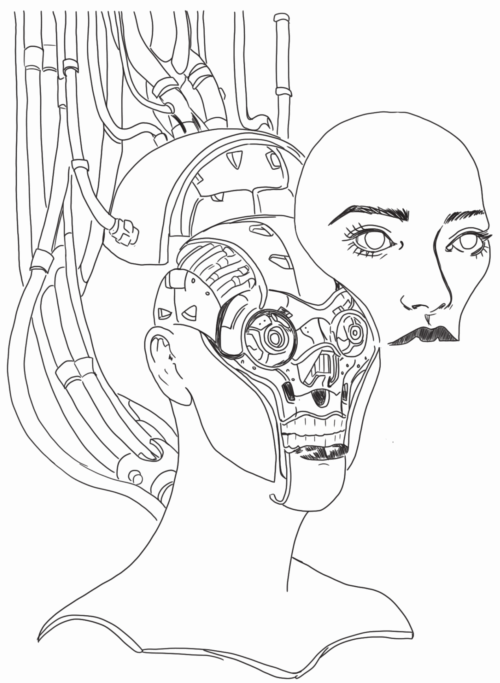
And it’s not just our Houses’ hallways; AI-generated images are becoming more and more pervasive. We see them used everywhere, from AI-advertisements, to videos, to artists using them to supplement their own works. The use of AI to replace every form of artistry ties to the larger problem at hand, bringing up a more elusive, and pressing, question: can AI-generated art even be considered “art?”
Well, to begin with: What even is art?
My art teacher used to emphasize that art shouldn’t be perfect. It shouldn’t just be a copy of what you see in the real world—in that case, just take a photograph, which is what cameras are for. Art is valuable not for straight lines, but for the unique touch that an artist adds. Artists are valuable for their ability to successfully represent an interpretation of the world as they see it—a perspective that is unique to themselves.
Already, we can see that AI can’t possibly be creating art if one of our requirements for art is “originality” or “creativity,” since AI can’t create. Yes, AI can “generate” very quickly, however, it’s not actually producing its own work—instead it’s synthesizing from various data, images, or sources that already exist on the internet, and combining it all together to form a new image. As a result, AI can only scrape together a picture from other places, including actual artists’ original work, creating even more problems with plagiarism and intellectual property.
Even as art has evolved over time, starting from plant dyes and cave paintings, to impressionist canvases to the digital forms of animation and sketching that we see today, art has always preserved each artist’s individuality. We know from history that art is a way of expression, and there’s something so human about desperately needing to express ourselves that we put art anywhere we can. And no matter how art has changed—no matter how much people dislike “modern art” or “digital art”—at least it’s still produced with a human touch and expressing a human’s interpretation of the world, which AI will never be able to replicate.
We were quick to understand that AI could not replace writing, and with that, written art forms including poetry, creative fiction, or narratives. Just like human writing has voice, personality, tone, and intrigue, art has the same. When AI writes, we do consider its output writing, since it’s a string of words, yet we find it stilted, bland, and clunky. We realize that it is artificial, and that the words feel unnatural; the same goes for art. In the same way we don’t consider ChatGPT to be real writing, how can we consider AI-generated products to be real art?
Raina Wang ’28 (rainawang@college.harvard.edu) has run out of clever bylines but refuses to turn to AI.