What We Do With Our Fear
Graphic by Clara Lake

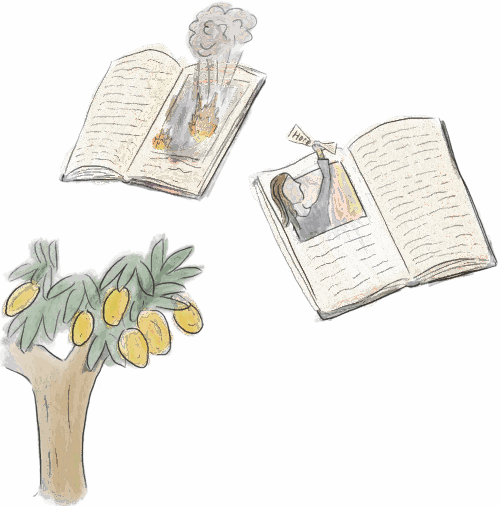
Throughout high school, I spent much of my summers in the Honduran countryside.
Swaying in a hammock beneath mango trees, I’d lose myself in history books. I was always especially interested in those exploring the rise and collapse of authoritarian regimes through a humanitarian lens. I was drawn to the lived experiences of people who had survived unimaginable times. What I learned from reading these stories was not just how democracies collapse—but how people endure. That endurance, I’ve come to realize, often begins not with grand defiance, but with fear, and the quiet refusal to be broken by it.
These were stories that forced you to pause. My thoughts drifted from the bloodshed that followed the rise of Chilean dictator Augusto Pinochet, to the civilian disappearances that plagued Argentina’s military dictatorships, to the testimonies of Syrian refugees forced into exile following the 2011 uprising against the Assad regime. With each chronicle, it felt as though my mind stepped into worlds steeped in grief, fear, and an unshakable sense of uncertainty.
Every account demanded a kind of raw vulnerability to understand fully. Siblings identifying their parents’ dismembered remains through government records. Protesters gunned down, their deaths reduced to numbers in the next day’s headlines. Women, starved and violated, their suffering ended only by death. Each abuse left me asking: when does power begin to strip people of their humanity so completely, and how is it allowed to continue?
I distinctly remember the feeling that would wash over me after finishing a page: a profound sense of relief at being shielded from the unspeakable tragedies I had just read about. I’m safe, I’d think. But almost immediately, guilt followed. The only reason I was not living the realities those books described—and was instead able to hide behind them—was sheer luck. These stories’ fears felt so distant from my life in the United States that I could hardly imagine myself in their place. But for many in this country, fear doesn’t arrive through history books—it arrives through flashing sirens, the presence of armed officers, and laws that determine whose bodies are protected and whose are deemed expendable. For millions living in the United States, state violence is not abstract. It is felt, not theorized. Fear shows up in the quiet calculations of how not to be seen.
I began to wonder how people have survived such perils throughout history. War and conflict have accompanied humanity since the very beginning. Suffering at the hands of power is a story as old as time. This is what British philosopher Thomas Hobbes meant when he described life in a “state of nature” as “solitary, poor, nasty, brutish, and short.” Even knowing this, I still hoped I would never have to feel what it’s like to be silenced by my own government—or punished for simply questioning the status quo.
But lately, I’ve begun to question the certainty of that hope. What once felt like a distant threat now inches closer to home. In recent years, concerns about democratic backsliding in the United States have grown more pressing. Under the renewed Trump administration, this possibility feels even more real. The use of immigration policy to detain or deport dissenting voices mirrors Cold War-era crackdowns, when the government surveilled, restricted, or denied entry to international scholars for perceived ideological threats. Censorship and mass layoffs of federal employees scarily echo the early years of Pinochet’s regime in Chile, when political purges targeted government agencies and public universities alike. European regimes followed similar patterns: under Francisco Franco and Benito Mussolini, universities were purged, curricula rewritten, and intellectual life brought under state control. What may look like bureaucratic restructuring is, in practice, a targeted dismantling of systems meant to hold a government accountable.
In a recent Fresh Air interview with NPR, Harvard Professor of Government Steven Levitsky—director of the David Rockefeller Center for Latin American Studies and co-author of “How Democracies Die”—argued that the Trump administration has already inflicted serious damage on American democracy. “We are no longer living in a democratic regime,” he declared.
The United States has never been perfect, even under Democratic leadership. But the current administration’s efforts to silence opposition and dismantle key institutions have brought a growing sense of dread.
In recent months, thousands of migrants have been detained in brutal conditions—including tent camps deep in the Florida Everglades, where heat and squalor seem designed not just to detain, but to dehumanize. International students and dissenting faculty have been arrested or deported. Universities have lost critical federal funding under the guise of fighting “ideological bias.” Entire agencies—like the Department of Education and USAID—have faced sweeping funding cuts and staff reductions, dismantling the very infrastructure meant to protect civil rights and public accountability.
That same chill I once felt while reading about repression in faraway places now visits me in real time every day I see the news headlines. It’s hard not to connect the dots. The censorship, the scapegoating, the erosion of civil rights—all of it feels eerily familiar. The stories I once read in the abstract have started to echo around me.
Naturally, this stirs fear. The idea of witnessing a democratic backslide, one that spirals beyond the point of no return, no longer feels impossible. It feels real.
It’s hard to move forward when the ground beneath us feels like it’s shifting so quickly. But I’ve started returning to something else I found in those stories—something buried beneath the horror. There was always a thread of resistance. A quiet defiance that refused to let despair win.
I’ve found that people survive by holding onto hope—the fragile promise of a future that still feels worth fighting for.
In “Why We Fight,” political economist Chris Blattman, who studies the causes of war and peace, outlines five core drivers of war, one of which is intangible or ideological motivation. He recounts how, during peasant revolts in El Salvador, many joined rebel groups not for strategy or gain, but simply in pursuit of justice. That has stayed with me. I’ve come to believe that what gives people the strength to resist isn’t just necessity—it’s a trust in something greater. A vision of what could be. The unwavering hope that, one day, these intangible ideals can become reality.
The stories I read were filled with unimaginable suffering—but also with moments of quiet, fierce resistance. A mother in Argentina who returned each week to the Plaza De Mayo, carrying a photograph of her disappeared son, long after hope had faded. A dissident in East Germany who smuggled banned books across borders, not to start a revolution, but to preserve a truth the state was trying to erase.
These weren’t grand gestures or headline-making acts. They were private, persistent refusals to stay silent and to let the machinery of power define what was real. They were everyday people choosing dignity, even when the world denied it to them.
If history has taught me anything, it’s that hope—when nurtured and shared—can outlast oppression. It can rebuild what fear tries to destroy. Fear, if left unchecked, paralyzes. It clouds judgment. It isolates. But when named, examined, and shared, it becomes something we can work through. We begin to see that we are not the first to feel powerless. And in that, we inherit a quiet strength.
So, how do we live through moments like these? Maybe not with certainty. But perhaps by learning to sit with fear, without letting it calcify into numbness. By letting ourselves feel panic, but not be ruled by it. By turning off the news when it becomes noise, but turning it back on when it matters. By reaching for those we love—not just to name what’s wrong, but to remind ourselves of what we’re still willing to fight for.
Resistance doesn’t always announce itself. Sometimes, it whispers. In the books we read. In the questions we keep asking. In the refusal to let cruelty become routine. The people in those stories I read didn’t survive because they were fearless. They survived because they chose, again and again, not to let fear swallow who they were.
I think back to the summers I spent beneath the mango trees, when I read those stories to make sense of a past I thought I was separate from. I know better today. The patterns are here, reshaped but familiar. And yet, resistance still takes shape: in students staging sit-ins outside Harvard Hall, in undocumented activists risking everything to be seen, in faculty building networks to protect each other when no one else will. We are not living in history, but we are not outside of it either. And the question now, the one I keep coming back to, is how we carry forward what those before us refused to let perish.
Nashla Turcios ’28 (nashlaturcios@college.harvard.edu) writes Forum for the Harvard Independent.