What’s on Broadway?
Graphic by Emma Crago

Author’s note: spoilers ahead!
The Picture of Dorian Gray:
One of the first Saturdays back from school, my mom told me that she’d acquired high-demand matinee tickets to the Tony Award-winning show, “The Picture of Dorian Gray.” At first, I would have preferred shopping in SoHo or a walk in the park, but I opted for the cultural experience once I learned that Sarah Snook was starring—flashback to my short-lived “Succession” obsession—in the play written and directed by Kip Williams, based on Oscar Wilde’s novel of the same name.
I read Wilde’s classic years ago. The tale follows a young Dorian Gray, praised for his beauty. During Dorian’s youthful prime, the artist Basil Hallward paints his portrait. But as Dorian ages and his soul becomes corrupted by vanity, he loses sight of right and wrong—yet somehow remains physically flawless. Instead, it is Hallward’s portrait that bears the marks of his decay. Dorian becomes haunted by this decaying image, but remains steadfast in his vanity until he is sent into a spiral of madness, isolation, and violence, resulting in his demise. While I’m sure I appreciated it at the time, the story did not really stick with me beyond the premise of introspective moral decay.
We took our seats on the right section of the orchestra, and the lights dimmed. But when the curtain rose, I was confused, to say the least. Snook sat alone onstage in a tailored pantsuit, surrounded by a stagehand camera crew projecting different angles of her face onto large screens hanging from the ceiling—not your classic period piece. There was no set beyond a grey brick wall in the background.
The “script” was simply an audible narration; in a smooth, flat voice, she began speaking Wilde’s florid words. The sound of her voice, accompanied by a minimal setup, was hardly distinguishable from an audiobook. In fact, as her voice filled the theater, I felt my eyes become heavy and began nodding off despite myself.
Thankfully, I was awoken by the jostling of stagehands as Snook slowly transitioned from the simple narrator to the opening protagonists of Basil Hallward and Lord Henry Wotton.
As a lifelong fan of Broadway classics—“The Lion King,” “Wicked,” and other timeless productions—I was skeptical of a one-woman show featuring cameras and screens in place of costumes and sets. However, Snook’s genius transformation into more than two dozen characters in the ensuing 90 minutes fostered an unbelievable immersion into the world of Dorian Gray, allowing the cameras and ever-present stagehands to fade away amidst the drama.
Snook’s ability to shift into so many characters so seamlessly using hardly more than slight voice inflection, facial expressions, and change in demeanor was astonishing. Despite her presence as the only one on stage, she created a world full of characters, only adding to the fragmented sense of identity Wilde’s words invoke.
As Dorian Gray descends into madness and loses his sense of self, Snook confronts the camera in front of her. Her face is grotesquely close—every wrinkle and bead of sweat projected onto the massive screen above her. It was close to the point of discomfort. And yet, I found it impossible to look away.
Beyond the simple projections, as Dorian’s sense of self becomes distorted and he loses his conscience along with any moral compass, the screenplay employs iPhone camera filters to warp the projections of Snook’s face, demonstrating the effects of vanity and warped self-perception in a visual manner.
In this way, Williams’s adaptation of a timeless story became a commentary on a digital age consumed by cameras, filters, and falsity. These digital features of the play resonated with the effects of social media on comparison and self-perception, as filters and Facetune become the basis for comparison.
Snook’s emotional commitment surpasses simple technical skill. She not only inhabits each character with intensity, but the psychological weight she brings to Dorian’s madness as he is consumed by guilt and vanity additionally creates a sense of internal descent in the audience—it feels as if you too are spiraling as the projections warp. It also serves as a cautionary tale to the audience on the dominating presence of screens in our everyday lives, warning against the societally prolific vanity of generations dominated by social media, and the horrors they may result in. In doing so, “The Picture of Dorian Gray” creates a world all the more consuming.
For two hours, Snook was in conversation and conflict with herself. This play was not only an artistic masterpiece but a strikingly relevant portrayal of a centuries-old story, deserving of the Tony Snook was awarded.
Oh, Mary!:
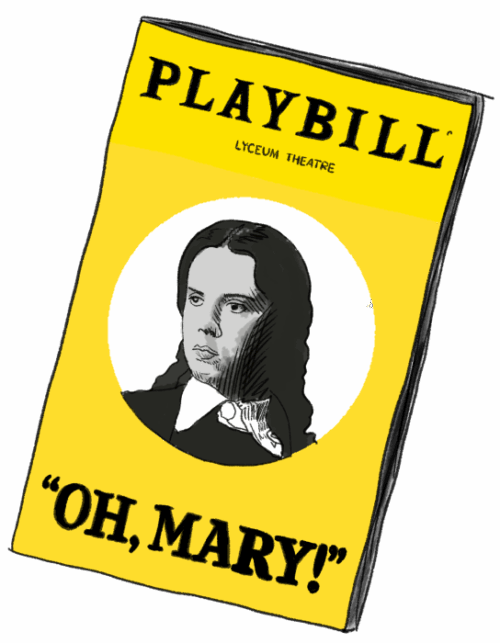
Meanwhile, down the block at the Lyceum Theater, Cole Escola pranced on stage, cross-dressed as one unstable and miserable Mary Todd Lincoln in his Tony Award-winning performance of “Oh, Mary!,” directed by Sam Pinkleton.
Though the dark humor and vulgarity are comparable to preceding classics like the timeless “The Book of Mormon,” I have not seen anything quite like Cole Escola’s unhinged interpretation of an all-American story—the assassination of President Abraham Lincoln, played by Conrad Ricamora.
Mary is portrayed as a drunken, hysterical madwoman, suffocated by an infantilizing Lincoln. Lincoln, in turn, is portrayed as an angry, closeted satyromaniac, unraveling under the pressure of the Civil War and sexually abusing his servants, with no interest in his wife.
As Mary wrestles with Lincoln for her bottle of whisky throughout the show, he places her in sophisticated painting and acting classes in an attempt to keep her at bay and fulfills a false promise of allowing her to perform in a cabaret.
John Wilkes Booth, played by James Scully, is her acting coach—a failed actor himself—and a love interest for the bored and lonely Mary. In a twist, he turns out to be Lincoln’s secret lover.
The play has an ultimately subversive ending for Mary, in which she is the true killer of her despised husband. She frames Booth and escapes with one of Lincoln’s abused servants to live out her lifelong dream of being a cabaret star, culminating in a final, glorious rendition of “Copacabana.” She perseveres, rising above her subordinate condition as a despised wife and widow to become an independent star, even if she remains within her own delusional fantasy.
Escola plays Mary like a walking train wreck—their genius dialogue was witty, cutting, and always walking the line between hilarious and horrifying. The crowd (myself included) was laughing out loud the entirety of the show. Like “Book of Mormon,” it is probably not a show you want to see with your dad and grandpa (which I unfortunately did for both), but it is the unapologetic vulgarity of Escola’s screenplay that makes it so effective.
The plays share a common theme of emotional spiral, but where “The Picture of Dorian Gray” reads as a moral parable of vanity and introspection, “Oh, Mary!” combines history, gender, and theatrical excess that renders identity, spectacle, and satire as a subversive mechanism. Together, the two shows act as foils: one interrogates identity through introspection and solitude, and the other through spectacle and chaos.
Both productions use gender-blending as a theatrical device to expose how unstable identity really is —Snook’s fluid transitions between male and female roles create a surreal detachment, while Escola’s drag performance turns gender itself into satire and spectacle. In the case of Snook’s rendition of Dorian Gray, her fluid and ever-changing role, sometimes male, sometimes female, enhances the sense of fractured identity that is so thematically central. Meanwhile, Escola’s cross-dressed performance of Mary offers a historical critique by presenting a caricatured version of the shunned hysterical woman.
Beyond their plots, both “Oh, Mary!” and “The Picture of Dorian Gray” are examples of the broader implications of Broadway’s evolution. Rather than sticking to their sources, these shows use technology and vulgarity as theatrical tools of modern storytelling.
While “The Picture of Dorian Gray” is no longer playing, “Oh, Mary!” remains on sale through Jan. 6, 2026, running at the Lyceum Theater with Tituss Burgess starring as Mary through Aug. 2, and Jinkx Monsoon starring through Sept. 28.
Mia Wilcox ’28 (mwilcox@college.harvard.edu) now knows who really killed Lincoln.