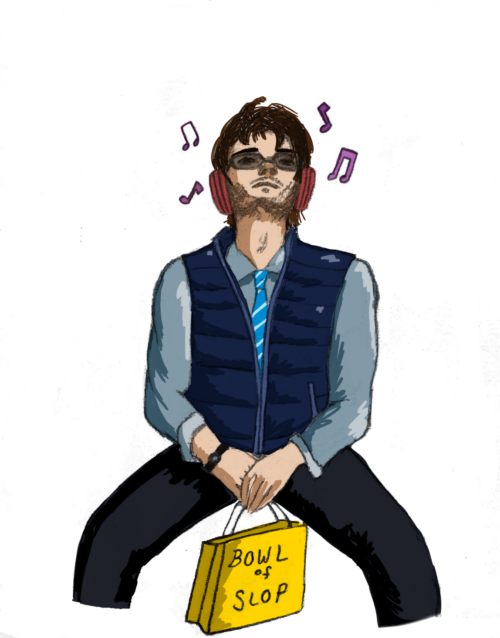
When Your Artistic Side Needs a Résumé
Graphic by Nuala Mernin

It is almost impossible to spend time at Harvard without feeling the gravitational pull toward consulting, banking, or law school. It can feel like ambition has a uniform, calling undergraduates to join the sea of interns wearing the Aritzia ‘Effortless Pant,’ J. Crew quarter-zips, and lunching at Sweetgreen between coffee chats. Some flock to consulting club introductory meetings and networking events, hoping their “Why consulting?” answer will reveal itself in due time. And if a student’s life passion isn’t realized during a case interview, the pressure skyrockets. For those whose ambitions lie in the arts in particular, the hunt for available opportunities can feel especially isolating.
Yael Danon ’28 knows this intimately. A musical artist from Panama, she has been performing since she was eight years old, winning Israel’s Got Talent in 2019 and spending the following years cultivating a discography of original music. She came to Cambridge through Harvard College and Berklee College of Music’s dual-degree program, which allows undergraduates to pursue rigorous academics alongside professional music training. Danon is currently working on an album called “Evil Eye,” a project blending alternative music and Middle Eastern hip-hop and rock influences that she has been developing alongside her studies in psychology. But she felt something was missing: support.
“It’s very hard to tell your parents, ‘I want to be an artist’ or ‘I want to be in the music industry’ when you go to Harvard,” Danon said to the “Independent.” “Everyone’s obsessed with internships and career opportunities.”
Using this personal experience as a springboard, Danon co-founded The Mix, a student-run community for individuals interested in the music industry. As the first club of its kind, the Mix unites students from Harvard, Berklee College of Music, and other Boston-area universities to provide them with mentorship, networking, and educational opportunities. Typical meetings include visits from record label executives, alumni, and industry professionals. The Mix has adapted the same infrastructure that consulting clubs have used for years, but curated to the music industry.
The club has leveraged Harvard’s organizational resources directly by hosting events at the Hasty Pudding Club and using the University’s credibility to attract a vast network of industry professionals. Record label executives and alumni are keen to respond to a Harvard-specific club, demonstrating how Harvard engages with artistic ambition. It doesn’t repress it, but instead translates it into the language of its pre-professional culture. Here, passion excels when it is formatted into a structured career pathway, one with a recruitment cycle, networking events, and LinkedIn-friendly experiences.
“How can I make it sound less scary to say, ‘I want to do something in the music industry?’” Danon asks. She uses this question to guide her work developing new events and opportunities for The Mix. The question itself also speaks to what’s happening underneath, as a personal, artistic passion is legitimized into something the environment will respect.
This translation has tradeoffs. There is something inherently constraining when art has to justify its existence in the world of professional development. The music industry’s intimacy, entrepreneurship, and unpredictability make it harder to explain at Harvard. Unlike finance or consulting, there’s no set timeline, no signing bonus, no predetermined career path to making partner one day.
This is where The Mix steps in, formalizing the trajectory through speaker series, events, and career opportunities. The club is also an intimate space for cultivating personal relationships. Danon met one of her collaborators on “Evil Eye” through Berklee, but it was a Mix event that solidified their partnership.
Yet, this sense of community still cannot replace Harvard’s pre-professional demands. While it is a community for individuals with a common interest, it also, by necessity, becomes a credential.
The anxiety of pursuing the arts is felt beyond Harvard’s campus. Artists at elite universities across the country must navigate the same social pressure to legitimize their passions within the culture’s definition of ambition and professionalism. Danon also notes that The Mix exposes students to careers in the music industry that extend beyond being an artist, such as entertainment law and artists and repertoire scouting, because undergraduates fear instability in an industry with no clear pipeline.
Danon distinguishes Harvard’s curriculum from the social pressure outside the classroom. “There is something about the liberal arts degree that allows you to be creative,” she said. “The beautiful thing about Harvard is that you can easily do an assignment in an hour, or in ten hours. Diving that deep into something is creativity itself.” The pressure comes more from social momentum. The institution offers many opportunities to immerse yourself in curiosity-driven exploration, but it is the culture that sets the unspoken rules and judgments about how you direct your attention.
This distinction is important. Harvard does not repress art or expressions of popular culture. It does, however, impose a cost and a framework to follow. Danon is candid about the sacrifices she has made.
“Am I going to be an A-plus student, or am I going to build The Mix, do music, and meet people?” she said. “I made a choice.” It is a decision that students with artistic ambitions must face—the decision of how to balance institutional rewards against pursuing their creative work.
The University’s resources, network, and scale are all incredibly powerful, and The Mix is proof that artists can utilize them. But the complicated truth about Harvard and the arts is that access must be repaid through translation and conformity to the pre-professional culture. In other words, yes, you can pursue an artistic career inside these gates, but you have to be willing to back it up with a résumé first. Danon’s answer to this tradeoff is her organization, a space that allows artistic identities to thrive within a structure that the University culture respects.
Audrey Adam ’27 (audreyadam@college.harvard.edu) will be joining the sea of Sweetgreen lunchers this summer.