Where Are You Really From?
Graphic by Hafsah Kahn

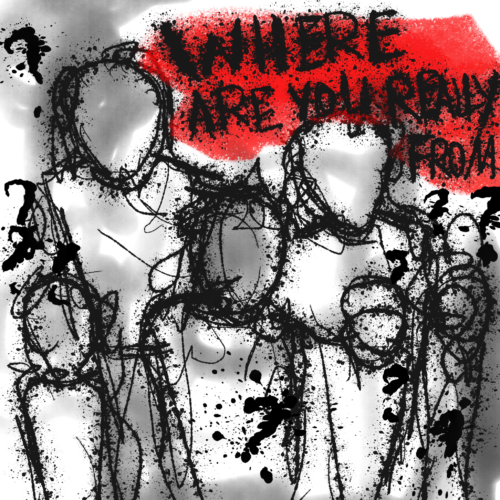
“Where are you from?” I gave my answer, as one does, and they looked at me, confused. I looked back at them, also confused (I was only a child; I hadn’t realised that this was a canonical “living while Black” moment). Like two dueling cowboys who both missed their first shot, we stood feet from each other, staring each other down in silence. Nobody moved.
“Where are you really from?” Another shot comes my way; another miss.
I give the same answer. It flies at my target and hits them square in the chest, yet they remain standing. This one’s resistant to a straight answer.
Again, we look at each other, confused. Then the kicker comes … “Ok, but where are you from in Africa, though?”
They think they’ve got me dead to rights with that one; you can see it on their face.
The bullet flies, zipping through the air, and the grin grows on their faces as they think they’ve finally got me. It hits me. Though in a similar way, I am unfazed. I don’t like dumb questions.
I reply, “I’m not from anywhere in Africa,” and again, just like the time before and the time before that, we look at each other, confused.
Over the years, I have been asked this question more times than I can bother to count, yet my answer remains the same every time. Where I’m really from hasn’t changed since the first time I was asked, nor the most recent time (which was this Monday, in case you were wondering). What has changed, though, is how I think about that question and its implications.
Despite maintaining that same answer, I have struggled with this question a lot as I’ve grown older. Where am I really from? The answer for me, like many other African Americans (a term in itself I find testing), is clear in its lack of clarity; we don’t know.
In lots of cases, our names aren’t even a reminder of home; we carry the familial name of men who kept our ancestors as slaves and profited from their pain. Their ties to home were literally beaten out of them to the point that when freed, many knew no other name but that of their slave master to take as their own.
Names changed, and histories erased: as the years went on, the homes their forefathers left became a foreign concept. America’s cold embrace became our comfort, and from its arms came a resilient people who weathered every storm and made it out in one piece. Our roots in this country are deeper than most, and they’re stubborn SOBs who have survived the weed killer, the bow saw, and the flame. This “tree” wasn’t transplanted from somewhere else but grown by ourselves for ourselves by a people whose original trees were bound in chains and whose roots were dragged out by force.
I recently had a conversation with a friend who debated with me if I was truly African American because I was born and raised in a different country, have a different accent, and wasn’t like the ones he knew. I wasn’t offended by the question, oddly enough, but I pointed to roots as my main counter-argument.
Our roots, as I understand it, are a thread of a particular kind—one that doesn’t simply bind us but connects us to those we know and those we never get to know. Invisible in nature, yes, but unbreakable nonetheless. A thread that doesn’t care about borders, accents, or circumstances, but one that simply runs through each of us, whether you like it or not.
We don’t choose where we are born or who we are born to; nevertheless, we are all born to a family, however you choose to define that, and that means something. That ‘something’ is hard to explain but cannot be ignored. It’s a laugh you’ve never heard before but sounds familiar, or a smile that’s passed down from generation to generation, a mark that says they’re one of us.
Edmund Burke, commonly known as one of the key founders of conservatism, in “Reflections on the Revolution in France,” spoke on the idea of society as a contract, saying “It is a partnership … not only between those who are living, but between those who are living, those who are dead, and those who are to be born.” If we remove the commentary on society from the equation, it perfectly encapsulates my feelings towards my own roots.
The person I am was confirmed before I took my first breath. I carry the lives, struggles, and smiles of those who came before me. Their stories become mine, and all our stories will be someone else’s one day in the future.
I imagine in the future someone will ask my children where they’re really from. I can hope they’ll have learned something from their father and answer without hesitation. Not because our culture or family history is simple, but because they know what they are, not just who they are.
Roots, to me, are separate from ancestry; ancestry can tell you what you are, but roots tell you who you are. Ancestry is like an old photograph; it captures a moment, serving as a record of existence. It says we were here. Roots, on the other hand, aren’t moments in time but are living; they grow deeper and get stronger, generation upon generation. They don’t just say we were, but we are.
Noah Basden ’29 (nhbasden@college.harvard.edu) is tired of being asked where he’s really from.