Who Really Calls the Shots?
Graphic by Angie Li

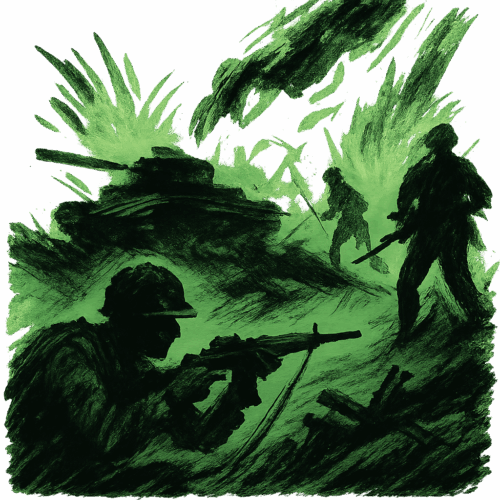
Israel’s June 2025 strike on Iran wasn’t just a preemptive military action—it was a provocation. Behind the drone strikes, cyberattacks, and public messaging lies a deeper strategy to draw the United States into a broader conflict—one that could dismantle Iran’s regional influence and reshape the international affairs of the Middle East in Israel’s favor. With American political support already secured through deep lobbying ties, Israel is now seeking military backing to finish what it started. The question isn’t just why Israel attacked, but why it did so in a way that almost guarantees U.S. involvement.
Early morning on June 13, Israel launched a premeditated attack on Iran. The offensive began with a cyberattack on Iranian radar and air defense systems, followed by drone strikes—some reportedly launched from inside Iran—targeting high-ranking officials and critical infrastructure.
According to the Israeli Defense Forces, the operation was intended to disrupt Iran’s nuclear program. Israel frames the strike as a matter of national survival—a preemptive act of self-defense against an existential threat. However, a harder question must be asked: Is targeting Iran truly about survival or about expanding Israeli power across the region?
Codenamed Operation Rising Lion, the offensive marks Israel’s boldest action against Iran since the 1980s. According to the Associated Press, over 200 aircraft struck more than 100 targets, including the Natanz nuclear enrichment site and the residences of top Islamic Revolutionary Guard Corps commanders, such as Hossein Salami and Mohammad Bagheri. While Natanz sustained damage, deeply buried facilities like Fordo remain largely untouched, suggesting the nuclear program may not have been the only target.
The June operation was preceded by covert Mossad activity and cyber sabotage—tactics typical of Israel’s longstanding campaign against Iran. But this mission’s scale and focus on political and military leadership suggest broader ambitions: not merely delaying Iran’s nuclear capabilities but potentially destabilizing its regime.
For decades, Israel has pursued a doctrine of preemption, striking enemies before they can pose existential threats. The Begin Doctrine—asserting that no hostile state should acquire nuclear weapons—justified past attacks on Iraq’s Osirak reactor in 1981 and Syria’s covert nuclear facility in 2007. Both strikes were conducted without public warning or the approval of international partners.
But Israel’s preemptive reach has long extended beyond nuclear concerns. In the 1970s and 1980s, it targeted Palestinian Liberation Organization bases in Lebanon, culminating in the 1982 Lebanon War—aimed not just at militants but at reshaping Lebanon’s political order. More recently, hundreds of Israeli airstrikes in Syria have targeted Iranian weapons shipments, Hezbollah infrastructure, and even Syrian military assets—all without formal declarations of war.
In Gaza, major military operations—Operation Cast Lead from 2008-09, Operation Protective Edge in 2014, and more recently, the devastating Israel-Hamas war in 2023—have been presented as defensive responses to Hamas rocket fire. Yet they have fueled an ongoing debate over proportionality and long-term objectives.
To be sure, Israel’s fears of Iran are not baseless. Iran has openly called for the destruction of the Israeli state, funds armed groups like Hezbollah and Hamas, and supplies advanced weaponry to militias stationed across Lebanon, Syria, Iraq, and Yemen. Its ballistic missile program continues to advance, and its nuclear program—while ostensibly civilian—has raised red flags for decades.
Israel justifies its strike on the grounds that Iran poses a nuclear threat, but the charge rings hollow given Israel’s own nuclear history. Israel is widely believed to possess a nuclear arsenal developed in secret, outside the bounds of international oversight. It has never signed the Nuclear Non-Proliferation Treaty, never subjected its facilities to International Atomic Energy Agency inspections, and has maintained a policy of deliberate ambiguity. Iran, by contrast, remains a member of the IAEA and the NPT, and its facilities—while deeply buried and concerning to many—have at least nominal oversight. The irony is stark: the only nuclear-armed state in the Middle East, which acquired its weapons outside any international framework, now leads a campaign to stop a neighboring country from doing the same.
The logic of preemption—central to the Israeli government’s security strategy—has run up against the reality of a decentralized threat that cannot be neutralized in a single blow. Operation Rising Lion represents not just an effort to degrade Iran’s nuclear progress but an attempt to decapitate its regional influence—and perhaps, to provoke a larger war that draws in the United States.
And that may be the real objective: American intervention.
By launching such a sweeping assault—disabling air defenses, killing key IRGC commanders, and signaling an intent to destabilize Iran’s leadership—Israel appears to be laying the groundwork for U.S. escalation. Despite official reluctance, Washington is unlikely to stay out of the fight. Political pressure—fueled by pro-Israel lobby groups—remains immense.
In the 2023-24 cycle alone, American Israel Public Affairs Committee and aligned groups spent over $53 million backing 361 pro-Israel congressional candidates. Nearly two-thirds of Congress—349 members—received AIPAC funding. Yet AIPAC is not registered under the Foreign Agents Registration Act, allowing it to operate as a domestic lobby despite working on behalf of a foreign government’s strategic interests—a point recently raised in a high-profile interview between Tucker Carlson and Senator Ted Cruz. With such deep financial ties, it becomes politically untenable for most lawmakers to oppose a U.S. role, even if few want another conflict.
It’s not just elected officials pushing for deeper U.S. involvement—American elites in business and media are amplifying the call. Billionaire hedge fund manager Bill Ackman ’88, a vocal supporter of Israel, has been involved in a private WhatsApp group including Israeli military leaders and top U.S. executives, created to “change the narrative” by promoting stories of Hamas atrocities and bolstering support for Israel in the American public sphere.
On June 14, Ackman tweeted to his millions of followers that the U.S. should help Israel “finish the job,” arguing that this was the “lowest-risk, highest-probability moment” to destroy Iran’s nuclear program—a message viewed over 8 million times. Ackman’s deep ties to Israel and access to influential networks reveal the close alignment between certain segments of American elite opinion and Israeli security priorities. This kind of elite narrative pressure helps turn foreign wars into domestic mandates.
For Israel, U.S. military support is indispensable. Despite years of covert operations and proxy wars, Israel lacks the military capacity to dismantle Iran’s regime on its own. Iran’s nuclear infrastructure is deeply buried; its leadership, heavily protected. Only American firepower—bunker-busting bombs, intelligence networks, and sustained airpower—offers a credible path to regime change in Iran.
But Israel needs more than firepower. It needs legitimacy, and only U.S. endorsement can provide that. Without it, a unilateral war risks condemnation and global escalation, possibly drawing in China or Russia, both close allies of Iran. Without U.S. support—under the banners of nonproliferation or counterterrorism—the equation changes. Regime change led by American hands is more palatable to allies, more intimidating to adversaries, and easier to sell domestically in Israel.
By pushing the U.S. toward the brink of war, Israel is not just trying to weaken Iran, but it is trying to reorder the Middle East. It seems Israel hopes to remove the one state that consistently resists its expansion and disrupt the network of militias, movements, and governments that challenge Israel’s regional supremacy.
However, the cost of escalation is already becoming clear. Even limited U.S. involvement risks spiraling into regional war. Iran has already warned that any American support for Israel will be interpreted as an act of war. The Strait of Hormuz—through which a fifth of global oil passes—could become a flashpoint. Iranian proxies might target U.S. forces in Iraq, Syria, or the Gulf. Regional U.S. allies such as Jordan could be dragged in. In the U.S., a war with Iran would likely spike gas prices, destabilize global markets, and send another generation of American troops into a region with no clear exit plan.
Most troubling of all: this is not a war the American public asked for—or supports. In April 2025, the Pew Research Center found that a majority of U.S. adults—53%—now express an unfavorable opinion of Israel. That raises deep questions about the legitimacy of any military action taken in its name. Yet war may come anyway—driven not by popular mandate but by the influence of a foreign ally with deep sway in Washington.
Israel’s ability to steer U.S. foreign policy through lobbying networks, intelligence partnerships, and congressional ties has created a dangerous precedent: American lives and resources leveraged to serve another nation’s geopolitical goals. That’s a direct challenge to American sovereignty. When one country can essentially trigger another’s military support—not through democratic debate, but through political pressure—that’s not an alliance. It’s a liability.
None of this excuses Iran’s actions. Iran funds proxy militias, threatens its neighbors, and violates international norms. But that doesn’t mean the U.S. should fight a war that serves Israeli goals more than its own. When Israeli military strategy implicates American power, the line between ally and architect begins to blur.
We must recognize what this moment truly represents: a coordinated attempt to reshape the Middle East by force, with the United States as the enabler. The question is no longer just whether Iran poses a threat, but whether that threat justifies another open-ended war, risking global instability and undermining democratic control over American foreign policy.
On June 22, the United States bombed three nuclear sites in Iran—confirming that Israel’s initial strike was designed to trigger American military involvement. B-2 bombers deployed bunker-busting bombs on Fordo, Natanz, and Isfahan, three of Iran’s major uranium enrichment centers. Yet early analysis suggests the airstrikes failed to eliminate Iran’s nuclear capabilities, merely setting them back by several months. A ceasefire announced by President Donald Trump on June 23 was quickly violated by both Iran and Israel, raising serious questions about whether U.S. involvement is truly over—or just beginning.
So we’re left with a choice. Who determines when the United States goes to war? The people we elect—or the allies who know how to pressure them?
Patrick Sliz ’27 (psliz@college.harvard.edu) is the Multimedia Director for the Harvard Independent.