Gold Coast, Re-Gilded: A Look into the Renewed Adams House
Graphic by Alex Mullen

After a more than five-year renewal process, Adams House reopened this August, marking a major milestone in the University’s sweeping House Renewal Program. Adams House, one of Harvard College’s 12 residential dormitories, is known for its distinctive architecture and vibrant arts culture. Now, the House blends modernized facilities with historic features that have long defined its community.
Located in River Central, Adams House was founded in 1931 and is made up of five buildings: Apthorp House, Westmorly Court, Claverly Hall, Randolph Hall, and Russell Hall.
“Each of the buildings of Adams House was built at a different time by a different architect,” Adams House resident tutor Santiago Pardo-Sanchez ’16 said in an interview with the Harvard Independent. Each architect had individual visions, leading to a mixture of architectural styles in Adams.
The renewal project for the “Gold Coast” House was more than just renovating outdated buildings; it was about finding a balance between accessibility, modernity, and historic preservation. Unlike other houses, Adams’s renewal stretched across over five years, nearly double the time of the College’s other house renovations. Although work began in June 2019, the pandemic added delays, as did the challenge of renovating four separate buildings.
This extended timeline affected student living, forcing many into “swing housing.” Resident tutor Alex Reed noted that while these on-campus residential accommodations still allowed House traditions to continue, they never quite matched the spirit of having the community together. “I think that being spread out like we were before was so detrimental to the community,” he said in an interview with the Independent. “There are a lot of students that I never saw because they were just going to Lowell or Quincy to eat.”
Reuniting a distant community was not the only thing that the finished construction accomplished. Before Adams’s renovation, accessibility was a significant issue. Without elevators, students with accessibility needs could only enter and reside in a handful of House spaces, and some areas, like the library, remained impossible to reach. “If you used a wheelchair, you could go into the dining hall and into the Gold Room, but that was the only common space you were able to go into,” said Pardo-Sanchez.
Now, with the addition of elevators and ramps, Adams is fully accessible. This change has been celebrated not just as an architectural improvement but as a cultural shift, as the House is now open to all its students. “It’s fantastic. You can finally access the library without having someone carry you up the stairs,” Reed said.
Equally important was the preservation of Adams’s historic character. Some of the focal features include the grand spiral staircase at the entrance of Claverly Hall and the portico adjoining the dining hall. As a resident tutor, Reed had the opportunity to speak with several of the restoration workers about how they preserved the architectural elements that make the House so unique.
“In the Upper Common Room, for instance, they had peeled off the different layers of paint and found that there were design schemes in that room that we didn’t even really know about before because they had just been painted over,” Reed said.
In the Adams dining hall, contractors took care to maintain the original woodwork. “All the wood that you see in Adams is still kind of the original. They took it down and essentially cleaned it and shined it,” said Pardo-Sanchez. “Those trees are over 100 years old—you don’t have those anymore.”
Some of the most striking changes from the renewal appear in Adams’s common spaces. The Pool Theater, a hallmark of the House, has been transformed into a fully functional performance space. Once literally a drained swimming pool with makeshift seating, it is now a purpose-built theater. “It has a green room, a makeup room, the stage, and the floor of the pool can go up and down, meaning that you can do a kind of theater in the rounds,” explained Pardo-Sanchez.
Stories of the Pool Theater often center on its role as a “space for personal expression and liberation,” especially for those who identify with the LGBTQ+ community. While the Pool Theater is not open yet, it is expected to be unveiled by the end of the fall 2025 semester. Its opening marks the return of not only another space for student groups to perform but also a historic haven for minority groups.
Another notable relic of Adams House is Franklin Delano Roosevelt’s ’03 600-square-foot suite from the early 1900s in Westmorly Court. With four rooms, 14-foot ceilings, and a bathroom extraordinarily modern for the time, the FDR suite has now been restored with its original period furniture and antiques. The University proclaims this as “the only existing memorial to the former President at Harvard, as well as a living museum of daily College life at the turn of the twentieth century.”
The suite acts as more than just a memorial. “They raised half a million dollars from the alumni of the House, and so we were able to both renovate the suite and then use a lot of that money to support undergraduate research, to support Adams students, and people from around the College,” Reed said. “It goes beyond just the suite itself.”
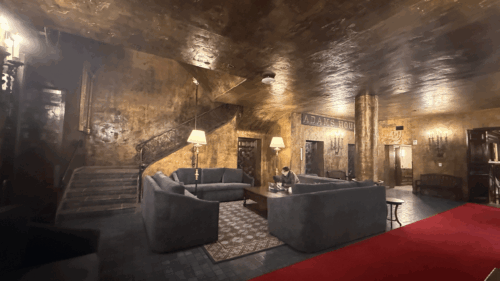
Meanwhile, the Gold Room next to the House dining hall remains an iconic display of Adams’s character. With its golden walls and richly painted ceiling, it is both a gathering space and a reminder of the house’s gilded reputation. “If you’re sitting on one of the couches in the Gold Room, and you just look up, you can see the ceiling,” she said. “It has a lot of intricate designs. It’s a royal blue color with gold and everything,” Aghader Yassen ’27 said.
When the decision was made to move students fully back into Adams this fall, even before every final detail was complete, it was met with relief. “I’m glad that they moved everybody in, even though it wasn’t fully complete,” said Yassen. Finishing touches continue in bursts, but residents say it has not significantly disrupted their day-to-day lives. “It’s usually something I don’t notice,” she added.
Now that Adams residents are back in their historic home, there is a renewed sense of unity. The dining hall has once again become the center of daily life, with students gathering not just for meals but also for studying and casual conversations. “You come to the dining hall, and more people are just hanging out because it’s more central,” Reed said.
Similarly, Yassen shared her experience of casual conversations in the dining hall. “I just go out for brain break and I just see friends talking, and then I sit down and we have a nice little chat,” she said.
Events have also gained momentum, with more students attending House traditions and weekly gatherings. “There’s more buy-in to events, just coming to Carpes and things,” said Reed. “Carpes” refers to the weekly Carpe Noctem events hosted by the Adams House Committee for students to enjoy food, drinks, and a chance to mingle with their House community.
The physical renewal may be complete, but the cultural renewal of Adams House is just beginning. As students settle into their new spaces, they will define what it means to live in Adams in the decades ahead.
“It’s the nicest dorm in America,” said Pardo-Sanchez.
Taylor Thorne ’28 (taylorthorne@college.harvard.edu) is forever thankful to the housing gods for her placement into Adams.