When Empires Decline: Singapore’s Former Minister George Yeo Reflects on U.S. Power and China’s Rise to Global Influence
Graphic by Mia Stewart

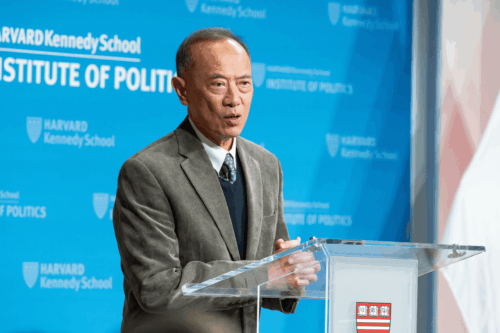
On Oct. 8, Harvard Kennedy School’s John F. Kennedy Jr. Forum hosted the 2025 S.T. Lee Lecture featuring George Yeo—Singapore’s former Minister for Information and the Arts, Health, Trade and Industry, and Foreign Affairs—in conversation with moderator Anthony Saich. Drawing on his experience steering Singapore’s foreign policy, Yeo explored the prospect of a U.S. decline in global influence and engagement, describing how America’s international relations have grown more inward-looking and confrontational as China continues its steady geopolitical ascent on the world stage.
The S.T. Lee Lecture, endowed by Singaporean philanthropist Seng Tee Lee, brings distinguished voices to Harvard to reflect on pressing global issues. This year’s speaker, Yeo, previously served as a brigadier general in the Singapore Armed Forces and remains one of Asia’s most respected voices in diplomacy and governance. Anthony Saich is the Daewoo Professor of International Affairs at the Harvard Kennedy School and director of the Rajawali Foundation Institute for Asia.
Yeo began the lecture with a reflective monologue, sharing his perspective on America’s shifting place in the world.
“When I was in Cambridge, I remember [there was] Alistair Cooke’s series [America: A Personal History] on the BBC… I bought the book and lived through it with pleasure. America inspired many generations of us in Asia. The American dream became the Asian Dream.”
That sense of admiration, Yeo noted, has since given way to uncertainty. “A few months ago, I was across the river for my 40th class reunion at the Business School, and two of my classmates saddled up to me to ask, ‘Do you think we’re in a decline?’” he said.
“It is a question asked all over Asia today. Is the U.S. in decline?”
Over the past decade, the U.S. has repeatedly stepped back from pillars of the post-Cold War order—pulling out of the Trans-Pacific Partnership in 2017, announcing plans to withdraw from the Paris Climate Agreement that same year and again in 2020, and halting World Health Organization funding and initiating a withdrawal in 2020. Public sentiment reflects the drift: surveys find Americans increasingly say U.S. influence is weakening and show less enthusiasm for an active global role.
“Trump has been very hard on Asian countries, threatening them, beating them, bullying them,” he said. “If you’re a small country like Singapore, you’d rather be in the shadows and not attract too much attention. But if you’re China, you have no choice but to stand firm.”
Yet, Yeo added, the trend extends beyond any one administration. Even before 2017, bipartisan skepticism toward large trade deals was rising. Moreover, both parties have embraced industrial policy and selective protectionism.
“It’s not just Trump,” he said. “Because even if there’s a rebound after Trump, there is a ratcheting downward movement—a sense that the U.S. is feeling more insecure about itself and will no longer waste time on nice words about the globalist agenda and will insist on its own prerogatives.”
As Yeo emphasizes, American attitudes toward Asia and globalization have shifted in recent years. He cautioned that as great powers weaken, global order tends to unravel. “When big empires go into decline, when America starts shutting down military bases—800 of them maintaining peace and stability and local equilibria in different parts of the world—then the pieces will begin to move again, and everyone will begin to make alternative arrangements and regional hegemons will start throwing their weight around,” Yeo said.
Some analysts frame this risk through the “Kindleberger Trap,” which describes how global order unravels when a declining power cannot or will not provide key public goods, and the rising power fails to step in. The theory draws parallels to the 1930s, when Britain was unable and the U.S. unwilling to stabilize the global system. Commentators now use this idea to explain U.S.-China tensions, warning that if neither country takes the lead, the world could grow more unstable even without a major war.
Nonetheless, Yeo noted what appears to be a contradiction in America’s global posture—an apparent retreat from globalization alongside ambitions that still project power outward. Since returning to office, Trump has repeatedly suggested making Canada the “51st state,” and revived talks of annexing Greenland. At the same time, naval deployments by the U.S. have surged off Venezuela in an attempt to patrol the Caribbean.
“Watching [Trump’s] moves, even if they are not consciously thought about, he’s sliding down paths of lower resistance,” Yeo said. “In Asia, all of us accept that China will be a rising power.”
He warned, however, that a U.S. retreat from its international role could have destabilizing effects. Following World War II, the U.S. positioned itself as the principal architect of a rules-based global order and the engine of postwar globalization—building institutions and norms that promoted open markets and security cooperation. Washington led the creation of Bretton Woods institutions like the IMF and World Bank, backed the dollar as the world’s reserve currency, and launched the Marshall Plan to rebuild Europe. For decades, these efforts positioned the U.S. as the leader of global stability and economic integration.
“If the U.S. retreats, there will be a transitional period where the imbalance may become very unsettling.”
The discussion then shifted to what Yeo described as “the nature of China,” reflecting on its long history in the region. “In Southeast Asia, we have seen China in all its previous incarnations,” he said. “During the Tang, it created Srivijaya. It’s a lucrative trade—so lucrative that the local kingdoms were vying with one another for a share of the trade.”
He went on to reference the Ming Dynasty as another example of China’s enduring influence beyond its borders. “In the Ming Dynasty, we’re all familiar with how, after Zhu Yuanzhang established the Ming in 1368, by 1405, the first great fleet sailed and reached Africa.”
His point underscored how China’s historical reach often came through commerce and diplomacy rather than conquest.
“It’s always been defensive because it’s homogeneous,” Yeo said. “And you often get the feeling in China that even if the rest of the world were to disappear, China will carry on because it’s big enough. It’s vertically integrated enough.”
After outlining China’s enduring tendencies, Yeo turned to what this means for the rest of the world. He offered practical advice for how nations should navigate relations with Beijing. “So what do we do first?” he asked. “Don’t have it as an enemy. Don’t get too close. Be nice. You’ll get a lot of advantages. If they push too hard, lean the other way and get your friends around.”
Pausing for a moment, he posed the question that holds great relevance for global diplomacy today: “Can such a China coexist with the U.S.?”
Yeo rejected the notion that conflict between the two powers is inevitable. “If China were the Soviet Union, with the same missionary zeal as the U.S., thinking of the Mahan strategy of naval power, then a class is inevitable,” he said. “But I don’t think China’s nature is like that.”
To illustrate his point, Yeo turned again to history. “Why would dynasty after dynasty invest such vast resources into the construction of a Great Wall? Because it is defensive in nature,” he said. “China can only be governed if it’s homogeneous. And if it starts absorbing large numbers of foreigners and is not able to digest them, it cannot be governed in the old way.”
Following Yeo’s remarks, the discussion shifted into a Q&A format led by Saich. It began with Saich asking about China’s growing dominance in technology and infrastructure across Asia. “What I see increasingly across parts of Asia is that China is beginning to dominate supply chains in the region,” Saich said. “Will [that] undermine the U.S.-dominated security order in Asia?”
Yeo acknowledged that China’s ambitions are strategic but argued they are more rooted in statecraft than aggression. “Does China seek to control the global supply chains? Well, the Belt and Road Initiative is very important,” he said.
“They know that it’s a way of regulating and growing the economy and using it as part of statecraft,” Yeo explained. “Their thinking is this, and it goes back to Sun Tzu’s ‘Art of War:’ you have to prepare yourself militarily and you have to deploy to deter, but be very careful about actually going to war because war yields uncertain outcomes and wars are expensive.”
Nonetheless, Yeo emphasized that while China prepares for war, it views conflict as a last resort, relying instead on economic leverage to achieve its aims. “Why do we need to fight?” he asked. “If I can use bananas and pineapples and sugar to influence your behavior, that’s what they do. And it is a statecraft honed and perfected over centuries.”
He added that China’s approach is pragmatic and deeply calculated.
“They say, ‘Oh, China is unpredictable.’ It’s completely predictable,” Yeo said. “When they were angry with Australia, what did they do? Your lobsters, your wine—they buy them from America to make a point to Australia. Now they don’t buy soybeans from America; they buy them from Argentina… That’s what they do. And they’re very good at this.”
To conclude the discussion, Saich asked whether China’s rise in a new technological era would differ from its past dominance over trade goods like silk.
Yeo responded by pointing to artificial intelligence as a defining example of how China’s modern strategy departs from historical monopolies. “When they made DeepSeek open-source—whether the decision was made by Liang [Wenfeng] or by the center—the result was open source,” he said. “And all other AI developments in China are open source. To me, that is China’s biggest contribution to global public goods.”
“It’s a revolution, because AI is not just apps that we download to draft speeches and to do PowerPoints—it’s how AI is married to automation and robotics to make lives better.”
Nashla Turcios ’28 (nashlaturcios@college.harvard.edu) writes News for the Harvard Independent.