I Hate the Word “Grief”
Graphic by Kerrie Zhu

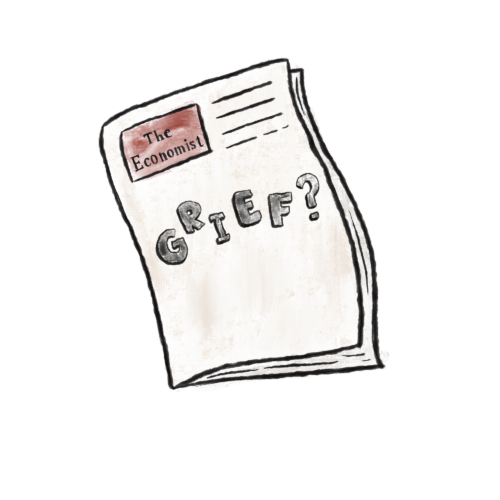
I hate the word “grief.” What is it supposed to mean? Am I meant to be crying every single day, an uncontrollable emotional mess, angry at the world? Grief carries a pressure to mourn in a “correct” way.
Immediately after my Dad’s death, I felt absolutely nothing. Nothing at all. No intense sadness or anger. I just felt completely normal. I kept waiting for something to happen, just like in the movies. Sometimes I even forget that he is dead. But the people around me don’t. The word “death” is scary. It is so unexpected that no one knows what to do. And neither do I.
I don’t feel it, but I see it in the people around me. The worried glances between my roommates when I get out of bed, the concerned words professors offer after I ask for extensions on assignments, or even the constant “I’m here to talk if you need to.” Death is terrifying. It’s paralysing. But it feels normal now.
My Dad taught me how to ride a bike, how to swim, and how to do algebra. He would drive me to swim practice and explain how to improve my technique on the way home. Every Saturday for six years, he would commute two hours to and from London with me to conservatoire. He would always take part in my adventures in the kitchen, stomaching raw cake with a smile. We would watch “University Challenge” every Monday, competing to see who would get more answers right (it was always me). We would go on runs around the park in the evening. But when I go back home this summer, he won’t be there.
I feel like I am on a different side of life. It feels like I’ve crossed a line where my rose-tinted sunglasses have been snatched from my face. I see others who have lost loved ones, and I finally understand. The dead Dad jokes flow right out of my mouth. It’s one of the only things I find funny at the moment. I can no longer banter like I used to—it takes effort to make a joke that isn’t dark.
Maybe grief is the sleepless nights filled with walks by the Charles River and Justin Bieber blasting through my headphones. I force myself through problem sets, midterms, and essays when all I want to do is stay in bed. Days blur together—I can’t remember what I did yesterday or who I talked to. By the time my head hits the pillow, I’m too tired to dream.
Each day I wake up and try to be the person I was before his death. Everyone else around me carries on like normal, sitting outside on the red blankets from orientation week, laughing with their friends, enjoying the end of their time in the Yard. But, for me, everything feels like a haze. I hate that when I talk to people, pity fills their eyes. When they say, “I’m so sorry for your loss,” I just say, “Don’t worry, it’s okay,” because somehow, it is. Sometimes I think about the girl throwing snowballs in the Yard, laughing uncontrollably in our dorm after our toilet broke, chatting for hours in Annenberg Dining Hall. But now, conversations feel harder than they used to; everything moves too fast around me. Walking out of the dorm feels like a performance. I smile, I laugh, I act like everything is fine. I don’t know if the old me is coming back, and I’m too scared to find out who this new person is. It makes me realise that maybe I’m mourning the girl I used to be just as much as my Dad.
Scrolling online, I’ve tried to make sense of these feelings. Articles about the five stages of grief fill my feed. Again, the word grief. What’s that supposed to mean? Denial, anger, bargaining, depression, acceptance. What stage am I in? Normal? No emotion? Nothing I feel at the moment feels like it can be categorised. I read stories about people who lost mothers to cancer, siblings to suicide, grandmothers to old age. The sudden heart attack stories are hard to find, though.
But through all of this, I’ve seen the most beautiful acts of kindness. Words will never fully capture the gratitude I feel for all those around me right now. From my roommates who take me out for ice cream every day, to my friend who sacrifices sleep to walk with me at night, to those who push their problem sets back to sit and talk. I want them to know how much I love them, how grateful I am for them, and that I will be there for them as well. I remember these small things more now.
It’s strange what stays. The way he always napped on a Sunday afternoon. The way he loved eating hummus. How he always had a copy of the “Economist” on his desk. It would arrive in the post every week, and we would pick out the bits and pieces we found interesting or disagreed with. Back then, I would always skip the obituaries. But my Dad loved reading them. It was his favourite section.
I don’t think a life can ever be synthesised like that. Not the chicken stew he cooked when I had a bad day, or the times we raced our bikes on the way back from school, or the way he told me off for not cleaning the dishes properly.
I can’t read the obituaries anymore.
It was his subscription.
Anonymous is a guest writer for the “Harvard Independent.”