Graduate Student Union Strike Continues Through Visitas Weekend
Graphic by Sam Park

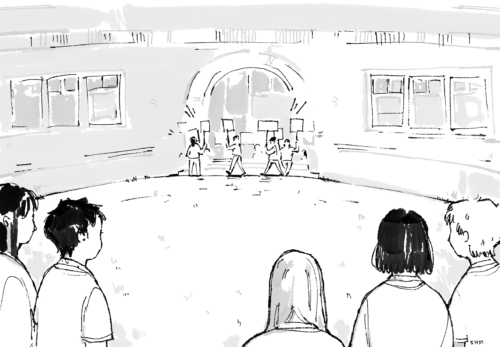
The Harvard Graduate Students Union–United Auto Workers picketed in Harvard Yard on April 26 and 27 in the midst of Harvard College’s Visitas weekend, shifting the College’s atmosphere for prospective students and families. Some strikers circled outside the Science Center with signs and megaphones while other union members offered informational flyers to passers-by, urging admitted students to consider the labor dispute before choosing Harvard. For many prospective students, the strike was the first sign that Harvard was navigating an active labor dispute—one that had already disrupted classes, sections, and the daily routines for current undergraduates.
“It wasn’t until someone handed me a flyer that I realized these were Harvard graduate students advocating for fair pay,” Rella Wang ’30 told the “Harvard Independent.” Still, she said the experience added something to the weekend. “In a way, I think it gives the weekend more complex dimensions when I see people actively negotiating issues like labor and equity.”
Wang, who had already committed to Harvard before attending Visitas, said the demonstrations did not affect her feelings about enrolling. Still, she noted that some of the strike’s messaging may have landed differently for students still weighing their higher education options. “I do feel like some of the messaging was saying that maybe you should go to MIT or Yale or Stanford,” she said. “I’m guessing that message could have influenced other students who were still deciding.”
The demonstrations began on April 21, 2026, after negotiations with the University stalled following 14 months of bargaining. The Union, representing 4,900 graduate student Teaching Fellows and Research Assistants across Harvard, has been pushing for four demands: higher wages, stronger protections for non-citizen workers, meaningful recourse in cases of workplace disputes, and union fees. At the center of the conflict is compensation: many graduate workers report earning about $26,000 during the academic year—an amount that, in Massachusetts, can qualify them for public assistance programs like SNAP benefits.
For striking workers, low pay also represents a failure to recognize the value of their contributions in a University that depends heavily on their labor. Leading discussion sections, grading assignments, and holding office hours are just some examples of how graduate students often serve as the most consistent point of contact for undergraduates. Yet many of these striking graduate students say that they are struggling to meet basic living costs in one of the most expensive cities in the country.
Though the Union has clearly outlined its concerns, the strike has had mixed reactions from on-campus affiliates—undergraduates, professors, prospective students, and the strikers themselves.
While some Harvard College students have experienced disruptions to their courses amid end-of-semester midterms and finals, not all undergraduates have graduate-student teaching fellows. Madison Kang ’29 expressed that her coursework has remained consistent, but recognized that her experience is not universal in an interview with the “Harvard Independent.” “Some of my friends’ finals got canceled, or they haven’t really had any sections,” she said. Kang also noted that one of her professors canceled class in support of the strike.
For others, the effects of the strike have been more immediate. One first-year undergraduate in Apley Court, who requested anonymity to speak candidly about her academic experience, said the absence of teaching fellows has significantly affected her classes. Without regular sections, she described the course as less structured and more difficult to navigate. Questions that would normally be addressed in smaller group settings now go unanswered, and the lack of consistent guidance has made it harder to keep up with the material, especially as the semester reaches its most demanding point.
“You don’t realize how much [the teaching fellows] do until they’re not there,” she said.
Even among students who are impacted, many support the message behind the strike despite complicated feelings about its influence on the Harvard community. Kang believes the workers’ demands are reasonable and that graduate students deserve better working conditions. “I think the school needs to do a better job of listening to their staff and their students,” she said.
At the same time, she acknowledged the tension of experiencing the strike as a student. “It’s unfortunate that it’s toward the end of the school year,” Kang said. “I would imagine people who want to go to office hours might be a little frustrated.”
For organizers, timing the strike during Visitas and at the end of the semester was no accident. Denish Jaswal, a graduate student organizer with HGSU-UAW, explained that the Union chose to emphasize its presence during the admissions weekend because of the audience the weekend reaches.
“Visitas was designed to showcase the University at its best,” Jaswal said. “But prospective students deserve an accurate picture of Harvard before committing to the formative years of their education here.”
Jaswal framed the strike as an effort to make visible what she sees as a gap between Harvard’s public image and its internal realities. While the University highlights its academic excellence and commitment to students, those values are not fully reflected in the conditions faced by the graduate workers who sustain much of its teaching and research, she said. “[The University] publicly praises the contributions of its non-citizen students, workers, and fosters a safe, educational, and working environment. However, we’re not seeing that at the bargaining table,” she explained.
“We are the ones that teach the courses,” Jaswal said. For her, the issue is not only about wages, but about the quality of education itself: financial insecurity limits the time and energy graduate students can devote to teaching, ultimately affecting undergraduates.
“If someone is seeing Harvard for the first time, they should take away that Harvard is not living up to its values, but that it has the opportunity to do so,” Jaswal added. “I think it’s squarely the responsibility of the University. They could have easily avoided a strike at any point. They can avoid the strike continuing on tomorrow. And so I really hope that undergraduates will see that. It’s not us that have the power to stop the strike.”
Some undergraduates believe that the choice to strike on Visitas was necessary. “It’s interesting that the University didn’t really care too much about it, since they usually place such a big emphasis on their public image,” Kang said. “It’s just crazy to see how little attention the school carries towards these kinds of causes.”
“Students should be aware and exposed to what’s actually going on,” Kang said.
For the anonymous undergraduate, however, that distinction does not fully resolve the immediate impact. “Right now, it’s an inconvenience to me,” she said. “Getting in the way of undergraduate education is not the best way to garner support from the undergraduate population. A lot of the Visitas students were stopping and watching, [they] didn’t know what to make of it.”
The overlap between Visitas and the strike placed these competing perspectives side by side. As admitted students toured the school and attended panels, they also encountered a campus in active negotiation over the conditions of teaching and research.
For now, according to Jaswal, those negotiations remain unresolved. The University does not plan to return to the bargaining table until May 14—after final exams—meaning the strike’s disruptions and visibility may continue through the end of the academic year.
Brenda Li ’29 (brendali@college.harvard.edu) is comping the “Harvard Independent.”