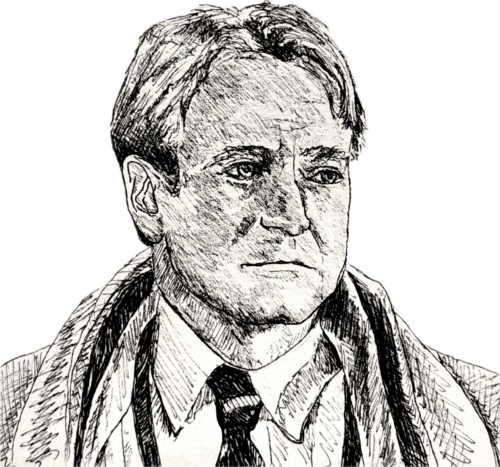
I Went to the Woods to Live Deliberately
Graphic by Caleb Boyce

“Carpe diem. Seize the day, boys. Make your lives extraordinary.”
These words are spoken by John Keating, an unorthodox English teacher, in the 1989 film “Dead Poets Society.” At my dad’s recommendation, I watched it for the first time in the fall of my junior year of high school. It was the best and worst time for me to do so.
For starters, being 16 years old is probably one of the worst times in a modern human’s life—it’s when one is just conscious enough to be disillusioned with the world, but not enlightened enough to cope with it. Getting a driver’s license at 16 exemplifies this, as one realizes that the majority of people should never be allowed behind the wheel.
For me, I felt oppressed by the hustle culture of my school and deeply resented everything about it. It seemed that everyone around me had planned out their entire careers, had stronger extracurriculars, and was fiercely competing for that coveted Ivy League acceptance letter. I watched as my classmates backstabbed each other amid a series of schoolwide academic-dishonesty scandals. But I was part of the culture, even though I hated it. I worried that my 4.0 GPA was in jeopardy and felt a dangerous amount of ego and superiority when I scored well on a test. My friends only spoke about school; it was barely in our vocabulary to do something fun on the weekends.
No wonder “Dead Poets Society” resonated with me. I watched Neil Perry, a top student at his boarding school whose parents were pressuring him to go to Harvard, find passion and love through poetry in Keating’s English class. I romanticized every scene in which he and his tight-knit group of friends snuck out into the woods to escape academic pressure.
The movie was everything I wanted my life to be.
I suddenly realized what I wanted to pursue in college and beyond. Keating’s words—“Poetry, beauty, romance, love, these are what we stay alive for”—became my mantra. I leaned into the humanities and became completely horrified that I once aspired to go to medical school. I became increasingly disillusioned with the peers I associated with. I became aware that my life was painfully ordinary.
How would I make my life extraordinary? I gathered a group of people who weren’t so-called “mindless conformists”—theater kids and creative writers—to start my own “Dead Poets Society,” backed by my eccentric English teacher. It was thrilling, it was exciting, it was everything a student taking five Advanced Placement courses shouldn’t have been doing.
Every Friday at lunchtime, while my English teacher warmed up his meal in his illegal classroom microwave, I would begin our meeting by reading an excerpt from “Walden” by Henry David Thoreau ’37—the same passage used in the movie.
Then another Dead Poet or I would present a work of poetry. Over the club’s two years, we discussed anything from songs and movie scenes to our own work. My personal favorites were strangely insightful internet shitposts, such as “this whole thing smacks of gender,” by X user @dril. We would analyze these texts as if they were as serious and legendary as Shakespeare, commenting on meter, motifs, and syntax under the assumption that everything was an intentional poetic choice. Who was I to tell anyone what was or wasn’t poetry?
One night, we gathered by what we thought was the outlet of a stormwater drainage pipe, a concrete tunnel about five feet in diameter. The only water was a shallow puddle with disintegrating leaves in it. Single file, we shuffled a few feet into the pipe, where a ladder led to a manhole cover. Here, we could stand upright and read our poems (or write them on the walls). Our voices echoed down the pipe in both directions, words traveling underground at the speed of sound.
When I graduated, I decided not to recruit freshmen to continue the club. Perhaps it was cynical of me, but I wanted to preserve my particular vision for the Society. I was afraid future members might want to expand its size or make it an official school club, only to add it as another bullet point at the bottom of their Common Application activities section. I was also worried it would become too radical, crossing the boundary from literary analysis to conspiracy theory.
My English teacher supported my choice. He described the two years of the club as a “safe haven.” I remember him telling me something to the effect of: “It’s a bunch of smart people getting together and saying ‘No, we’re not doing that today. We’re going to be stupid, and we’re going to have fun.’”
***
I look back on this time and acknowledge its quixotic nature. I couldn’t recreate a movie in real life. It was also immature of me to hate my peers and friends for desiring conventional success. The danger of creating a “safe haven,” like the cave the boys escape to in “Dead Poets Society,” is that its tight confines can quickly become an echo chamber. For a while, I became obsessed with being different, expressing my individuality at the cost of important relationships. I should have seen it coming—the film warns of this danger. Charlie Dalton, enamored by the idea of seizing the day, gets himself expelled from school and jeopardizes his future in pursuit of an idealistic liberation.
Yet I don’t regret the time I spent with the Dead Poets Society. It was brave, reckless, spontaneous—whatever you want to call it. I cannot erase it from my past or mitigate its effects on my values and judgments now.
Oscar Wilde wrote in his poem “Apologia”: “I have not made my heart a heart of stone, / Nor starved my boyhood of its goodly feast, / Nor walked where Beauty is a thing unknown.”
The Refuser of the Call has crossed the threshold.