Every Name Represents a Universe: Harvard Affiliates Gather to Honor Gaza’s Victims
Graphic by Wallace Selph

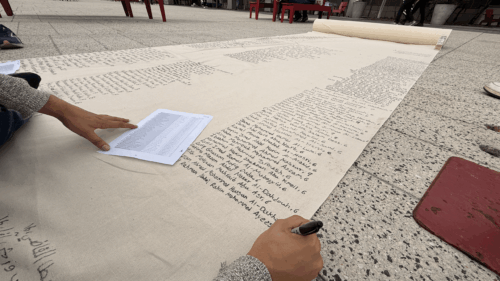
On the morning of Oct. 8, Harvard University affiliates gathered with markers in hand and heavy hearts at the Science Center Plaza to fill blank canvases with the names of Palestinian casualties in Gaza from the past two years. The Harvard Undergraduate Palestine Solidarity Committee organized this event for the second year in a row, inviting students, faculty, and members of the wider Cambridge community to come together and grieve those killed.
Upon arrival, attendees were provided with sheets of paper containing the names and ages of Gazans killed by the IDF since 2023. PSC organizers invited attendees to whisper the names as they were being written to honor their lives after death. Some students wrote down a few names when stopping at the Plaza between classes, while others stayed for several hours, mourning with peers. By the final day of the event on Oct. 11, the canvas spanned dozens of meters long and contained thousands of names of Palestinians killed between ages zero-85 years old.
The following student interviewees requested anonymity due to past on-campus doxxing scandals relating to speaking out about Gaza.
“What we’re doing here is just trying to keep people’s memories alive… We’re trying to honor them,” explained a female sophomore at the College to the Harvard Independent. “There’s a physical act of actually writing the name… It just really makes you think about how these were people with hopes and with dreams and with aspirations and with goals and with entire lives that they were planning on living and who have been cut short because of the Israeli state.”
The intense emotions of grief and sadness associated with the magnitude of death were a key part of the name-writing event. “The immensity of the violence and the dehumanization—words cannot do justice to it. That’s why the name writing is so important.” she reflected. “It’s a list that’s too long.”
Echoing her words, an organizer from the PSC confirmed to the Independent that the event intended to illustrate that the Gazans who died are more than just numbers; each Palestinian is an entire universe worth memorializing.
“We see these big numbers in the headlines and news and media, and they’re a lot of times to dehumanize or desensitize the numbers of mass casualties,” the organizer said. “We believe that attaching these names shows how every martyr has a name, has a story, has an age, and has a life taken away by Israel.”
The event was held in conjunction with a vigil held on Oct. 8, where Harvard affiliates, including undergraduates, graduate students, and faculty, gathered to grieve in a candlelight vigil. “When you see scrolls of names stretching out so far along the Memorial Church steps during the vigil, that display moves people to understand this must be reckoned with,” the PSC organizer emphasized.
The event also coincided with a ceasefire between Israel and Hamas, which was announced on Oct. 9. This is the second ceasefire that was declared since the start of the conflict; the first was proclaimed in January 2025 but was violated in March by Israel. On Oct. 14, Israel announced it would be cutting in half the number of aid trucks allowed to enter Gaza due to Hamas’ delay in delivering the hostages’ bodies. Hamas explained that the delay resulted from the difficult conditions caused by the destruction of the sites where the bodies were being held.
There is a divide in choosing to label Israel’s killing of Palestinians in Gaza as genocidal or not. Human rights organizations such as the United Nations Human Rights Council, Amnesty International, B’Tselem, and Human Rights Watch have concluded that the scale of the violence and the intentional creation of unlivable conditions in Gaza mean Israel is committing genocide according to the United Nations’ 1948 Genocide Convention.
Other organizations, however, such as the Anti-Defamation League and the American Jewish Committee, as well as countries like the United States and the United Kingdom, have stated that Israel is retaliating to the Oct. 7 attacks with legitimate military actions and that, despite the immense death toll and destruction, its actions do not constitute genocide. However, the organizations labeling it as a genocide argue that Israel’s military objectives and its genocidal intent are not mutually exclusive.
“The violence is large and indiscriminate, and numbers cannot do justice to that,” a male sophomore at the College explained to the Independent regarding this divide. “When you see Palestinian children starving due to Israel’s blockade on Gaza and families being blown up by precision airstrikes with your own eyes—you see that with your own eyes, and hear racist and hateful rhetoric by Israel towards Palestinians with your own ears—it’s easy to assess that there’s intentionality there, that it’s a genocide.”
The PSC has maintained that Israel’s actions in Gaza are genocidal and that its blockade of aid—which even prior to the conflict was necessary for the survival of Palestinians in Gaza—amounts to collective punishment, a war crime.
Both sophomores emphasized feeling relieved after the ceasefire was announced, but also shared concerns over the reality of the situation.
“I have to hope that there is an end [to the violence], but at the same time, that hope is not dampened, but it’s certainly restrained a bit by the knowledge of the fact that the people who are orchestrating this deal are originally real estate brokers who don’t care about human lives—they care about making money,” the female sophomore said. “These are the same people who months ago were joking about turning Gaza into a resort…to displace them even further.”
“We’ve seen Israel violate the [January 2025] ceasefire hundreds of times in both Gaza and Lebanon, which are still being bombed to this day, as well as other ceasefires historically,” the male sophomore undergraduate continued. “Besides, this ceasefire doesn’t address the issue of Israeli apartheid since 1948; we must continue to demand justice and an end to the occupation.”
The PSC will continue regular programming, both on Gaza and about Palestine as a whole. The organization, which has been a registered student organization for over 20 years, has long provided space for discourse about Palestine. “We’ve been able to actually foster a lot of conversations around Palestine that this University has silenced in such unimaginable ways,” the PSC organizer said. “We have a platform to be advocating for people in Gaza, to be demanding justice and an end to the occupation and this genocide.”
The PSC’s Apartheid Wall installation is a major upcoming event that will be installed in the coming weeks. The wall, which was not displayed in 2025 because the PSC was put on probation in April, is typically an annual installation that aims to bring awareness to the struggles of Palestinians living in the West Bank.
Zaid Al-Ississ ’28 (zalississ@college.harvard.edu) writes News for the Independent.