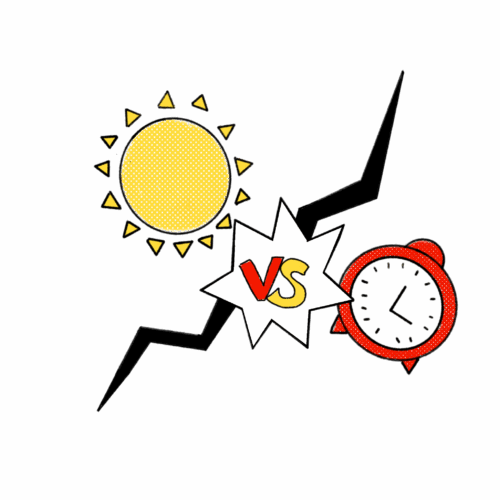
Falling Back, Falling Apart
Graphic by Christiana Zembrowski

It’s time we fix the time.
Each year, on the first Sunday of November, most Americans turn back the clock and relish an extra hour of sleep as we “fall back” to Standard Time, marking the end of Daylight Saving Time until March rolls around.
Though our Halloweekends were blessed with an extra hour of fun, the long-term consequences far outweigh the short-term perks. I’m dreading the 5:30 p.m. walk home after my Thursday section, trudging through the pitch-black evening after an absurdly early sunset. Personally, I detest the annual switch back to Standard Time and the inconvenience of alternating between different time zone systems.
Ben Franklin famously mused about the benefits of waking and sleeping early, yet I can’t help but disagree. My days often begin at nine or 10 in the morning, due in part to Harvard’s practice of scheduling classes at 9:00 a.m. instead of 8:00 a.m.; many of my peers share a similar experience. Clubs, classes, sports, and parties often keep us awake well past midnight.
College students’ unique schedules make the time change all the more difficult. In fact, this change runs directly against our bodies’ natural rhythms. According to the National Institutes of Health, adolescents and young adults are biologically disposed to sleep and wake later than older adults and children. With more sunlight earlier in the morning, we’re caught between conflicting forces: our schedules, our biology, and the sun.
While we’re encouraged to adjust our sleep schedules and use the “extra” hour to catch up on rest, disruptions to our circadian rhythms linger, regardless of whether we gain or lose an hour. It’s not just about sleep schedules: this dysregulation has various health implications, including worsened mood disorders, weakened immune systems, and increased reliance on sleep supplements like melatonin. It also affects cognition, threatening mental concentration and academic performance.
On a federal level, time changes are a recurring source of contention. In 2022, the Senate passed the Sunshine Protection Act, which would make Daylight Saving Time permanent nationwide, but it stalled in the House. In 2024, then President-elect Donald Trump pivoted course, announcing plans to eliminate DST permanently, citing inconvenience and economic inefficiency.
This controversy isn’t new. Daylight saving is commonly thought to have originated from farmers’ desires to have more daylight for fieldwork. However, the true nature of the time change is more strategic: the U.S. passed the Standard Time Act in 1918 as a measure to conserve energy in World War I. Following the law’s 1919 repeal, time-change enforcement was inconsistent across cities and states. This persisted for decades until Congress finally passed the Uniform Time Act in 1966, which established consistent dates for switching between daylight saving and standard time.
Still, even today, states remain divided. Hawaii and most of Arizona remain on Standard Time year-round, while 19 other states have passed legislation to permanently observe Daylight Saving Time, pending congressional approval that has yet to come.
With such inconsistencies, it’s no wonder the time change sparks chaos every year. Between airports, shift workers, emergency services, and tech systems, resetting the clock invites miscommunication and logistical headaches. This is exacerbated by the era of global scheduling and digital infrastructure.
Beyond the large-scale grievances, it’s simply irritating on a personal level. My micro-fridge is the only clock I’ve had to adjust this year, but I think of the dozens my family must change back at home: the microwave, the oven, the analog clocks on the walls. It takes time to fix them all. Multiply that by millions of households nationwide, and we’re wasting countless collective hours—the very ones we are meant to be “saving”—on this outdated ritual.
As college students, I believe the time change has unique effects on our lives. Living in Cambridge, our earliest sunsets will occur before 4:30 p.m., which is essentially the middle of our days. Coupled with the colder weather, it discourages us from spending more time outdoors and in community with one another. Staying locked in our dorms as the nights grow darker threatens Harvard’s already shaky social scene.
A common defense of the annual switch between times is tradition: we’re used to it; it’s part of the rhythm of the year. But maybe it’s time to reevaluate old habits. Our world has evolved past the wartime era of 1918. Twenty-four-hour businesses, modern technology, and flexible work schedules show that life has progressed, and our clocks should, too.
Some traditions are worth keeping for continuity’s sake. But in this case, the twice-yearly change only reminds us that we can’t even agree on what time it is. DST breeds confusion, fatigue, and frustration—habits worth letting go of.
Then again, maybe the problem isn’t time itself. Modern society is ruled by the clock—the classic nine-to-five structure that keeps our lives tethered to work. We’ve learned to treat time as a fixed measure rather than something we can live with flexibly. Historically, humans followed the seasons: longer summer hours, shorter winter workdays, time structured around daylight rather than the clock. Somewhere along the way, we lost that rhythm. Without the ability to capitalize on the limited winter daylight, we unintentionally invite seasonal depression and less time outdoors.
Eliminating the time change would be a first step toward reclaiming control of our time, letting human nature, not policy, dictate our schedules. If daylight saving has taught us anything, it’s that time is more fluid than we think. Change can happen if we decide it should.
Seyi Amosun ‘29 (samosun@college.harvard.edu) can’t wait for the days to get longer after the Winter Solstice.