Love Island Reconsidered
Graphic by Emma Crago

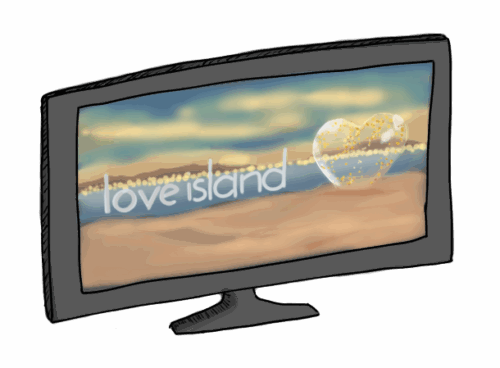
Somewhere in a chemistry lab in Cambridge, a rising sophomore pauses her chemistry experiment to watch an intense recoupling. Across the world in New Zealand, an Econ concentrator spits out his morning coffee because Belle-A was sent home from the Villa. And in suburban Ohio, I trade an hour of nightly reading for the thrill of hearing, for the hundredth time, “I got a textttt!”
We are Harvard students—future politicians, startup founders, and Nobel Prize winners. And yet, at 9 p.m. EST, a shocking number of us cozy up to watch tanned individuals “have a chat” by a fire pit, in the hit reality TV show, “Love Island.”
At first glance, tuning into a nightly reality TV show may seem like intellectual laziness. But in actuality, it’s something more: intellectual indulgence. As Harvard students, we tend to feel some moral opposition to consuming what most consider “trashy TV.” However, there are clear benefits to indulging in media that aren’t intellectual by nature—positives that may not be found in textbooks.
With slightly less ethics and much more Botox, “Love Island’s” Fijian villa functions like a living, breathing psychology experiment. Twelve participants are flown to a secluded villa and stripped of their phones. Romantic stimuli like flirtation, physical attraction, and the pressure to couple up are introduced. Their attachment patterns, stress responses, and conflict resolution skills play out on national television. The producers, acting as researchers, manipulate variables by dropping bombshells (new islanders) and throwing in unpredictable challenges. Participants are compensated with Instagram followers, brand deals, and newfound fame. And we, the viewers, are the peer reviewers, voting for which participants deserve the cash prize, and which should be dumped from the island.
But “Love Island” isn’t just psychological—it’s literary. The love triangles and betrayals echo Shakespearean drama. When an islander sacrifices their place in the villa to leave with a partner, it’s a modern-day Romeo and Juliet. Timeless tropes appear every season: the star-crossed lovers, the charming villain, the loveable fool. Like any good play, the show offers arcs of real character development—some islanders find their happily-ever-after, others are blindsided. And as with Shakespeare, viewers spend half of the episode deciphering the islanders’ confusing language.
Even the supposed “lack of intellect” among islanders is a misconception. Many of them are playing a game—strategically. While the premise is love, there’s always someone scheming for popularity and the cash prize. These are social chess players, navigating alliances, performing loyalty, and weaponizing emotional intelligence. Manipulation hides beneath perfect teeth and a dimpled smile.
Yet beyond all the academic parallels, “Love Island” offers moments of true emotional sincerity. I’ve shed more than a few tears watching someone indulge in Casa Amor’s temptations, only to return to the Villa and find their partner standing alone. The show wrestles with universal relationship themes: trust, jealousy, forgiveness. It fast-forwards through months of emotional growth in a matter of weeks, capturing the intensity of human connection under pressure.
“Love Island” is a social experience. It shifts dining hall conversations from looming p-set deadlines to the latest episode’s drama, relieving students of academic stress. It connects peers outside of the classroom and lights up forgotten group chats. It brings people together in an intense atmosphere that can drive competition. Among young adults who obsess over intellectual performance, bonding over something unserious can be a lifeline. It reminds us that laughter, levity, and the occasional dramatic recoupling are just as important for our mental health as office hours and exams.
So no, I don’t take personal offense if you’re still unconvinced. In this case, I urge you to indulge in reality TV nonetheless. As Harvard students, we often feel that every piece of media we consume should be intellectually stimulating. However, even without literary analysis or psychological insight, there’s value in joy and relaxation. And that is more sustaining than burnout. Therefore, I’m done feeling guilty for loving reality TV.
Watching “Love Island” doesn’t make viewers less smart. It makes us emotionally attuned, culturally literate, and better at spotting red flags from miles away. It might not challenge our brains like a documentary or philosophy textbook—but it serves just as useful of a purpose.
Paige Cornelius ’28 (paigecornelius@college.harvard.edu) is a “Love Island” fanatic.