Civility and Privilege
Graphic by Madison Krug

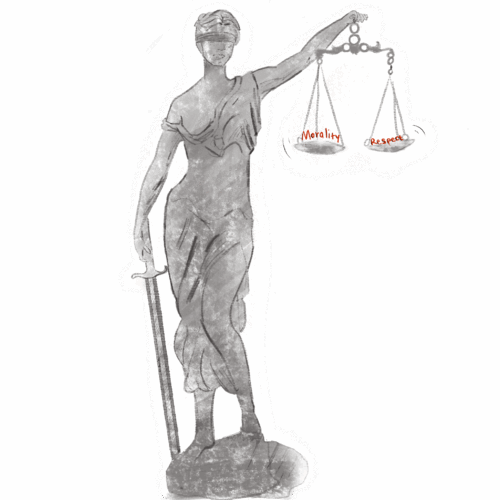
Central to any university’s mission is debate, discourse across disciplines, and exchange across backgrounds. Yet, according to University president Alan Garber ’76, these conversations are faltering. In a recent interview with the Wall Street Journal, Garber reflected on how life at the University has changed since his time as an undergraduate.
“Students today find it much harder to have conversations with one another about difficult subjects, particularly with someone they don’t know well,” he said. “And to me, that is a big loss, and it’s something my colleagues have also recognized.”
This critical view of college discourse is not isolated to Harvard. In recent years, higher education institutions have come under increasing scrutiny for rising incivility in protests and a perceived decline in tolerance across political, social, and economic divides. In response, many colleges have begun implementing measures to reduce these tensions, such as training incoming students to engage in conversations “across differences.”
As a graduate of the master’s in bioethics program at Harvard, I’ve experienced the institutional response to incivility first hand. My classes were inundated with “community learning commitments”—sets of principles designed to promote respectful dialogue. For my classmates and me, these measures have served as a surrogate for academic leadership. As reflected in Garber’s statement, educators appear especially concerned with preserving civility in the classroom and academic environment, particularly in debate-oriented fields such as bioethics.
In conversations with some of my mentors and professors, they state that the decrease in civility is due to some form of moral decay: that students today are less respectful of each other and their character more fallible compared to previous generations. But this is a shortsighted view. The heated discussions or raised voices of my friends and classmates are not signs of declining virtue; instead, they can be better understood through the lens of identity.
Since Garber’s time as an undergraduate, universities have become more diverse. As one example, in 1976, there were 383,000 students of Hispanic ethnicity enrolled in higher education. As of 2023, that number has climbed to nearly 4 million. As a result, the makeup of classroom voices, and how outcomes in class discussion impacts those in it, has changed. Debates around immigration, for example, are no longer just theoretical policy exercises for the students discussing them; they often touch the lived realities of classmates, their friends, and their families.
Today’s conversations are more emotionally charged, not because students lack character or the ability to restrain themselves, but because the personal is now, more than ever, inseparable from the political. The integration of the experience of the impassioned student has become as important within conversation as the “rational” or statistical arguments.
As a collateral of the decline in virtue, some may conflate the impassioned state of campus life with a lack of freedom of speech. That outrage or raised voices means the reduction of other viewpoints. These are related concepts; however, the idea of civility is more concerned with how messages are presented, not what the messages are. This distinction can help organize discussion on campus around these concepts, and allow individuals to advocate for freedom of speech while critiquing tone-limiting definitions of civility.
So, when I hear critiques of incivility aimed at those close to me, I often find they ignore a crucial dynamic: the call to “weigh both sides” of an argument is itself a form of privilege. This is especially true when the “other side” promotes ideas that threaten the dignity or safety of one’s community. In such cases, showing respect for an opposing viewpoint isn’t just difficult, it can feel morally impossible. Recent political events have highlighted this dynamic. With heightened tension around immigration policy, discussions of ICE enforcement have taken center stage. But students of this generation are not finding it harder to have difficult conversations about this topic; they are, however, finding it harder to tolerate groups challenging their lived experience and the safety and dignity of those close to them.
If this incongruence among students persists, then what is the role of civility in campus life? If Garber’s comments are true, does that imply there is a need to return to some historic equilibrium of respect? Civility, according to both political and moral philosophers, is often treated as a virtue that underpins social life. But in practice—historically and today—it can serve as a gatekeeping tool, used as a mechanism to silence those who disrupt the status quo. In this light, incivility is not always a breakdown of discourse, it can be a catalyst for social progress.
The most famous example of this incivility are the sit-ins of the civil rights movement. Within the context of American culture during that time, the invasion of sacrosanct “whites only” tables or counters were acts of disturbance. These were not displays of violence or brutality, but a mechanism to disrupt the current civil equilibrium.
Black Americans sitting at white-only counters is not uncivil to our eye today. The fact that those sit-ins are now widely remembered as brave and dignified shows that civility is not a fixed moral truth. Civility is historically contingent, often defined by those in power. What is called “uncivil” in the moment is often just the first stirrings of social progress. Today, when students protest policies or speech that they find harmful, the same dynamics re-emerge. Their disruptions are framed as a breakdown in civility rather than a form of principled resistance. I am reminded of the Harvard Encampment of 2024, and a letter sent to Garber by Harvard affiliates that encouraged him “to end the encampment swiftly and as peacefully as possible, so that the academic missions of our community…can go forward without further disturbance.”
But like the sit-ins, these actions reflect not moral decay, but moral clarity.
In these times, a return to traditional forms of civil discourse, perhaps the kind Garber imagines, is not what is needed. Instead, we need a redefinition of what civil conversation looks like in a diverse, pluralistic university. The contemporary college campus cannot shut down conversations labeled “uncivil” when that incivility is often applied to the impassioned voices of the marginalized demanding recognition and justice. What is called incivility is frequently a response to the deep frustration of being unheard, unseen, or continuously subjected to systems of inequality. Suppressing those expressions in the name of decorum risks sterilizing discourse and maintaining the status quo.
We need a definition of civility that distinguishes between disruption that fosters growth and furthers discussion and disruption intended to harm. We no longer live in a society defined solely by a diversity of thought, but also by a diversity of identity. Garber’s concern about the loss of civility confuses these two realities. On modern university campuses, we must critically examine how “civility” is invoked, and how it can be employed to silence others. Civility, when used as a moral standard, must be interrogated for the ways it can marginalize. The discomfort of confronting systemic injustice should not be mistaken for incivility.
When protest or discourse does occur in higher education, the goal of the administration should not be to eliminate “disturbance” for its own sake. The leadership of higher education needs to understand that, if we are to foster truly inclusive campuses, our definition of civility must evolve. It must account for how cultural norms shape who is expected to stay calm and who is punished for speaking out.
If universities are to be spaces of rigorous debate and intellectual growth, they must also be spaces that allow for expressions that challenge dominant norms. The use of civility as a mechanism to oppress others has a storied history, and a return to historical definitions of the concept does not reflect the changing values of our time. To grow intellectually, universities must welcome discomfort, and not disguise it as incivility.
Jonathan McCabe (jonathan_mccabe@hms.harvard.edu) graduated with a masters in bioethics from Harvard Medical School. He is now pursuing his MD at the University of Michigan Medical School.