The Game: A Storied Legacy of Pranking
Graphic by Jordan Wasserberger

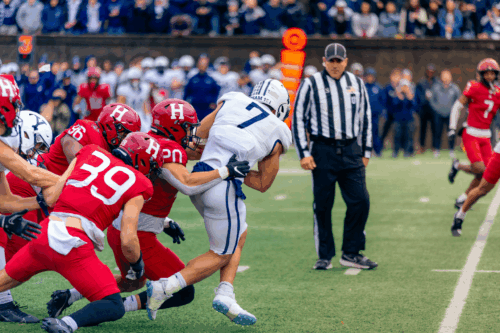
Last year, I got my first chance to see “The Game.” There are really only two football rivalries that share this name. Growing up in Michigan, I had often watched Ohio State face Michigan, but this was my first time experiencing the storied Harvard-Yale match-up. The atmosphere was unlike any other Harvard athletics game I had attended; the stands were packed, alumni came back for the occasion, and it felt as though the entire student body was present. I knew this rivalry had a long and storied history, spanning generations of students, but I did not realize how legendary the pranks and antics between the two schools have been over its 150 years.
Pranking is often a way that rivals build up hype for their matches. Stealing something treasured from the other student body, making the rivals look dumb, and getting under the opponent’s skin are all ways rivals often build up hype and excitement for the upcoming match-ups. A perfect example of this is Ohio State’s tradition of crossing out all M’s on OSU’s campus and social media in the weeks leading up to their clash.
Earlier this year, I was scrolling through Instagram reels when a video appeared on my feed about the most infamous prank in the history of The Game. In 2004, a group of Yale students disguised as Harvard students and handed out crimson-and-white paper meant to form a stadium-wide “Go Harvard” when held up. In reality, the clever Yalies arranged the Harvard section to spell out “WE SUCK.” (What’s less often mentioned is that Harvard blew out Yale, 35-3.) While this is the most well-known prank, a rivalry that has played out for over 150 years unsurprisingly has a long history of pranking on both sides. Here are some of the greatest hits.
Handsome Dan II Prank:
On March 15, 1934, the New York Times reported that Yale’s bulldog mascot, Handsome Dan II, had been kidnapped in the early hours of the morning. It was later revealed that two Radcliffe students, aided by the Harvard Lampoon, were responsible. The Times noted that the disappearance coincided with the night the Crimson swimmers were in New Haven for a meet. One Harvard swimmer, also a Lampoon board member, had been seen eyeing Dan shortly before he went missing. Not long after, the Lampoon circulated the “Bulldog Issue” with a photo of Handsome Dan licking the foot of the John Harvard Statue on the cover.
By March 24, 1934, the Times reported that the Lampoon had turned Handsome Dan over to the Yard police, and he was returned to his (probably less safe) home in New Haven. It was said that a first-year had stolen Dan, and of course, out of the kindness of their hearts, “The Lampoon had gained possession of him and was returning him in an effort to better the relations between Harvard and Yale.” I’ll leave it to the reader to decide how the dog ended up in the hands of the Lampoon.
Massachusetts Institute of Technology Pranks:
Keeping with the Institute’s technological reputation, MIT has found itself involved in quite a few pranks on The Game. Although MIT isn’t part of the Ivy League or directly involved in the Harvard-Yale rivalry, MIT still finds ways to join in on the excitement and fun. With MIT located just 2 miles from Harvard—and the two schools constantly vying for the top stop in national rankings—it’s safe to say they’ve become academic rivals. MIT, which doesn’t really have football rivalries, finds itself pulling pranks, or as they call them, “Hacks,” on its academic opponent by utilizing the grand stage that is the Harvard-Yale game.
Their first notable attempt, in 1948, was ambitious but ultimately a failure. MIT students planted wires and a detonating fuse under the field designed to detonate and spell “M I T” during The Game. Stadium workers discovered the device before the match, and police apprehended the student responsible for triggering it after finding batteries in his pocket. Eight students were suspended (and a ninth later joined them on probation).
It was almost forty years later when MIT students experienced success in 1982 after carefully studying stadium security patterns. They rigged a weather balloon, marked with “MIT,” to a vacuum-cleaner motor hidden beneath the field. During The Game, the mechanism launched the balloon upward, where it expanded to about six feet in diameter before loudly exploding.
While not as notorious as the weather balloon, MIT students fired a rocket-propelled banner over a Harvard goalpost in 1990. Boston Globe writer Joe Concannon quipped, “Perhaps the best way to explain Harvard’s frustration in yesterday’s 107th game against Yale in Harvard Stadium is to say that the students of MIT made it into the end zone before the Crimson offense.” In 2006, MIT pranksters struck again, altering the Verittas shield on the scoreboard to read HU-GE-EGO.
Despite having no stake in the rivalry itself, MIT has certainly left a mark on the history of The Game.
The JFK Situation:
For the 1961 game, the Harvard Crimson distributed parody issues of the Yale Daily News announcing that President John F. Kennedy ’40 would attend. Despite no official announcement, many on campus believed the rumor, given his Harvard roots. Before kickoff, the president of the Harvard Crimson, Robert Ellis Smith ’62, marched onto the field in a Kennedy mask, accompanied by students dressed as Secret Service agents and another in a ROTC uniform posing as a military adviser. The Crimson even coordinated with the Harvard Band to play “Hail to the Chief.” Many fans were truly convinced.
After a few minutes on the field, Smith took off his JFK mask and ran up to the press box, where he was the alumni magazine correspondent. Even after the spectacle, many correspondents in the press box still believed that JFK had been present and were upset that they hadn’t been informed in advance of The Game. The following day, the Crimson ran an article explaining the prank and revealing that JFK had actually not been present.
Band Pranks:
For the 1962 game, the Harvard University Marching Band decided to honor the rivalry by offering New Haven residents an early-morning parade. The only problem: it was 3 a.m. After a wave of noise complaints, the band spent the night in jail before the football game.
In 1992, the Yale Precision Marching Band began performing its customary block Y formation when the Harvard Band countered by forming an X, meant to “X out” the Y. But the Yalies caught on quickly, reconfiguring into an H instead, leaving Harvard’s band inadvertently crossing out its very own logo.
These are only a handful of the most famous pranks in the history of The Game. Undoubtedly, hundreds more have gone unreported. While pranking isn’t as common as it was in the past century, The Game still brings together Harvard and Yale students with humor, rivalry, and tradition.
In today’s world of heightened security and constant connectivity—where nearly everyone carries a camera and a phone—the chances of pulling off elaborate, deceiving pranks have greatly diminished. Research also shows that Gen Z exhibits less risk-taking behavior and tends to operate with a greater safety mentality than in years past. Stories from past generations suggest that our student body appears to be more controlled and less adventurous than those who came before.
Oscar Wilde once wrote, “Life is much too serious to be taken seriously,” a sentiment that perfectly captures the spirit of prank culture woven throughout the history of The Game—and, hopefully, one that continues to inspire many more in the future.
Kalvin Frank ’28 (kfrank@college.harvard.edu) wants to bring back pranking.