Thoughts from New Quincy: Leaving, Falling, Letting
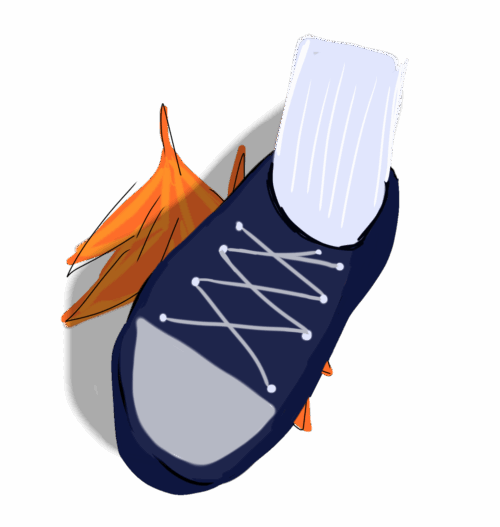
Graphic by Amelie Lima, Mia Stewart

By the time leaves begin to fall in the courtyard outside of New Quincy, the semester is already racing by—too fast for anyone to notice. They gather first in the tight corners of the brick path—wedged beneath bikes, pressed against the base of the lamppost, scattered along the entryway like an afterthought. In the mornings, I watch a maintenance worker blow them into soft, reluctant piles. By noon, they’ve scattered again, trampled flat by students rushing to class. No one looks down. The leaves pile up.
People like to talk about fall as if it’s a mood—a curated palette of colors and comforts. The season gets reduced to a checklist of flannel, pumpkin spice, and tan Ugg boots. Harvard is especially good at this. The Yard turns into a postcard the moment the leaves change. Everyone stops to photograph Widener framed in orange, convinced the image reflects something about themselves. Campus tours drift down the paths, pointing out the foliage like it’s a landmark, as if the trees do this for us each year out of habit.
The leaves aren’t putting on a show. Early cold shuts down the veins that feed them, and the tree seals the spot where the stem connects to the branch. After that, the leaf has nothing left to run on. It dries, cracks, and breaks off. What looks graceful from far away is just a slow collapse.
A breeze drifts down Plympton, and a handful of leaves lift off the bricks, hover for a moment, and then settle again in places they weren’t a second earlier. It isn’t dramatic; it’s the kind of small shift you notice only when you’re completely still.
Sometimes, in that same courtyard, the light gets low enough that everything looks smoothed—the bricks, the windows, even the tangled piles of leaves. For a second, the whole scene flattens into a fall day turned into wallpaper: warm, earthy tones, unreal in their neatness. I always catch it a heartbeat too late, right as the wind starts to scream in my face, and I feel a small, instinctive pull toward the version of fall we’re taught to want—the prettier, easier one.
But that part never makes it into the aesthetic—because the aesthetic isn’t built for honesty. It’s built to reassure us. And reassurance is easier to sell than truth. It’s easier to believe fall is about cozy sweaters and warm light than to acknowledge that it’s a season of losing things, small deaths scattered across the surface of the leaves.
Every October, campus leans into this performance, and every October, I fall for it a little less. The leaves seem to remember something we’ve forgotten: change isn’t supposed to be pretty. It’s meant to be bearable.
…
During the first week of October, I crossed the courtyard and stepped through a cluster of leaves that had settled into a single muted gold. They were damp from an overnight drizzle, softened to the point where the season’s brightness had already left them. When I pressed down, they yielded without protest. No crisp edges, no sharp break—only a dense, tired collapse, as if the work of holding themselves together had finally ceased. Had I lifted one, it would have come apart in my hands.
I realized then how rarely I actually look at the leaves. Mostly, I encounter them the way I encounter my own memories: accidentally, and only when I’m too distracted to confront them. There was a time when I noticed them more clearly: walking to school in October, kicking through big dry piles that gathered along the curb at my bus stop. The smell of cold dirt rose when my feet dragged across it.
When you’re younger, you’re closer to the ground; the world announces itself. Now, I only ever mistakenly register the leaves: a bright red one stuck to my shoe; a brown one caught in my hood; a yellow one plastered to the sidewalk after rain, its shape blurred and soft, already beginning to rot.
Sometimes I walk across Quincy’s brick yard, slip slightly on a wet leaf, and catch myself at the last moment.
Fall is supposed to make us nostalgic, but nostalgia always feels like a trick to me. It makes us remember things cleaner, warmer, and simpler than they ever really felt or had the right to be. Leaves fit that version of memory—they look delicate and beautiful only from a distance, only when we are not thinking about what it took for them to get that way. But that isn’t what fall is asking of us.
I think the leaves remember the things we try not to.
…
There’s a particular tree by the Quincy entrance on Plympton Street that always changes early, a streak of red appearing along the top branches while everything else is still green. It catches the late-afternoon sun in a way that looks almost intentional, like a warning flare. I walked past it every day for a week before realizing the change wasn’t sudden at all. It had been happening slowly, almost imperceptibly, leaf by leaf.
That’s how the semester feels, too. You don’t understand you’re exhausted until the morning you sleep past your alarm. You don’t realize the loneliness gathering around you until a weekend arrives and the silence makes itself known. You don’t see how you’re changing until someone says you seem different. The shift is slow, almost invisible, and then one day you look up and the whole tree has changed.
We talk about “falling behind” in college—the assignments stacking up, the opportunities slipping past—but the truth is most of us aren’t falling behind; we’re shedding. Letting go of the version of ourselves we tried to be in September. Letting go of the routines we swore we’d maintain. Letting go of the expectations that quietly rotted at the edges weeks ago.
We spend the semester pretending we are the people who arrive in September, even as the evidence quietly shifts around us. Our routines thin out. The intentions we swore we’d keep start to loosen. The version of ourselves we imagined at the beginning of the year becomes harder to inhabit. Most of the time, the change is small enough that we don’t name it. But it’s there, accumulating, the way a single branch begins to fade before the rest of the tree follows.
But because we’re students here, we pretend the process is temporary. We pretend it’s reversible. That we can become the earlier version of ourselves if we try hard enough. Trees don’t make that mistake.
Once a leaf falls, it doesn’t climb back up.
…
One afternoon, walking back from the Smith Center, I walked along Plympton Street and saw a fresh pile of leaves blown into a corner beside the curb: bright yellow, crisp red, fading green. They were arranged almost like a gradient—accidental but exact. A breeze lifted the top layer and scattered a few into the road. Cars rolled over them without slowing.
I thought about how easily things disappear when no one chooses to keep them.
The next few days, the pile kept shrinking. Rain pressed the top layer into the pavement, and passing cars dragged the rest into the gutter. By the end of the week, only a thin smear of color was left. It was the same spot, but it didn’t look like the same place.
Memory works like this, too—unreliable, uneven, reorganized by gusts we don’t control. Some moments stick like wet leaves to a windshield; others vanish on contact. I don’t choose what I remember from the semester any more than I choose which leaves cling to my shoes after walking through the courtyard.
Maybe that’s why fall feels heavy even when the air is crisp. It confronts us with how little we hold onto by choice.
…
There is a simple honesty in the way leaves fall that I find myself needing. A tree does not bargain with the cold or ask for an easier season. When the sap pulls back and the stem weakens, the leaf lets go. It does not cling to what it was in September or hope to be green again in November. It obeys the quiet law it was given.
We are less straightforward. We hold on to habits that no longer help us, to versions of ourselves that no longer fit, to people who belonged to another time in our lives. We persuade ourselves that keeping everything as it is is a kind of virtue. We call it loyalty, resilience, and responsibility. Mostly, it is fear.
The leaves are not heroic, and they are not sentimental. They do not imagine that staying on the branch a few weeks longer will change the winter. When the cost of holding on is greater than the strength left in the stem, they fall. There is no drama in it, no speech, no audience. They simply stop pretending that they can stay.
Watching them, I understand how much of my own life is held together not by necessity but by reluctance to face what would happen if I let certain things go.
Earlier this week, I reached into the pocket of a hoodie I hadn’t worn since last fall and pulled out a faded receipt. The ink had almost disappeared. I couldn’t remember the day it came from—what I bought, who I was with, why I kept it. It was a small, harmless object, but it felt like something left over from a person I was already no longer trying to be.
Fall makes it harder to lie about this. It shows, almost too plainly, what is still alive and what is only being carried out of habit.
…
By mid-November, the leaves in the courtyard are no longer pretty. They’re smashed into the brick, ground into residue by hundreds of footsteps. Rain turns them into a slick, dark paste. The aesthetic phase ends quickly, replaced by something closer to decay.
This is the part of fall people ignore, the part no one photographs. But this is where the real work happens: the breakdown, the softening, the quiet reordering. The leaves decompose into the soil they’ll feed on in spring. They become the substance of next year’s growth.
I try to remember that when I’m sitting at my desk late at night, staring at my calendar and feeling like everything is outpacing me. Not all breakdown is collapse. Sometimes it’s preparation. Sometimes what feels like losing is really clearing space.
Maybe the reason we romanticize fall is because it lets us practice losing things safely. The trees release what they can no longer keep. We watch from below and pretend we’re participating when really we’re just observing. But the truth is, the leaves aren’t teaching us how to let go. They’re showing us how not to pretend.
…
On the walk to class this morning, I passed the same tree that started turning early. Most of the branches were bare. Only a few leaves hung on—thin, curled at the edges, impossibly stubborn. I paused and looked at one of them, trembling in the wind, caught between staying and falling.
I understood the feeling.
We’re all somewhere in that in-between space, trying to decide what still serves us and what we’re only holding onto because it feels wrong to drop it. College doesn’t teach you that part—how to recognize the weight you don’t need anymore. How to shed gracefully, or at least honestly.
By winter, the trees will stand completely stripped. No performance, no pretension, no distraction. Just the bare shape of what they are.
The leaves will remember the version of the tree that existed before the letting go. The tree will remember what it takes to survive after.
Somewhere between the two, I’m trying to learn the difference. Sometimes letting go is just the quiet realization that what you’re clinging to has already slipped away.
Luke Wagner ’26 (lukewagner@college.harvard.edu) is the Managing Director of the Harvard Independent.