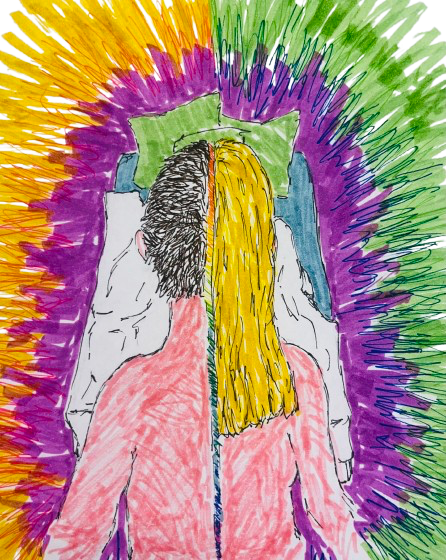
He Thinks, She Thinks: the Nine Stages of a Hookup
Graphic by Annabella Burton

The “hookup” embodies one of our most basic impulses. The term has been diluted over time, used to describe anything from making out to simply meeting up. This analysis, however, focuses on the traditional interpretation: sex. While we have evolved from our cave-roaming days, the custom persists. Frat parties have replaced balls, flowers have replaced donkeys as socially acceptable courting gifts, but the core remains: two people coming together for mutual enjoyment.
Hookup culture is thought of as a modern invention, framed as freedom: an escape from commitment, a space to experiment and “let loose.” However, its roots stretch far deeper, echoing ancient impulses to ritualize desire and power. In Greek symposia, erotic encounters weren’t simply about pleasure; they were performances of status and identity, ways to affirm belonging within a social order.
Today’s equivalents to symposia—clubs, parties, dating apps, social media—carry that same ritualistic energy, but filtered through the capitalist drive to self-brand and pressure to maintain reputation. The hookup becomes a performance of identity: proof that one belongs, that one is desirable, and most importantly, that one is free. Desire is real, but emotional economy quickly takes over. Reputation is currency, partners become metrics, and showing desire can be both attractive and shameful, a bait for social judgment.
Hookup culture is never just about pleasure; it’s about presentation. Each gesture, glance, and text is part of the choreography of managing how one’s seen, asserting one’s status, and curating one’s image. Yet, removing these mental barriers, to fully engage with someone one has just met, is easier said than done. Unlike other animals, humans are self-conscious about their impulses. Awkwardness, insecurities, turn-offs, and fear of judgement all interfere, turning what should be an act of connection and fulfillment into one of calculation.
A closer look reveals gendered asymmetries in how men and women are taught to express desire. Both perform roles centuries in the making: men are usually the pursuers, women the gatekeepers—each trying to appear effortless while silently calculating risk, reputation, and desire.
While nerves affect everyone, men and women navigate the stages of a hookup differently. What follows is not a guide to hooking up but an exploration of the mental choreography behind the so-called “casual.” Defining the stages and the constant calculations they entail reveal just how uncasual a hookup really is.
Acquiring the Target
The first stage of a hookup is selection: a quick, instinctive scan of a crowded room to identify a potential partner. Attraction is filtered through judgment, calculation, and circumstance. It’s not love at first sight. It’s a strategy disguised as spontaneity.
For women, preparation is control: the perfect playlist, flawless makeup, an outfit that “hugs all the right places,” and Instagram-ready photos. At the party, that control is challenged. She filters potential partners through safety and social cost: too drunk, too short, too sweaty, too loud, too many girls hovering. Her selection is less about “who do I want?” and more about “who is worth the night and the story that follows?” When she lands on someone she can’t dismiss, her panic isn’t just from attraction. It’s the awareness that wanting carries consequences.
Eye-Tag
Once aware of each other, the natural next step is shifting glances between one another, the red Solo cup in hand, and the floor. A slight smile every few glances may appear—enough to be noticed but not so much as to scare the other off.
For men, eye contact is a test of confidence and control. They are taught from a young age that looking is both an act of power and a risk. A well-timed glance can charm; a glance held too long can intimidate. Years of subtle practice, on escalators, in classrooms, condition men to use fleeting eye contact to their advantage. One mistimed look, however, can shift the mood from intrigue to discomfort.
The Approach
Now motive becomes action. Someone must take the proverbial leap. Being the initiator carries both risk and reward: rejection is brutal, but nothing begins without taking that first leap.
For women, initiating is often framed as empowerment, but with risk to image. A man striking out is business as usual; a woman who does faces judgment. Every move is a performance of casual indifference, proof she can play the game on her own terms, but the paradox remains: claiming agency while appearing effortless, unaffected, and desirable.
The First Line
Before contact, each person has already imagined the other, building an ideal companion out of glances, lighting, and wishful projection. The first exchange shatters that fiction. The moment hangs in the air, music blurring at the edges, sweat on the drinking cup, too-bright lights cutting through the haze. Every move is a small test of possibility. Here, any clear “icks” or turn-offs not perceivable from across the room are deduced, and the process can get cut short before any regrets can be formed.
For men, the first line is a test of survival. Confidence is key: a vague compliment paired with further questioning, friendly yet non-threatening. Beneath the calm exterior, fears race, becoming “that creep” or accidentally saying the wrong thing. If it works, the foundation is laid to advance.
The Test
Here, the interaction moves into romance territory.
For women, this stage is about subtle cues: a brief touch, a laugh at the right moment, lingering eye contact. These gestures gently nudge the moment forward, testing the waters without openly stating desire. Each signal is an intentional push toward the next level; a subtle way of advancing the moment without saying outright.
Yet, every cue is open to interpretation, one person’s friendliness can be another’s flirtation. Gender scripts complicate the exchange: women are taught to suggest, not state, while men are conditioned to read suggestions as invitations. Miscommunication becomes inevitable. The same glance meant to test interest can be seen as confirmation. Every move teeters between connection and confusion, where desire is performed, perceived, and often misunderstood.
The Exit
The moment of decision: stay, leave, or escalate. Flirtation becomes action.
For men, this is about execution under pressure. They offer a vague excuse to leave together, walking a line between interest and restraint. Desire is shadowed by the fear of appearing wrong or presumptuous.
Are we doing this?
The final pause before crossing the line. A word, look, or laugh that signals the contract called “consent.” Diplomacy ensures that both choose this moment together.
For women, consent is rarely simple. When she doesn’t want it, she feels the quiet pressure to say yes, to avoid disappointment, stay polite, and stay safe. Refusal can feel dangerous, or at least socially costly. And when she does want it, another kind of pressure sets in: to say yes the right way. Confident, but not eager. In control, but never too forward. Women are taught to please, protect, and perceive before they can simply feel.
The paradox of consent is that women are expected to be both autonomous and accommodating: free to choose, yet conditioned to please. Even when saying “yes,” they must navigate what that yes might mean, to him, others, and themselves. What should be a straightforward question of “are we doing this?” becomes a negotiation between agency, desire, and expectation.
Hanky Panky
Use your imagination.
The Aftermath
The hookup doesn’t end when the lights go out. Retelling, rationalizing, and rewriting follow.
For men, the morning after requires composure. Relief turns into bravado; vulnerability disappears, replaced with humor and control. Sex becomes validation, and the story transforms into proof of competence rather than connection.
For women, the aftermath is reflection. She edits what happened: softening or hiding moments. Leaving may become the “walk of shame;” staying risks attachment. What was mutual in the dark becomes gendered in daylight: he gains credibility, she manages consequences.
And then the story leaves them. It circulates through friends, group chats, gossip, and social media. A passing comment or single post online can tilt reputation, reframe memory, and rewrite consent. Social media becomes the new town square, where validation and judgement coexist. Everyone participates: laughing, liking, forgetting, and retelling. The individual stories fold into a collective one that reaffirms the same old double standard.
That collective story perpetuates the narrative that he walks away experienced, while she walks away seen. Experienced means that he has gained skill, confidence, charisma, and maturity. His identity remains intact, if not enhanced. Seen means that she’s exposed, vulnerable, and surveilled. A woman’s body and choices become not only visible to her hookup partner, but also to others. To be “seen” here is not to be acknowledged, but to be scrutinized. Society’s gaze turns her private experience into something public, material for conversation. What was once intimate becomes reputational, feeding the narratives that harden into social norms, and those norms, in turn, shape the culture itself.
Hookup culture markets itself as liberation, but beneath the glitter of “no strings attached” lies an old story, one still bound by gender, social judgment, and fear. Men and women enter the same encounter but play by entirely different rules. What’s called “casual” is anything but. Until we stop treating desire as something to defend, disguise, or perform, even fleeting encounters will mirror gender norms and social conditioning. Maybe the act of naming the awkwardness, fear, and choreography itself is where freedom begins. To see hookups clearly for what they are, to admit that they aren’t all shimmer, nonchalance, and ease, is to loosen their hold and make them feel, ironically, more casual and free.
Katherine Chung ’29 (katherinechung@college.harvard.edu) and Philipos Alebachew ’29 (philiposalebachew@college.harvard.edu) probably thought about this way longer than anyone involved in an actual hookup ever has.