“What Would Brooke Davis Do?”
Graphic by Mia Stewart

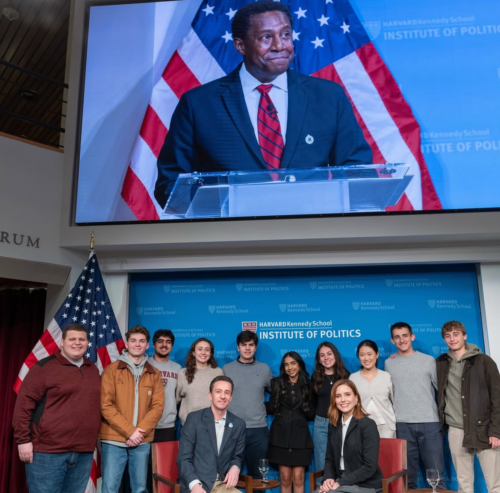
On Dec. 3, American actress, activist, and podcast host Sophia Bush took the John F. Kennedy Jr. Forum stage for the final panel of the year. Titled “Activism and Entertainment,” the talk was moderated by JFK Jr. Forum Director Aaron Goldman.
Bush is known for her starring roles on television and film, including Brooke Davis on the 2003-2013 teen drama series “One Tree Hill,” Erin Lindsay on the police drama series “Chicago P.D.,” and Dr. Cass Beckman on the medical drama series “Grey’s Anatomy” since season 21. These roles have allowed her to represent women authentically and in conventionally male-dominated fields.
“When I’m going to play someone in a role like that, where I know women are underrepresented, one of my favorite things is the prep is going to meet with women who do those jobs, hearing their stories, hearing how they balance their time, hearing about the microaggressions they experience, hearing about their success, hearing about what their track into their career looked like,” Bush explained.
Bush selects her acting jobs carefully and, despite initial scripts, will often instill her own values into the characters she plays. For example, in OTH, Bush had Davis boast a strong entrepreneurial spirit, social confidence, and personal worth.
All JFK Forums include opportunities for audience questions. “What did you learn from playing Brooke, and what lessons were you able to take from that character into either your personal life or your career?” I asked.
“There was a boldness about her,” Bush reflected. “She’s a very unapologetic person. There is something about really stepping into your power as an exercise that I’ve reflected on more recently.”
“Some of our writers on that show were like…‘fine, [Brooke Davis is] going to fix it. She’s going to organize for union wages like at Carl’s.’ And I was like, ‘Yes, we have to do that,’” Bush added. “Maybe that was because of me influencing her, but I know she influenced me as well. Certainly, when I go on a rant occasionally on the Internet, I’m like, ‘she would be proud.’”
Beyond the acting profession, Bush has extensive experience in community activism and philanthropic work. So far, her efforts have centered on LGBTQ+ rights, abortion rights, environmental awareness, and presidential elections, among other causes. Bush has also been a fierce advocate for Democratic presidential candidates, campaigning for Barack Obama in 2008 and 2012, Hillary Clinton in 2016, Joe Biden in 2020, and Kamala Harris in 2024. She was a founding member of “Time’s Up” and a vocal supporter of the “Me Too” movement, citing her own experiences on a podcast episode of Monica Lewinsky’s “Reclaiming.” She is also involved with organizations such as I Am A Voter and Human Rights Campaign. This work and the topics she cares about have always been a part of who she is, she said.
“The profound responsibility of representing people’s stories, helping to bring their life experiences to screen, maybe create empathy or curiosity—and I’m just a news junkie. It was the right balance for me,” she explained, describing her transition from studying theater to studying journalism at the University of Southern California to act upon her activist instincts.
Bush continues to elevate these conversations on her podcast “Work in Progress,” which was another focal point of the discussion. She has hosted prominent guests, including Michelle Obama, Malala Yousafzai, and Ava DuVernay, as well as Lewinsky and Harris, using the platform to delve into some of today’s most urgent political and social issues.
“A real source of joy for me is to give people a space where they can really be heard and they can really be themselves, and they can expound on their ideas or laugh or remind you they’re human or that they’re growing where they’re offered space to change their mind or talk about their own evolution,” she said.
Bush has been especially outspoken about women’s rights and gender equality in entertainment, advocating for equal pay and fair compensation.
“My two new favorite words for women are counter-offer. It’s so incredibly important for you, for all of us to negotiate for ourselves,” Bush said.
She also affirmed the power of both genders working together to level the playing field: “Equal pay can’t just be women talking to each other, men have to get involved in the conversation… When I found out that 20 years into my career, I was still being offered 50% of what the guy they hired to play my dad was getting offered, I was like, ‘Well, thanks for telling me, but this is unacceptable,’” Bush explained.
“But I needed that allyship from him also to even know to fight for myself the way that I did. So, it’s an individual project certainly, but it’s also kind of a group project, and I expect everyone to sign up for a role.”
Bush stressed the vital duty artists can fulfill when they use their platforms to champion change. “I look a lot at what art was able to do in terms of social movement,” she said. She described the positive effect the television sitcom “Will & Grace” had on shifting public opinion of gay marriage, photographs that came out of the freedom riders, and imagery from the AIDS crisis as examples in which art brought public change.
“If it’s writing, if it’s photography, if it’s painting, if it’s performance, if it’s a sitcom, if it’s something you can give to your family—what is it you can do that makes someone or their circumstance seen instead of that circumstance being something that continues to be ignored,” she explained.
“I believe that we have to use our relative platforms and voices to remind each other that we’re neighbors, whether we live next door to each other or halfway around the world… We’ve got to be connected, and I think art does that in a way that a lot of other things don’t.”
…
Bush ended with a pointed reminder of the power of speaking up, urging the audience to raise their voices and advocate for change. “When good people stay quiet, bad behavior feels like it has the space to grow,” she said, an apt reflection of her enduring commitment to advocacy and creative work. This sentiment also echoed a broader theme of the Forum this semester: conversations that reached across the political aisle, pushed the boundaries of debate, and engaged students from across Harvard’s schools.
Goldman closed the event by thanking Bush and the many staff members who work each semester tirelessly to bring Forum discussions to life—including the media services team, facilities staff, student workers, and JFK Jr. Forum Coordinator Dejanee Miller.
For co-chairs Anjali Krishnamurti ’27 and Bahar Moradi ’27, the event was “bittersweet” as it also concluded their leadership term. Forum members Cynthia Garcia ’27 and Tucker Coombs ’28 will take over beginning in the spring.
“We’re so grateful to our audience members for continuing to contribute to this truly magical space for discourse and for challenging our committee to push ourselves to design conversations that inspire and engage the future world leaders at Harvard,” Krishnamurti said before the discussion began.
Goldman also recognized former Institute of Politics Director Setti Warren, a steadfast presence in the Forum who passed away suddenly on Nov. 2 at the age of 55. “A very, very big thank you to Setti for setting the standard for us, for smiling down on us tonight and every night,” Goldman said.
As student leaders gathered with Bush for a final photo, an image of Warren appeared on the screen above, smiling with them.
Layla Chaaraoui ’26 (laylachaaraoui@college.harvard.edu) is the Editor-in-Chief of the Harvard Independent.