
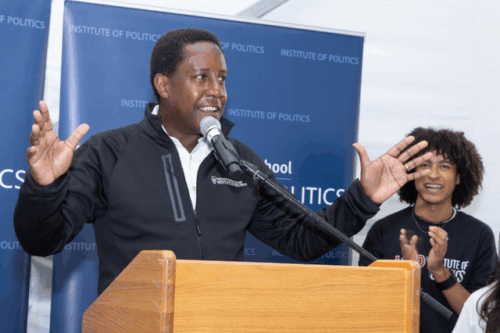
Writer’s note: As the John F. Kennedy Jr. Forum enters another month of inspiring conversations with distinguished leaders and experts, it faces a profound loss. Institute of Politics Director Setti Warren passed away suddenly on November 2, 2025, at the age of 55. Warren dedicated his life to public service, serving in the Navy during the Iraq War, working for both the Clinton and Obama administrations, and making history as the first African American mayor in Massachusetts.
Warren frequently moderated Forum discussions and was widely admired for his commitment to nonpartisan dialogue, elevating diverse perspectives, and championing his students’ ideas. His presence in the Forum and impact on the Institute of Politics as a leader, mentor, professor, and friend will not be forgotten.
“It’s often said that the measure of a person’s life is found in their service to others—and by that standard, Setti’s life stands as an example to us all,” wrote Harvard Kennedy School Dean Jeremy M. Weinstein and Harvard College Dean David Deming in a joint email.
“Setti’s students loved him, and their impact—like his—will reverberate for generations to come.”
…
Throughout October, the Harvard Institute of Politics’ JFK Jr. Forum welcomed a distinguished lineup of speakers, including former Singaporean Minister for Foreign Affairs George Yeo; United States Secretary of Commerce Gina Raimondo ’93; NAACP President and CEO Derrick Johnson; “Pod Save America” podcast host Jon Favreau; and Republican strategist and commentator Scott Jennings. The month closed with notable guests addressing topics closely related to President Donald Trump’s domestic and international policies.
Dana Bash
On Oct. 22, CNN’s Chief White House Correspondent and host of “Inside Politics” Dana Bash joined Lombard Director of the Shorenstein Center on Media, Politics, and Public Policy moderator Nancy Gibbs. How have the past ten months of Trump’s term reshaped Washington’s values? And what is the role of journalism in an era defined by political polarization?
“He wants to make sure that we never forget him and this is one way,” Bash explained. “The idea that he is a disruptor who wants to take a wrecking ball to Washington, the fact that he is physically doing it, is almost too much.”
Bash questioned the complicity of right-wing journalists in amplifying Trump’s controversial actions, citing their coverage during the “No Kings” protests on Oct. 18. Republicans had warned of potential unrest, prompting media outlets to brace for violence. Instead, Bash observed millions of people peacefully demonstrating nationwide. “It was narrative warfare,” Bash said. “Republicans ended up setting themselves up for this becoming a bigger news event than maybe it even would have been because their predictions didn’t happen.”
“I try to unpeel the facts,” she said. “The hard thing is to be intentional and not bounce from one thing to the next and say, ‘Ok this is a big deal…and we are going to try to explain it.’”
Now, with CNN’s potential sale under Warner Bros. Discovery and the rise of independent media outlets, the media landscape is continuing to evolve. Bash emphasized that these pressures do not influence journalistic standards: “It affects how we feel but not what we do and not how we approach the news.”
H.E. Ehud Olmert
On Oct. 23, Ford Foundation Professor of Democracy and Governance Tarek Masoud continued his “Middle East Dialogues” series with H.E. Ehud Olmert, former Prime Minister of Israel. Their conversation focused on the Israel-Hamas war, prospects for a two-state solution, and the role of the U.S. in advancing peace.
“I would have made a deal on the 8th of October to bring back all the hostages right away and to postpone any military action for a different period, a different time, a different circumstances,” Olmert reflected, referring to Hamas’s October 7, 2023 attack on Israel, which killed about 1,200 people and took 251 hostages. “We were never before as polarized and divided as we are.”
Olmert accused current Israeli Prime Minister Benjamin Netanyahu of having “flirted with Hamas” rather than pursuing a comprehensive peace. He maintained that a two-state solution remains the only viable path forward. “Only separation and the granting the Palestinians the opportunity to exercise their rights for self-determination will eventually build up the kind of rapport, the kind of rush of relations that will be entirely different from what they were and they are now,” Olmert explained.
As ceasefire agreements were announced and broken, Olmert argued that U.S. leadership, especially from President Trump, who has approved nearly $12 billion in support for Israel and remained involved in regional peace talks, is crucial. “[Trump] can force Netanyahu to embark on a peace process that will change history,” Olmert stressed.
Jen Psaki and Dee Dee Myers
Closing out the month, Jen Psaki and Dee Dee Myers, Joe Biden’s and Bill Clinton’s former White House Press Secretaries, took the Forum stage on Oct. 27 for a conversation titled “The Power of the Podium.” The event was moderated by Peter Baker, Chief White House Correspondent for the New York Times and Fall 2025 Harvard IOP Resident Fellow, and Forum Student Committee member Kyle Davis ’28.
According to Psaki, the beginning of her tenure was rough. “I didn’t really know Joe Biden very well…How am I going to do this job?” This fear was only compounded by the unsteady media ground left by the prior presidential cabinet. “We were following the first Trump administration. They did not regularly brief…They regularly lied to the press.”
Together, Psaki and Biden sought to change this narrative for his White House press room. “Joe Biden’s objective for us was to take the temperature down and to return it to a room where people could ask questions, where there could be healthy debate,” Psaki said. “And that’s part of democracy too: debates between the press secretary and reporters.”
Building on Psaki’s assessment, both guests stressed transparency and accountability in public service. Psaki criticized the White House’s recent decision to remove the Associated Press and the Wall Street Journal from the briefing pool.
“The public has no idea what’s happening. And all the public is going to be served is whatever Benny Johnson or whatever other sycophant that they have in the pool or the press briefing room is telling the public. That’s what they want,” Psaki added. “There’s propaganda, and it’s spent sending this message to the public that these are normal lines of questioning.”
Discussing the Democratic Party’s future and the upcoming 2026 and 2028 elections, Baker asked Myers, now a senior advisor to California Governor Gavin Newsom, whether Newsom plans to run for president in 2028. Newsom, a frequent critic of former President Trump, is known for parodying his all-caps social media posts and sharing satirical videos online. “He made really clear that he would be lying if he said he hadn’t thought about it, but that he’s going to wait until after the 2026 election to make a decision, and he’s termed out. His term ends in January of 2027,” Myers said.
“He has a better feel for this moment than almost anybody in political life. He moves fast, he is willing to mix it up.”
…
This month’s Forum featured powerful conversations on media, governance, and the future of democracy. Looking ahead to November, the Harvard community can expect the Forum to continue fulfilling its mission: “We hope to prepare them for a life of servant leadership and imbue them with a dedication to the common good.”
Layla Chaaraoui ’26 (laylachaaraoui@college.harvard.edu) is the Editor-in-Chief of the Harvard Independent.