Harvard International Students Respond to Fall 2025 Enrollment Threats
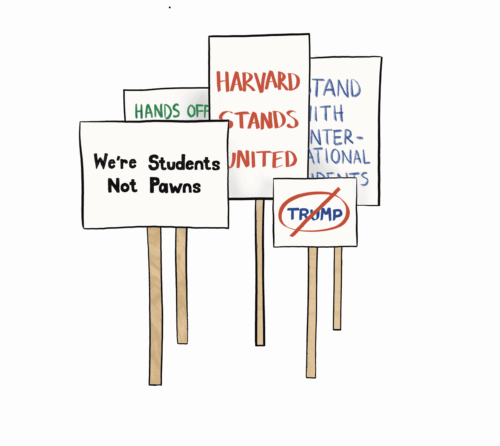
Graphic by Neshama Ryman

On April 16, the Trump administration first threatened Harvard University’s ability to host international students across its 13 schools. After weeks of contention between University leadership and the federal government, foreign undergraduates have started to join administrative push back and speak out against the government’s actions—despite clear federal disdain for international enrollee activism.
“A visa is a gift. It’s a voluntary thing. We decide to give you a visa,” Secretary of State Marco Rubio said in recent remarks to the press.
This conflict surrounding international student enrollment began with a larger debate between the federal government and the University. As the presidential administration instituted what some political analysts have called an “antisemitism crackdown,” Harvard stood at the forefront of institutional action. Starting on April 11, the administration sent a letter to the University demanding reforms relating to university governance, transparency, and “discontinuation of DEI,” among other topics, by August 2025.
The University responded on April 14 in an email titled, “The Promise of American Higher Education.” “The administration’s prescription goes beyond the power of the federal government,” University President Alan Garber ’76 said. “We will not accept their proposed agreement. The University will not surrender its independence or relinquish its constitutional rights.”
The next day, the Trump administration froze 2.2 billion dollars in grants to the University.
Two days after Garber’s message, on April 16, Homeland Security Secretary Kristin Noem sent a letter to the University threatening its ability to enroll students on visas through the Student and Exchange Visitor Program if Harvard did not comply with a list of seven demands relating to providing information about scholars in the program. This move impacts almost 6,800 international students, or over 27% of the campus.
As back and forth dialogue between the University and the federal government persisted, including a lawsuit issued in response to federal funding cuts, multiple government agencies announced increased cuts from the original 2.2 billion: the federal task force on antisemitism, the Department of Homeland Security, and the Department of Energy, among others. These actions have brought the total cuts and freezes up to 3.2 billion.
On May 22, the DHS announced that “Harvard can no longer enroll foreign students and existing foreign students must transfer or lose their legal status.” Noem cited that the University “brazenly refused to provide the required information requested,” along with reported cases of antisemitism and crime on campus.
While Harvard and the Trump administration have continued their legal battles, recent actions indicate a potential break in the rising tensions. The State Department ordered embassies to resume processing Harvard student visas following the temporary restraining order on the federal prohibitions issued by U.S. District Judge Allison Burroughs.
On June 10, Education Secretary Linda McMahon said that Harvard and the administration are “making progress in some of the discussions.”
Most recently, on June 20, Trump suggested a more positive outlook on his communications with Harvard. “They have acted extremely appropriately during these negotiations, and appear to be committed to doing what is right. If a Settlement is made on the basis that is currently being discussed, it will be ‘mindbogglingly’ HISTORIC, and very good for our Country,” he said.
Even with the developments indicating calming tensions, there is still no concrete deal in place between the Federal Government and the University. With uncertainty swirling around their attendance at Harvard in the fall, some international students have elected to speak out. “I applied to college in the United States, seeking a place where truth-telling was a right, not a provocation,” Mexican international student Frida López ’27 wrote for the Harvard Independent in May. “In this suspended state, I confront, face to face, the steep price of standing up to a government intent on silencing criticism.”
A recent Harvard College graduate from Sweden echoed López’s words. “The most dangerous response to authoritarianism is self-silencing. I refuse to retreat into it—and Harvard should not either,” Leo Gerden ’25 wrote on April 8 in response to the revocation of five Harvard students’ visas by the Trump administration; this was before significant federal action was taken against the University.
Harvard international students have also organized demonstrations against the federal government’s threats. Founded in the height of funding cuts, Harvard Students for Freedom hosted a protest condemning the Trump administration’s requests for international students’ academic and disciplinary records in April and have continued since.
“Today, they are coming for some. And tomorrow, when they come for the rest, we need to be together. We cannot, at any cost, leave anyone behind,” Harvard Undergraduate Association co-president and international student from Pakistan Abdullah Shahid Sial ’27 said in a speech during the demonstration. Supplementing such collective shows of support for foreign enrollees, individual students have also spoken out against federal actions.
Finishing his first year in Cambridge after growing up in Wales, Alfred Williamson ’28 joined his international peers to champion foreign students’ rights. “I thought it could be the last thing of significance I ever did at Harvard,” Williamson stated in an interview with the New York Times published on June 7.
In an interview with the Independent, Williamson pointed out that speaking out is an essential part of American democracy. “I really do believe that the moment that we feel that we have to self-silence is the same moment that the American democracy begins to die,” Williamson said. Although international university enrollees across American universities have recently had their student visas revoked for criticizing federal policies, Williamson affirms his commitment to such potentially bold activism, while also acknowledging his unique position to comment on these developments openly.
“I think that I am still in a more privileged position compared to many other international students,” Williamson added. “I’m from a country that has always had a good relationship with the United States.”
However, despite his apparent willingness to publicly criticize the Trump administration’s recent actions against Harvard’s international community members, it was not a choice Williamson took lightly. “It wasn’t an easy decision at all to speak out,” he shared. “We’ve watched ICE snatch students off the streets in such a brutal fashion, and we are getting to a point where non-citizens in the United States no longer have freedom of speech.”
“I know what it means to speak at a cost. I am intimately aware of that danger. As someone who has left a country to flee such a risk, I refuse now to trade that voice for counterfeit safety,” López wrote in her article.
Even as internationals face federal pressure, they have received significant support from the University. Williamson takes pride in Harvard’s response to the Trump administration. “I do greatly appreciate Harvard for standing up and making the right decision. I think it proved to me that Harvard had a level of integrity that I deeply respect to go to stand up to the Trump administration’s unlawful and un-American demands,” he said.
Williamson is far from the only student to receive national media attention. Sial recently did an interview with CNN in which he declared that the Trump administration is using international students as “poker chips.” Sial, Gerden and Karl Molden ’28, published a Letter to the Editor in the Washington Post maintaining their right to speak out.
Harvard is fighting two ongoing court battles against the federal government over funding and its ability to enroll international students. Hearings on the Harvard SEVP International visa lawsuit began on June 16 in Boston. Judge Burroughs extended the block on the entry ban until June 23.
Kalvin Frank ’28 (kfrank@college.harvard.edu) writes News for the Harvard Independent.