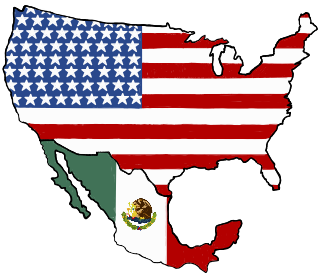
“This Land is Your Land, This Land is My Land”
Graphic by Sara Kumar

Mexico City residents are frustrated as a result of years of redevelopment in the area. Animosity quickly turned into actionable fury on July 4. Mexico City civilians took to the streets, protesting the sizable influx of foreigners—mostly American—who have relocated and made the area their home. “Gentrification is colonization!” shouted Mexican civilians.
Mexican American Harvard College students studying abroad in Mexico City witness a dissonance now being brought into the national spotlight: seeing Mexican families face discrimination in America, while Americans are freely settling in Mexico.
Adelina Escamilla-Salomon ’27 is one of five Mexican American Harvard College students currently studying Spanish abroad in Mexico City.
“It is such a deep contradiction, the way our current government is treating Mexican people, immigrant people, those who have built our country on their back with their blood, sweat and tears,” Escamilla-Salomon said in an interview with the Harvard Independent. “Meanwhile, I’m in this place [Mexico City], where Americans are coming constantly…living here and ripping the benefits of all this work once again.”
Migration from the United States to Mexico City increased in the wake of the COVID-19 pandemic, as Americans working remotely sought lower living costs and more ideal weather. Locals, however, have come to view the influx of American expatriates as a threat to their way of life.
According to the 2023 National Survey of Demographic Dynamics, out of the 1.2 million migrants in Mexico City, about 70% of them are Americans. Most of those U.S. citizens who migrate to Mexico City and work remotely often receive pay in American dollars, contributing further to gentrification.
As newcomers continue to flood into areas of Mexico City—particularly high-end, pedestrian-friendly neighborhoods like Roma and Condesa—rents have skyrocketed. Long-time residents have been priced out of their homes, contributing to the loss of family businesses and displacement from communities their families have been part of for generations.
Some Mexican civilians, however, are now negatively reacting against migrants—the ones that accelerate gentrification and displace local working-class families. The 12 Harvard students taking part in summer programming in Mexico City are watching the conflict unfold.
The summer program: “SPAN S-64 Study Abroad in Mexico: Encountering Mexico – Public Art in the Contemporary City,” is one of the many programs sponsored by the College that brings undergraduates across the North and Central American border. Others include the David Rockefeller Center for Latin American Studies Summer Internship program. Both the study abroad and internship programs include cultural immersion experiences where students interact closely with the country and its citizens.
Escamilla-Salomon suggested this migration of Americans into Mexico City is a “hypocritical situation,” especially when juxtaposed with the harsh treatment Mexican migrants face in the United States.
In recent months, Immigration and Customs Enforcement deportations have been at an all-time high, with an increasing number of immigration raids in predominantly Hispanic communities, including in Los Angeles and San Antonio. Since the start of FY 2025, 204,297 individuals have been booked into ICE detention centers.
“Living in Mexico, [I noticed that] there is always someone in your family, a neighbor, or someone close to you, that lives in the United States,” Carmen Fajardo, a Mexican citizen, told the Independent. “And I think that the narrative that used to exist [in Mexico] was that if you went to the United States, you would have a better life. It was seen as a way that your life and the lives of your family members left behind would be better, but recently, due to the existing anti-immigrant discourse in the United States, this narrative in Mexico is starting to change.”
At 23%, Mexicans account for the largest percentage of immigrants to the United States. Fajardo’s statement speaks to a broader reality: immigration does not always lead to an easier or better life, but it does often come with a financial advantage. In 2024 alone, the U.S. sent almost $70 million in remittances to Mexico toward housing, education, healthcare, and everyday expenses.
This income is earned all while Mexican immigrants are actively contributing to the American economy. In 2023, 67% of the Mexican population in the United States were part of the labor force, playing crucial roles in construction and agriculture.
“Here in Mexico, everyone is very conscious of the difficulties that migrants working in the United States face,” Fajardo continued. “Those first few years are not easy and are filled with difficulties, which I think is a discussion often lost in the U.S. Instead, the dominating discourse there is usually that immigrants steal jobs and don’t pay taxes.”
Mexican Americans across the United States have not taken ICE raids lightly, with more than 40 cities hosting anti-ICE protests.
“When I first heard about the ICE raids happening in the U.S., I was in shock and utter disbelief,” shared a Mexican American Harvard student studying in Mexico City with the Independent who requested anonymity. “I could hardly believe the news coverage. I was watching on my phone screen, and it was hard to comprehend that such a thing was even allowed to happen… I felt guilty for not being there in person to protest or advocate against these ICE raids.”
At least 565 anti-ICE protesters have been arrested across the U.S. since January, indicating the sheer intensity of the risk that many are willing to take to defend immigrant rights. Fajardo says that ICE is “taking advantage of their power” by “violating the rights of Mexican Americans” which will leave a lasting impact on Mexican families and communities.
There are notable divergences in migration patterns between the United States and Mexico. While many American citizens have relocated to Mexico to take advantage of affordable housing, Mexican citizens have migrated to the U.S. due to safety concerns and economic challenges. Both groups of migrants are shaped by different motivations and challenges.
As gentrification in Mexico City continues to displace locals and ICE raids in the U.S. endure in disrupting families and communities, it seems there is a new reality: the forced movement of Mexicans is inescapable on both sides of the border.
“As someone who feels kind of in between these two worlds [Mexico and the United States] I think it always feels like my responsibility to really try to uplift my community on both sides of the border… to bring people together to really create a place where we can all be heard, seen and valued,” Escamilla-Salomon shared.
Jocelyne Delgado ’28 (jidelgado@college.harvard.edu) is a Mexican American student who writes News for the Harvard Independent.