
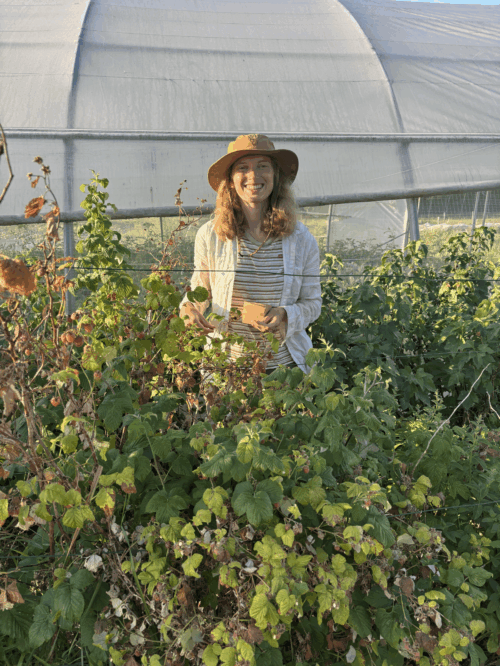
Throughout Harvard College’s annual academic calendar, one thing rarely leaves an undergraduate’s mind: summer internships. As the spring semester comes to an end, students anxiously confer with each other about their suitably prestigious occupations, often citing consulting in New York, public policy in Washington, D.C., or start-ups in Silicon Valley. However, not everyone follows Harvard’s “typical” pre-professional route: Sylvie Wurmser ’27 is cultivating a one-of-a-kind summer experience by working on organic farms in France.
A Social Studies and Environmental Science and Public Policy concentrator, Wurmser has long been interested in the intersection of food and the environment. “It’s got these incredible implications for the individual—what you eat, how that affects you, how that affects your social spending, and how you perceive the world,” Wurmser said in an interview with the Independent.
After taking “GOV 1318: “The Great Food Transformation”—a course offered at Harvard—during her sophomore spring, Wurmser wanted to apply her studies outside of the classroom. “I wanted to just get some more tangible experience, because I felt like [food research] was this big, nebulous field,” she explained. “I wanted to find a way to get hands-on farm experience, to explore a new place, get out of New Jersey, but also to improve my language skills.”
With this goal in mind, she discovered Worldwide Opportunities on Organic Farms through a friend.
According to the organization’s mission statement, WWOOF “links visitors with organic farmers, promotes an educational and cultural exchange, and builds a global community conscious of ecological farming practices.” Since its founding in 1971, WWOOF has connected over 100,000 volunteers with 12,000 farmers across 130 countries—and Wurmser is now one of them.
WWOOF is made up of distinct national organizations, all of which are members of the Federation of WWOOF which facilitates the constant exchange of ideas and supports worldwide program development. Each member nation is managed by its own team. For countries without an established WWOOF branch, the FoWO will usually sponsor any interested independent hosts under its global umbrella.
Volunteers—also known as “WWOOFers”—agree to work on organic farms in their chosen destination for four to six hours per day. In exchange, they receive a horticultural and educational experience, a room to sleep in, and home-cooked meals. There are no offered financial incentives between hosts and WWOOFers. The respective host simply gains a worker on their farm while instructing a potential consumer on the nuances of organic farming practices.
Since beginning in June, Wurmser has already worked on multiple farms across France, starting with two and a half weeks on a family fruit farm in Normandy. “During the week, I picked fruit for five hours a day, or I did a lot of weeding,” Wurmser said.
On weekends, Wurmser’s host family made sure she was immersed in the local culture. “They would drive me to different cities, give me money, pay for my food,” Wurmser recounted. “I accompanied them to all the markets that they went to, and I would walk around and talk to the different farmers.”
Beyond the work and French landscape, Wurmser expressed the impact her host farmer had on her, ultimately setting the tone for her next few months in the country.
“He and I worked side by side, and we would just talk for hours about why he started this farm, what it all meant to him, the importance of providing for his family,” she said. “He couldn’t imagine living any other way. He didn’t want to raise his daughter where she didn’t feel like a connection to the earth.”
“He saw the world in such a deeply distinct way—such a unique way from [how] I see the world, coming from New Jersey and then Cambridge and all of these really urban places where we’re so removed from our food,” Wurmser continued.
The differences in eating habits between urban America and rural Normandy, regardless of income, were likewise striking. “I feel [they have] this kind of connection between the Earth—their intentionality [with their consumption],” she explained.
In America and France, farm incomes are often variable and subject to wide disparities depending on the size of the farm. French newspaper “Le Monde” reported in 2024 that “farming appears to be the most unequal of professions in France today.” Wurmser noted that despite living modestly, her Norman hosts were nonetheless focused on healthy eating. “In the U.S., these class distinctions manifest themselves through inequality in food,” she said. “At least in this one small community, in this one family, that was just not the case… Status did not dictate health outcomes or their relationship to the earth.”
In early June, Wurmser began making Camembert—a special brie-like cheese native to Normandy— after making a spontaneous request during one of her weekend outings.
“I met the second farmer at one of the markets. I was just talking to the different farmers, and one of them was a Camembert farmer,” she explained. “I was like, ‘Hey, I have a funny question. Do you need an extra hand on your farm? And could I live with you? And could you feed me for, like, five days or something?’ And he laughed, and he said, ‘Why not?’”
Much like her experience at the first farm, Wurmser expressed how daily life brought conversations filled with personal reflections and life lessons.
“It’s interesting to listen to him,” she said. “He also felt passionately about climate change, so much so that he said he’s never let an American live with him ever before in his life, because he doesn’t believe in planes, and the fact that we have to fly over is something that he so deeply objects [to].”
This was one of Wurmser’s shortest stays—she worked at the farm for only about five days. “It was only me and the farmer working, and we worked long and hard days—more than 12 hours of work a day,” she said.
“We milked the cows at 6:30 a.m., then rotated pastures, and made hay…We also made Camembert, which was fun but [very] time-intensive. I [ladled] the fresh curdled cream into the molds to become Camembert—this is a famous part of the process of Camembert, which we call moulé à la louche for only the most authentic camemberts.”
Wurmser then moved on to her third farm in Lorraine for a larger-scale market gardening experience. “[I] loved the other workers with me, and also there was a lake that I biked to swim every day,” Wurmser added in a statement to the Independent.
Continuing her journey across the French countryside, Wurmser began working at a direct-to-consumer vegetable farm in Bordeaux, a city in southwestern France. “Farm 4 was outside of Bordeaux, and market vegetable gardening recently converted from wine production [because] climate change was making it just untenable to stay in wine,” Wurmser wrote.
Now, about eight weeks into the summer, Wurmser is on her fifth farm—another community produce farm in Provence, France, where she is staying with Seventh-day Adventists who are passionate about bringing fresh food to their community.
As the WWOOF mission suggests, the organic farmers remain at the core of Wurmser’s summer. “I’ve been very lucky [because of] the farmers that I’ve met and just the kindness everyone has shown me,” Wurmser said. “So it’s only thanks to the kindness of all of these farmers and their hospitality that I’ve been able to have the amazing summer I have.”
Though she has only a month left in the program, Wurmser feels that both her studies and worldview have been permanently enriched. “I feel I just have a new perspective on what food systems even mean and the role that food plays in society,” she said.
“It has indescribably informed my academic studies by giving me this entire new framework of looking at the social implications of food and the climate implications of food.”
Kalvin Frank ’28 (kfrank@college.harvard.edu) might be WWOOFing next summer.