
Robert Darnton ’60 was educated at Oxford University (B. Phil., 1962; D. Phil., 1964), where he was a Rhodes Scholar. He served as Director of the Harvard University Library from 2007 to 2016 and now continues his research on the history of books, publishers, censors, booksellers, writers, and readers in eighteenth-century France from his office on the top floor of Widener. A fervent advocate of free public access to libraries and the knowledge they provide, Darton earned the National Humanities Medal from President Barack Obama in 2011. In May 2025, he published “The Writer’s Lot” with Harvard University Press.
Last September, Darnton welcomed me into his study at Widener Library, as he prepared to leave for Paris and revisit, in an exercise of self-criticism, a 1971 essay on Grub Street, or the marginal life of hack writers in pre-revolutionary France. We conducted our interview entirely in French. Having had the privilege of assisting him for his book “The Revolutionary Temper,” I once again appreciated his immense generosity, precision, and vigor in the course of our long conversation.
Every topic was rich in references, from a symposium held in his honor in Mexico City to his long teaching experience with anthropologist Clifford Geertz, with whom he shared a “spirit of kinship.” But what impressed me most this time was his love of music and literature, which radiates from his shelves. For a few hours, we discussed some of the volumes that have constituted him, as well as his impassioned research on literary life and censorship.


Photos of Robert Darnton’s office. © MariePrunières
Entering Darnton’s office always feels like stepping onto firm ground. Yet our host writes about people like “J.P. Brissot, Police Spy,” who led dangerous lives and struggled to make ends meet. His own father, reporter Byron Darnton, died covering World War II and gave his name to a Liberty ship—a tragedy that left his family with the material and moral imperative to continue journalism in his place.
Subsequently, the seventeen-year-old R. Darnton, along with his mother and Pulitzer Prize-winning brother John Darnton, joined the New York Times, an experience that conferred on him what he refers to as a taste for exactitude. His assignments plunged him into the seedy world of police stations, where fictional Rameau’s Nephew, one of the most famous and theatrical characters from his beloved writer Denis Diderot’s novel of the same name, would have felt most at home in the 1760s. “It is written with such talent, humor, and wit,” said Darnton, who enjoys the comfort of books. “I read it and reread it often.”
The eponymous piece is indeed a jewel of French literature, in which Diderot portrays himself as a provocative genius in a sparkling conversation with “Lui” [Him-self] about music and morality. It also emanates from one of the greatest encyclopaedists of the time, a mission that Darnton has perpetuated at Harvard through the Digital Public Library of America project.
“We want to shape [the] digital future for the public good instead of it being taken over by commercial interests,” he said as he received the 2011 National Humanities Medal from President Barack Obama for his commitment to digitalizing and increasing accessibility to the humanities through the DPLA. Contemplating his wooden credenzas, this commitment only deepened his interest in printed novels, one of which, the 19th-century French classic “Illusions Perdues [Lost Illusions],” even inspired his latest book. “This work by Balzac deals a lot with conflicts and intrigues. I find that the world of lost illusions among miserable writers already existed in Paris in Diderot’s time,” Darnton explained.


“The New York Times Style Book” and Balzac’s “Illusions Perdues” on Robert Darnton’s desk. © MariePrunières

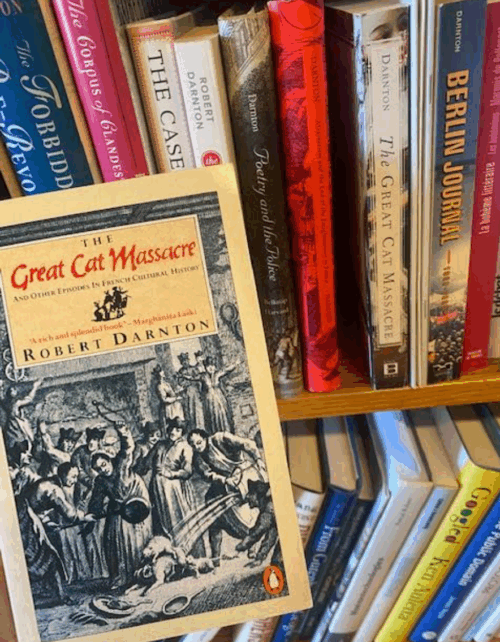
“The Great Cat Massacre,” Robert Darnton’s famous bestseller, published in 1984. “I never made any money out of it,” he said with a laugh. © MariePrunières
When it comes to music, Darnton admits that he is not particularly fond of rock ‘n’ roll, even though Pink Floyd happily sat at the Byron Darnton, a pub named in honor of his father’s Liberty ship that ran aground on Sanda Island. In 2005 he also visited the tavern with his brother and their two wives in the Firth of Clyde. He rather cherishes German classical compositions, meaning that the first volume I found on his shelves was of Mozart.
“Mozart fulfills my need for beauty, clarity, and inspiration,” he explained. “But you know, he was also a writer! I have read his correspondence, particularly with his father. After receiving news of Voltaire’s death, he wrote, ‘How happy I am that this devil is dead.’ That shocked me a lot because, for me, Voltaire is a kind of god.”
We are thus invited into Darnton’s world, imbued with academic collegiality, steeped in art, and joyously populated by 18th-century friends. To the American Historical Association, he even recounts having bought an apartment by the Richelieu’s site of the National Library of France, so as to be close to the archives, among his various historical subjects. We imagine this pied-à-terre filled with operatic melodies and symphonies coming from his window.

Some of Darnton’s books on Voltaire in his office. © MariePrunières

“Rhythmic Gesture in Mozart” from Robert Darnton’s office. © MariePrunières

Mesmer, at the core of Robert Darnton’s book “Mesmerism,” was very close to Mozart’s family. The first performance of the comic opera “Bastien and Bastienne” even took place in Mesmer’s gardens in Vienna, Darnton recounted. © MariePrunières
In particular, Darnton speaks with great enthusiasm of Mozart’s adaptation of Beaumarchais’ comedy, “Le Mariage de Figaro [The Marriage of Figaro].” “When Figaro recounts all the suffering he has endured, the music is incredibly powerful. I feel transported by the energy it conveys. It is more revolutionary than the play!” He further recommended “Point de Lendemain,” an intoxicating libertine text by Vivant Denon, pioneer of Egyptology at the Louvre. Its conciseness and rhythm make it one of his favorites, placing it close to Rousseau’s “Letter to d’Alembert”: “a very daring text that sparked the Age of Enlightenment, at the origin of a certain modernity.” As we might expect, the perceptions and meanings of this cultural shift are central to Darnton’s work, most recently with “The Revolutionary Temper” and “The Writer’s Lot,” in which he explores the underground literary circles, gossip, and information circuits that played a subtle role in the revolutionary ethos of 1789.
Among the multitude of 18th-century works that Darnton preserves, I eventually came across the bestsellers of Madame de Graffigny and the correspondence of Dutch aristocrat Isabelle de Charrière, who in 1764 exclaimed to her secret friend Constant d’Hermenches: “For a throne, I would not give up what occupies me in my room. If I learned nothing more, I would die of boredom amid pleasures and grandeur.”
In fact, the brilliant “Belle” felt confined by censorship in the circulation of her very letters, a subject that fascinated Darnton throughout his career. To the admiration of a vast public—I remember the investor Frederick Iseman praising him in an art deco bar in England—he devoted himself tirelessly to the study of print censorship and its practitioners, as well as to making world literature accessible to all. “Censors at Work” stands out in this regard, as it chronicles the stories of state actors who shaped literary expression under the British Raj, East Germany, and France in the 18th century, the fruit of a lifelong engagement with the arts of reading and publishing as constitutive of historical subjects. “This was never a witch hunt,” he kindly commented, but an essential part of his being a historian.


Works by Isabelle de Charrière and Madame de Graffigny. © MariePrunières
As it happens, Darnton’s passion for the history of censorship led him to make history and join the Institute for Advanced Studies in West Berlin in 1989, a few months before the fall of the Wall. This period, which marked decades of teaching at Princeton, greatly enriched his collection of East German books, such as those by Christa Wolf, now on a shelf next to Kafka, Solzhenitsyn, and Goethe.
“Under the [Communist] regime,” he recalled from discussions with former “Ossis,” who lived in the now-collapsed German Democratic Republic, East-Germany, “you were given a banned book, perhaps Kafka, perhaps Schopenhauer, perhaps Freud, and were told: you have 24 hours to read it. So you read all night long with a fascination, an intensity that you cannot imagine, perhaps as one might do today in Russia or China.”
For us today, it is a powerful testimony to the vital importance of literature for humanity, which is nowhere more poignant than in Darnton’s small volume of Hölderlin, found on the body of a World War I soldier in the trenches, and of immense value to him.


Robert Darnton’s copy of Hölderlin’s poems, found on the body of a German soldier during WWI. © MariePrunières

“Poilu,” a collection of notebooks written by a French corporal during World War I. Robert Darnton keeps several soldiers’ accounts in his library. © MariePrunières
More than a hundred years have passed since the havoc of 1914-1918 left us with this piece of poetry, and newer generations may still find it difficult to be pacifist and defend love as the highest ideal. But taking to heart Robert Darnton’s preferred books, music, and literature can shed light on our lives—not as relics of the past, but as modern revelations of the power of the human spirit to hold fast to poetry in tragedy and turmoil. Mozart and Hölderlin are accessible on our shelves without censorship, even if this freedom must be conquered over and over again; yet we seek them out precisely when we lose what was most dear to us or feel in danger of death. Those works, and all the people who care for them, are eternal cries of hope and tenderness for the beauty, courage, and truth that will endure.
In this sense, Darnton’s study embodies an immense liberty and responsibility, which he took on in an extraordinary career, paying tribute to the figures, Voltaire foremost among them, who fought to make reading accessible to the public. There is no doubt that his long familiarity with literature and the arts also contributed to his renowned kindness and benevolence, to the intelligence of his soul as much as his commitment to his field.
Marie Prunières (marieprunieres@g.harvard.edu) is a PhD Candidate in Romance Languages and Literature at Harvard Griffin Graduate School of Arts and Sciences.