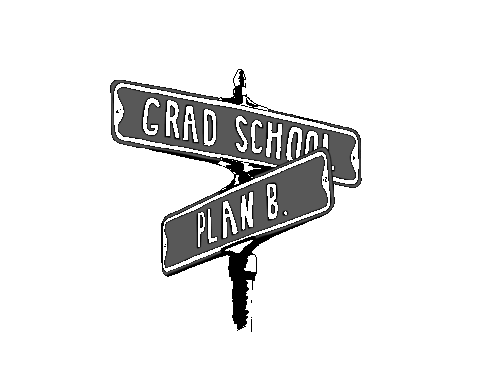
Too Late or Too Soon? The Right Time to Think About Graduate School
Graphic by Emma Crago

At the start of high school, I set a simple, resolute goal: get into a top college. For me, that felt like the ultimate measure of success, the culmination of years of work. Many students share that mindset—the process is grueling, but in hindsight, the path looks fairly straightforward. The formula is not exactly a mystery: discover an interest early, cultivate it, join aligned clubs or organizations, and trust that the pieces will fall into place.
Once you get to said college, however, the picture becomes more complicated. Having completed my first year and stepping into my second, I see post-college options as both wider and more daunting than I imagined. Graduate school, in particular, looms large—I consider whether to pursue it at all, and if so, in what field. These questions no longer feel like distant hypotheticals but like choices requiring real answers. The open-ended exploration of my first year has given way to the pressing weight of what comes next. At times, it feels exhilarating, the sense that I could choose anything. But it also feels overwhelming, like I could just as easily choose wrong and close doors without realizing it.
When I arrived at Harvard, I intended to study computer science. Much of my high school experience revolved around tech: robotics competitions, STEM-based summer programs, even app-building contests. It felt natural to continue that path. However, after two semesters, I found myself drawn toward economics, especially through a development lens. Suddenly, I was more excited about applying programming skills to empirical research on innovation policy than about building full-stack apps for their own sake.
The transition was exciting yet disorienting. I worried I had wasted time chasing the wrong path, and I wondered if I was already “behind” compared to classmates who knew their concentration tracks from day one. What pulled me forward, though, was the realization that computer science could be used to drive social change. In classes like “EC50,” I encountered projects that amazed me: machine learning models being used to deliver food aid in Sub-Saharan Africa, massive datasets revealing patterns of upward mobility in the United States. Seeing how technical tools could illuminate questions of inequality and policy made me think harder about graduate school, not just as the next logical step, but as a way to deepen my interests.
This summer, I raised these concerns to co-workers at my tech internship, and a piece of their advice stuck with me. A colleague explained how she always framed her future in terms of Plan A, Plan B, and Plan C. Plan A is where you devote your main effort should go; Plan B runs quietly in the background as a practical backup; Plan C provides a safety net, less ambitious but still viable. The point, she stressed, is that preparing for all three turns a potential “failure” into a controlled pivot.
For me, this framework did not just make sense on paper, it made me breathe easier. Suddenly, graduate school did not seem like an all-or-nothing bet. If Plan A did not work, I was not doomed; I had pivots built-in. That realization gave me permission to take my interest in economics seriously, without being paralyzed by the fear of choosing wrong. In practice, this could mean mapping out concrete steps for each path: research experience and applications for graduate school, networking and internships for the private sector, and policy fellowships for public service, so whichever way things unfold, I am already moving forward.
If graduate study is your Plan A, knowing its demands early matters. Requirements and timelines differ dramatically across fields. As a first-year, I find it worthwhile to explore widely. At Harvard, many students apply to finance or career-oriented programs—not necessarily out of herd mentality, but because experimentation clarifies what genuinely interests you. Others pursue entirely different avenues: launching startups, joining nonprofits, or exploring creative paths. By engaging thoughtfully, you gain a clearer understanding of which opportunities align with a graduate school path worth pursuing.
Clarity early on is especially important in fields with high barriers to entry. I learned quickly that economic Ph.D. programs come with steep, sometimes hidden prerequisites: advanced math like real analysis, meaningful research experience, and ideally a thesis. None of this was obvious to me at first, and I realized that without careful planning, I would easily need a two-year fellowship before applying. Students who realize this early can plan accordingly—taking the right courses, building research experience, and apply straight from undergrad if they choose.
Timing, in short, matters. Some programs—foreign fellowships, Ph.Ds—require early and deliberate preparation. Others, like law school, are more flexible: the LSAT can be taken later, and many majors remain competitive. Medical school falls somewhere in between: strict science prerequisites must be completed during college, but many applicants take gap years before applying.
The real challenge is the cost of late discovery. Students can still pivot into demanding fields, but they must be prepared to spend extra years filling in the gaps. This is where Plan B becomes critical. For me, Plan B might look like working as a research assistant after graduation—something that would let me stay close to economics while buying time to strengthen my application. Plan B isn’t a downgrade, but a detour that still moves you forward.
Plan C, meanwhile, offers quiet reassurance. I take comfort in knowing I could always return to tech. It may not be the dream anymore, but the skills I built in high school and my first year still give me a stable fallback. And, paradoxically, that stability frees me to aim higher for Plan A—when you know you won’t collapse if your first choice doesn’t work out, you’re more willing to take risks.
Looking back, high school felt like a straight line: set the goal, follow the formula, and trust the outcome. College has been different, less of a straight line and more of a maze. I’ve had to accept that uncertainty is not a sign of failure but a space for discovery. The real lesson is about agency: using your early college years to explore, your middle years to prepare, and always keeping alternative plans in view. Graduate school may be the goal, but the deeper challenge is learning how to choose with intention and build options that let you steer your own future.
Nashla Turcios ’28 (nashlaturcios@college.harvard.edu) writes Forum for the Harvard Independent.