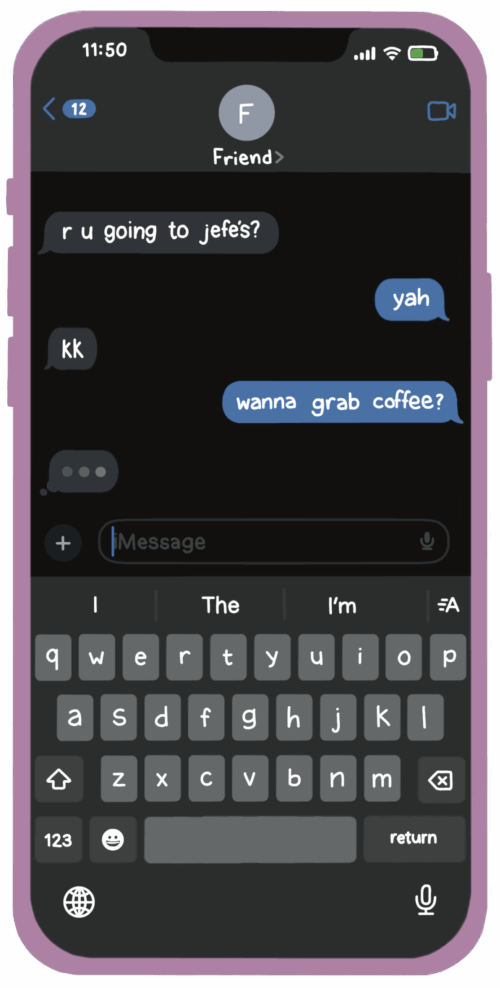
The Absolute Bane of My Existence
Graphic by Neshama Ryman

I hate texting.
I’m a bad texter. Like, BAD.
Anyone who knows me can vouch: I’m notoriously terrible at responding to messages. And it’s not because I don’t see them—that excuse doesn’t fly in a world where our phones are glued to our hands. The truth is, I just can’t take texting seriously as a real form of communication.
Even worse, I think texting has warped the way we connect with each other, and not for the better.
One of the biggest issues is the demand for constant availability. Since texting is such an “easy” and “convenient” method of communication, we’ve normalized the idea that everyone should be reachable, all the time. Suddenly, every single meal or moment in our schedule becomes a social opportunity. Texting deludes us until we start to believe it’s actually possible to keep up with dozens of people in a single day. We overstep our own boundaries that we didn’t even know we had so that we surpass our limits to the people we can see, think about, care about, and give our all to. And we fail to communicate these boundaries to others as well.
The reality becomes exhausting. Hundreds of Gmail, GroupMe, and WhatsApp notifications overwhelm us. And that pressure bleeds into our offline lives too: every meal, every walk, every study break turns into another “catch-up.” No wonder so many of us feel socially burnt out.
My conclusion (to justify my occasional 24-hour response time): texting is not a natural form of communication. We must see the people that we talk to; we can glean so much information from body language, expression, energy, and overall vibes—all of which you can’t capture through a phone. On top of that, texting is by far the fastest form of connection, which creates the expectation of a very fast reply. It exemplifies exactly what Byung-Chul Han—a South Korean-born philosopher known for his critiques of contemporary society—calls “smooth.”
In his book, “Saving Beauty,” Han defines “smooth” as “something one just likes. It lacks the negativity of opposition.” It’s simple, straightforward, and unchallenging. He points to artist Jeff Koon’s balloon dog as the perfect example: a piece of art defined by its smooth nature, inviting no discomfort, no distance, and no need for deeper thought and interaction with the artwork.
Extending this idea, Han asserts that “information is a pornographic form of knowledge.” Knowledge, he argues, is complex and nuanced while information is flat and recitable. If this is true, then texting naturally follows as a pornographic form of communication.
Texting creates a “seamless” digital connection between people, made even smoother with each update: automatic response suggestions, reaction emojis, to the ability to “like” messages. We’ve created ways to communicate without intentionality, easily displayed by trends like sexting, Snapchat streaks, and, don’t even get me started, dating apps. Technology enables what I’d call “fake communication” —communication with less effort. None of these methods require deeper thought and consideration.
For example: have our friendships really devolved into sending Instagram reels back and forth? (I’ve had friends admit this is their main way of staying in touch with people from home while at college.) As sweet as it may seem, it’s not the same as: “I was thinking of you.” Instead it’s: “I saw something that passively reminded me of you, and technology gave me a one-click way to send it.” Compare that to actually calling and saying: “Hi, I miss you. Biking by the river made me think of you today. Can we hang out soon?”
Contrast modern day versions of modern day text chains, back-and-forths that consist mostly of one to two sentences at a time, to what I almost want to call the vintage habit of letter-writing. Precisely because communication is faster (“smoother”), it feels as though there’s less delay, and therefore, less thought put behind the words that we write.
Even something as intimate as “I love you” has been reduced to “ily” in our digital worlds. How tragic it is that this emotion, this vulnerability with the rush of excitement, the comfort of reassurance, and all the meanings that those three words hold, has been “smoothed” out into three tiny letters.
Let’s go back to the days of hand-written letters, long conversations, time set aside for hours on the phone, generally just choosing time spent together, and not rushed lunches between classes. Real, intentional time and genuine connection in friendships becomes more and more rare as we normalize the quick, transient “connection” formed through text chains and group chats. Creating intimacy in friendships gets lost in our priorities, replaced by superficial interactions with dozens of people. And maybe, the solution isn’t to keep promising meals or grabbing coffees.
Maybe, the solution is to limit the number of people we keep in touch with, so that the relationships we do invest in can flourish. In order to be more intentional, it means choosing who we devote time to, and committing to giving those friendships our all. Otherwise, how are we to feel intimacy in rushed friendships sandwiched between Chem 17 and my next social appointment?
Raina Wang ’28 (rainawang@college.harvard.edu) romanticizes the idea of letter-writing, so reach out if you’re looking for a pen pal!