Calculating Wellness
Graphic by Madison Krug

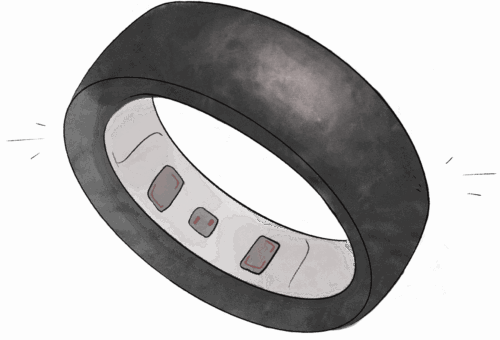
83. 75. When I wake up each morning, the first thing I check is two numbers—my Readiness and Sleep scores, courtesy of my Oura Ring. These digits define the quality of my rest and how energetic I am for the day ahead, calculating my physiological wellness through the light, gold ring that rests so delicately on my finger. And these numbers are just the beginning.
The Oura Ring, which has surged in popularity in recent years after its initial release in 2015, is a smart ring that tracks health metrics ranging from activity levels to sleep quality. Now on its fourth generation, the ring connects to an app to track heart rate, sleep, body temperature, activity, menstrual cycles, and blood oxygen levels; it can even predict illness and related health troubles, giving personalized advice to stay restored and healthy. Lasting around a week before needing to be re-charged, it helps users detect physical strength and monitors overall physical health, all displayed on its app.
Each day, it provides three scores on a scale from 0 to 100: the Readiness, Sleep, and Activity scores. The Readiness score, calculated from sleep, activity, and other body signals, is calculated overnight to reflect “how balanced your recovery and activity are.” Similarly, the Sleep score takes into account total sleep time and efficiency, as well as how much time you spend in each stage of the sleep cycle. Finally, the Activity score, the sum of six daily Activity Contributors, gives a personalized assessment of your daily activity and movement.
It was late last April when I made the impulsive decision to buy the ring. Struggling with a deficient sleep schedule and the mental and physical exhaustion of recruiting, I became set on focusing on wellness and exercise again. I hoped the ring would magically help me, even if in some performative, placebo-effect way. But it provided genuine support. It’s barely left my finger since.
In an effort to meet the ring’s goals, I began prioritizing working out and getting my steps in. Seeing my suboptimal Readiness scores and sleep quality—common side effects of being a Harvard student—encouraged me to not feel guilty about going to sleep earlier, staying more active throughout the day, and taking time to clear my head. Depending on how much I slept or my activity the day before, the ring adapted to tell me how to best restore myself, whether that meant more exercise or taking it easy.
From runs and walks, playing tennis and pilates, to wandering streets late at night with my friends, the ring tracked my every movement. It could classify each activity too, somehow knowing the difference between when I played golf and pickleball versus housework. Unfortunately, it did not pick up on low heart rate and movement activities, like Solidcore, which dominated my summer routine. Still, overlapping with a generally more restorative time in my life, the ring truly did spark a summer of wellness, a mindset shift I have since fully embraced.
From the moment I got the Oura Ring, I became obsessive. I opened up the app as impulsively as I did social media, scrolling through numbers I didn’t even understand or know existed. Soon, I became competitive with myself. It was like a game, exacerbated by my perfectionist tendencies. How can I get a higher score? How can I forcefully make myself feel better? Why do I still feel tired?
The scores began to define me. I needed to hit the daily step goal, to get enough sleep. Calories burned and step counts, things I barely thought about before, were all of a sudden constantly thrown in my face. Waking up to see a low sleep score psychologically marred the day ahead, even through its great moments. I would wake up feeling tired or lacking energy, even when my Readiness score was high, and I became obligated to feel better. Or, the reverse: I would wake up feeling energetic when my Readiness scores were low. There were even days that I told myself my challenging workout class combined with a run weren’t enough exercise because my activity score wasn’t perfect.
The Oura Ring might just be the epitome of our contemporary all-encompassing wellness culture. As technology advances further into the world of athletics and wellness, becoming more intertwined with telling us how we should feel, it’s important to remember that only intuition can define our confidence.
Many have pointed to just how exhausting wearable technology can be—the data is often overwhelming, sometimes even encouraging health anxiety rather than wellness. Constant technological monitoring of heart rate or body temperature, and their respective changes, can cause unnecessary concern even when statistics are perfectly normal.
Moreover, technology and social media have made us obsessed with pursuing numeric goals and habits that are not only incompatible with an enjoyable lifestyle but also degrade our emotions and how we mentally feel. Perhaps a truer measure of wellness cannot be captured by numbers. TikToks and Instagram reels, in particular, seem to be pushing this agenda of numeric wellness: videos with recipes that break down exact protein and calorie statistics, daily routines with influencers getting over 10 hours of sleep, expensive workouts that are all seamlessly tracked and recorded. While these technologies intend to improve health and well-being, their unintended consequences can take a major toll.
Don’t get me wrong: I will probably never go a day without wearing my Oura Ring. It feels like a part of me. But ultimately, I also understand that my wellness is not defined by any statistics on an app, and sometimes the low Readiness score came from a different source of wellness. Staying up late with friends or spending an afternoon lying on the couch watching movies are just as integral to the process of restoration as reaching ten thousand steps per day. The Ring, and other health technologies for that matter, cannot track when we laugh and smile, when we cry, or when we feel mentally strong, even if we physically don’t.
Meena Behringer ’27 (meenabehringer@college.harvard.edu) is the Arts Editor of the Independent.