
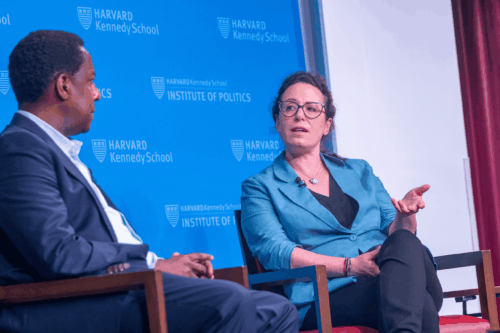
Harvard’s John F. Kennedy Jr. Forum welcomed Pulitzer Prize-winning journalist Maggie Haberman in conversation with moderator Setti Warren on Sept. 25. The discussion traced President Donald Trump’s path from his early tabloid notoriety to his enduring hold over the Republican Party. Over the course of the evening, Haberman unpacked the blend of ambition, grievance, and appetite for attention that has defined Trump’s political trajectory, while also reflecting on what his leadership reveals about the current state of American democracy and the press.
Haberman, a White House correspondent for the New York Times, has covered Trump for decades and authored the #1 bestseller “Confidence Man: The Making of Donald Trump and the Breaking of America.” She received the Pulitzer Prize in 2018 for reporting on Russian interference in the 2016 election. Warren, who previously served as mayor of Newton, Massachusetts, now leads Harvard’s Institute of Politics and serves as adjunct lecturer in Public Policy at the Harvard Kennedy School.
Three Campaigns, Two Elections
The conversation began with Warren asking Haberman to reflect on what motivated Trump to seek the 2016 presidency, run for reelection in 2020, and mount a third campaign in 2024. Haberman traced Trump’s ambitions back decades: “The first time that Trump ever, that I know of, spoke publicly about running for president was in a 1980 interview with Rona Barrett, where he said, ‘maybe I’ll run for president’ as sort of a throwaway,” she recalled.
While Trump did not act on the idea then, Haberman noted that since his early years in the New York tabloids, he understood that putting himself at the center of attention advanced both his business interests and public persona. “He recognized how much—if he could command focus, if he could command interest in himself—that was beneficial, yes, to his real estate business, but also he wanted to be a star from the time that he was young,” she said. “And he’s been very interested in attention for a long time.”
By the late 2010s, Trump’s political ambitions were resurfacing. The Tea Party insurgency cracked open space in the Republican party for outsider figures, conservative media rewarded spectacle, and “The Apprentice” kept Trump in the national spotlight. In that climate, visibility and dominance revealed itself as political currency. “In late 2010, he did start getting more interested. It’s always been there at the back of his mind. It’s the top job. It’s the best job. It’s the most attention in politics,” Haberman said. “It’s power. And Trump is ultimately interested in power. I don’t think he has ever pretended otherwise, frankly.”
Trump’s first serious flirtation with the Republican Party came in 2011. “He very briefly announces that he’s pro-life, which he had supported abortion rights prior to that. And a few weeks later, he starts this crusade of questioning President Obama’s birthplace,” she said. “But it vaults Trump from pretty far down in the Republican primary polls up to the top,” she said.
What followed, she added, was a stinging moment at the White House Correspondents’ dinner.
“President Obama really humiliates him at the White House Correspondents Association Dinner with a mockery that really was just targeted at one person,” Haberman said. “I was in the room that night. It was very tense, and it clearly left a mark on Trump. I don’t think that’s the only reason he ran in 2015, but I think it was a big part of it. That dinner really had an impact.”
Trump’s fraught history with the dinner became part of his political brand: following the viralization of Obama’s jokes in 2011, he repeatedly snubbed the event as president, refusing to attend even when it was held in his honor beginning in 2017. Deliberately skipping the Correspondent’s Dinner throughout his first term, he opted instead to stage campaign-style rallies, intensifying his attacks on the media by labeling it “fake news” and branding the press as the “enemy of the people.”
The discussion soon pivoted to Trump’s bid for reelection in 2020 and his choice to mount yet another campaign in 2024, as Warren pressed Haberman to analyze Trump’s rationale for both bids.
Haberman emphasized that Trump’s instinct to seek reelection was not unusual. “He ran because he wanted a second term because I don’t know any president who would leave willingly,” she explained.
However, the pandemic dealt a major blow to his 2020 run. The crisis’s destructive toll and economic upheaval reshaped the 2020 electoral landscape: by election day, the U.S. had endured over 234,000 confirmed COVID-19 deaths and a steep economic contraction. Turnout surged to about 66% of eligible adults (a 7% jump from 2016): 17 million more Americans cast ballots than in the prior presidential election. Moreover, some county-level studies estimate that areas with heavier COVID incidence saw significant declines in Trump’s support. For instance, 100 extra cases per 10,000 people corresponded with a 0.13% drop in his vote share.
“Without the pandemic, I think he probably would have won again. But that was a calamity in terms of how he handled it,” Haberman said.
Political Violence
Warren next steered the discussion toward the troubling rise in political violence, pointing to the recent attacks on political figures, including the assassination of Charlie Kirk. Specifically, he asked how Trump views the issue and what he aims to accomplish with his rhetoric.
“July 2024 was when he was shot in Butler, PA. And so much of his reaction has been through the lens of that. And that’s not guesswork—that’s from talking to lots of people,” Habermann said. “He tends to experience things through what he went through. And there’s a pretty clear parallel on this.”
She recounted a report in the Atlantic about Utah Governor Spencer Cox, who held a press conference following Kirk’s killing to call for lowering the political temperature. “Cox does that press conference. He barely says anything political. He does call for taking the rhetoric down. After that, Cox gave an interview to the Wall Street Journal where he described the alleged shooter as steeped in left-wing ideology,” Haberman said. “So I think that tells you sort of where the president’s mindset is.”
Comey’s Indictment
As the evening drew to a close, another contemporary and critical moment was discussed: reports indicating that the Justice Department may soon bring criminal charges against former FBI director James Comey. Warren asked Haberman why this case matters so deeply to Trump and what it could mean to the country.
Haberman’s response underscored one of Trump’s longstanding fixations. “The president has wanted to see him indicted for a very long time. He was hoping for this in his first term. He was hoping to find some evidence.”
“The Inspector General looked into Comey’s conduct… Michael Horowitz, the Inspector General, did not suggest charging him. He did suggest he violated department policies. Bill Barr, then the Attorney General, said there’s not a case here. And that enraged President Trump,” she continued.
For Haberman, the implications are stark.
“This is ‘I want you to prosecute this person, go get me a crime.’ Essentially, we saw the president do a version of this with two presidential orders he signed earlier this year… Comey would be, if he is indicted, a huge escalation on that front,” she explained. “We are now in a world where there is now an effort in half a dozen federal prosecutors’ offices to try to launch investigations into George Soros and his political activities.”
Nashla Turcios ’28 (nashlaturcios@college.harvard.edu) writes News for the Harvard Independent.