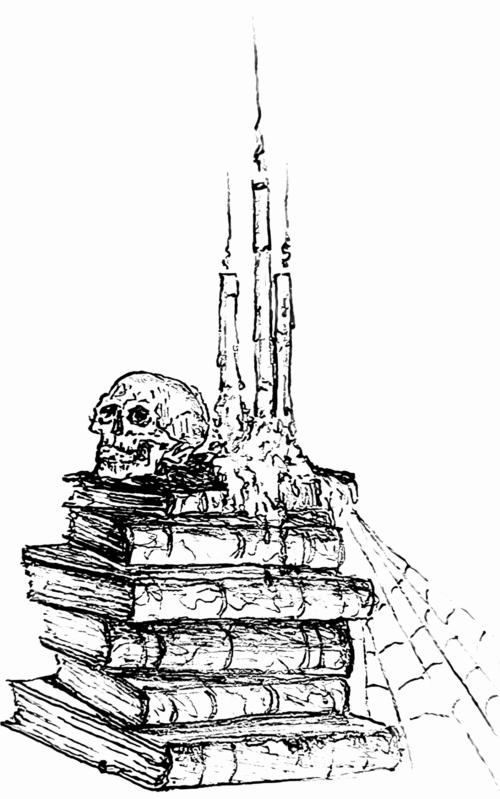
Spooky Stories for the Halloween Season
Graphic by Caleb Boyce

The fall season is traditionally hallmarked by pumpkin spice and sweater weather. But to me, fall is characterized rather by curling up next to a crackling fire, beverage of choice steaming in hand, while leisurely reading a good book. With Halloween just around the corner, horror and all things spooky are on everyone’s minds—making reading a thrill-chasing story only the more fitting. Many don’t know where to begin when tackling the expansive genre of horror: should they start with a well-known novel, such as “Frankenstein,” or perhaps something more obscure, like “The Willows”? To remedy this, Professor Deidre Lynch, who teaches Harvard’s ENGLISH 148: “Modern Monsters in Literature and Film,” helped me compile an official reading list for the upcoming season.
“Dracula” by Bram Stoker
A canonical work of the horror genre, Bram Stoker’s “Dracula” tells its story in many different forms from letters to ship logs to newspaper excerpts. The novel follows lawyer Jonathan Harker as he visits Count Dracula’s Transylvanian castle to discuss the count’s wish to move to England—a place where people don’t know that vampires exist. Unbeknownst to Harker, he is merely helping Dracula relocate to a more populated (and unassuming) area to easily stalk victims and further his reign of terror.
Lynch praises Stoker’s writing for capturing “that sense of the vulnerability,” explaining that “you [the reader] know more than the characters do, and you’re about to have the worst confirmed.”
“The Haunting of Hill House” by Shirley Jackson
Another horror classic is Shirley Jackson’s “The Haunting of Hill House.” More widely known for its adaptation into a 2018 TV mini-series, the novel follows Eleanor Vance, a dreamy yet troubled woman who stays at Hill House to aid in a paranormal activity investigation. As the story unfolds, Eleanor discovers her affinity for the supernatural, and she begins to lose herself to the will of unnatural forces within the mansion.
The original novel leaves the reader feeling disoriented and inner turmoil, which Lynch attributes to Jackson’s ability to “[evoke] setting,” yet “[make] you feel that you have no idea what’s going on in it.” The TV series, on the other hand, changes many elements in the original novel, including an added backstory about the haunted mansion.
“The Willows” by Algernon Blackwood
This novella, set on an island in the Danube River, observes two friends camping when they suddenly notice that their surroundings keep eerily changing form. Although both friends feel tense since setting foot on the island, this realization largely comes in the night when they realize that the surrounding willow trees have crowded around their tent. At this point, they have to figure out how to leave the island when their environment is actively working against them.
Lynch commends Blackwood’s ability to elicit “a sense of unease, so you feel slightly off-kilter, you don’t know what’s going on…and you’re fearing the worst.”
Similarly to “The Haunting of Hill House,” Lynch also praises Blackwood’s use of setting, attributing much of the “unease” to each novel’s unsteady surroundings. By empowering the environment, rather than any of the characters, Blackwood instills a feeling of hopelessness and defenselessness within the reader.
“The Sandman” by E. T. A. Hoffmann
“The Sandman” is a short story by German (perfect for Oktoberfest) author E. T. A. Hoffmann that traverses the memories of the main character, Nathanael, as he confuses reality with his visions of the titular figure, a terror-inducing character who is said to steal the eyes of children who do not go to bed. By constantly evoking absurd and nightmarish imagery (such as the Sandman stealing people’s eyes and feeding them to his owl-like children who live on the moon), Hoffmann weaves a tale that leaves the reader wondering what is real and what is a result of Nathanael’s delusions.
Lynch expounded that this short story was “sort of a source for…Sigmund Freud theorizing ‘the uncanny’ as a special category of the frightening.” Hoffmann’s ability to blur the lines between the real and the unreal, examining reality through a distorted, grotesque lens, is what provides this sensation of the uncanny, making this short story a pioneer in its genre.
…
While you can choose to merely watch scary movies, reading novels in the likes of those mentioned above preserves many key features of internal narration that do not always translate well onto film. This “narrative within a narrative structure” is a key aspect that Lynch feels can only be found in literature, referring to classic novels with many film adaptations, such as “Frankenstein” with its distinctive frame narration. It’s this aspect that contributes to the feelings of suspicion and unreliability that make horror distinctive as a genre. Because of this, Lynch also advises readers not to “let the films mislead you” when going into horror novels with popular film adaptations, as some of the story portrayed in the film may not be what it seems.
At the end of the day, there are endless scary stories to choose from. The sensations of suspense and tension heightened while reading a well-narrated horror novel perfectly accompany Halloween, making it truly no better way of spending your evening. If you want any more suggestions, you know where to find me: within the pages of a terrifying book.
Eden Bridge-Hayes ’29 (edenbridgehayes@college.harvard.edu) is a horror fanatic who is trying to make sure no one can sleep at night.