Live, Laugh, and Limit
Graphic by Trischelle Afihene

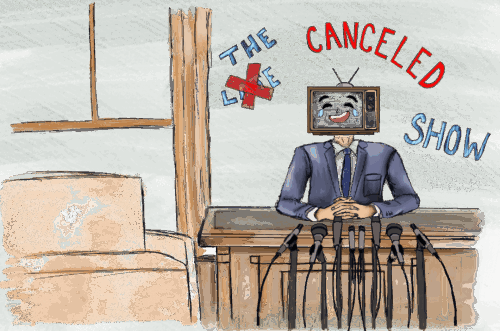
In just four months, the American comedy world has been shaken. On Sept. 17, ABC briefly suspended “Jimmy Kimmel Live!”, and in July 2025, CBS announced the cancellation of “The Late Show With Stephen Colbert.” These moves sparked concern among comedians worldwide about the narrowing space for political satire and the erosion of free speech.
Harvard is home to satirical magazines and a constellation of improv troupes. Here, comedy is not just entertainment, but an experiment in critique, parody, and cultural play.
Thus, the national turbulence surrounding late-night comedy raises a more local question: What does this mean for on-campus comedy?
When ABC pulled Kimmel off the air under pressure from Federal Communications Commission Chairman Brendan Carr, observers grew concerned about government interference in entertainment. More than 400 celebrities, including Lin-Manuel Miranda, Meryl Streep, Natalie Portman ’03, and Tom Hanks signed an ACLU letter warning of “government threats to our freedom of speech.”
“This is the moment to defend free speech across our nation,” the letter stated.
The suspension of “Jimmy Kimmel Live!” came amid a fraught moment in U.S. media politics. Conservatives had been pressuring networks over alleged bias in public media, and Carr had recently urged broadcasters to rein in “misinformation.”
After Kimmel commented on the assassination of conservative activist Charlie Kirk, several major ABC affiliates—namely those operated by Nexstar and Sinclair—pulled his show even before his official suspension, citing Carr’s explicit warnings to broadcasters. 
Rebecca Tushnet ’95, Frank Stanton Professor of First Amendment Law at Harvard Law School, outlined the broader threats posed by Kimmel’s suspension in an interview with the Independent.
“The issue isn’t corporate or affiliate pressure. Private pressure is just opinion. Private pressure exercised at the government’s behest is a First Amendment problem,” Tushnet said. “When the FCC threatens broadcasters with license revocation for speech the President doesn’t like, that’s not business discretion—that’s the government silencing critics.”
On Sept. 24, Kimmel returned to the air with a teary-eyed emotional monologue, apologizing for remarks he admitted may have misled viewers about Kirk’s death.
Just months earlier, late-night television had pulled Harvard into its cultural orbit.
In April 2025, comedians from Kimmel to Colbert rallied behind Harvard after the University defied demands from the Trump administration. “My money’s on Harvard… Harvard, unlike a lot of schools, is standing strong,” Kimmel said on his Instagram. Colbert and “The Daily Show” host Ronny Chieng joined in, satirizing the White House’s efforts to pressure Harvard.
“They’re standing up for their principles and for everyone’s right to free speech, even if it means possible financial ruin,” Chieng said.
At this point, late-night television was not just mocking politics—it was amplifying Harvard’s defiance, placing the University at the heart of a national cultural resistance.
Indeed, defiance through a comic lens has long thrived from within the University. Harvard is a comedy incubator. Most notable among campus’s various light-hearted groups, the Harvard Lampoon, founded in 1876, has shaped generations of humorists who went on to dominate American comedy. Alumni include Conan O’Brien ’85, Colin Jost ’04, and B.J. Novak ’01.
But the campus comedy scene is not confined to print. The 20th century brought live performance through the Immediate Gratification Players, which was founded in 1986 as Harvard’s oldest improv troupe. Other troupes include On Thin Ice, Three Letter Acronym, and the Stand-Up Comic Society.
These groups became training grounds for voices unafraid to experiment—and sometimes to provoke. IGP sees itself as offering something distinct.
“IGP provides a unique montage-style improv comedy to Harvard’s campus, which differs from the two other troupes that focus on shorter-form games and Harolds,” IGP co-president Jack Burton ’26 explained to the Independent. “Starting with only one word at the beginning of the show, the group focuses on refining narrative construction in an improvised performance. At the end of the day, we are building relationships with each other and the people who come to watch.”
That ethos extends to their sense of audience. “We specifically try to avoid Harvard references in our humor and stick to comedy that can be enjoyed more universally,” Burton said. Their mantra—“happy, healthy, well”—guides them away from offensive material and toward trust: between troupe members, and between troupe and audience.
“Regardless of our personal political views, we try to cater our humor to engage all audience members,” Burton continued.
In this way, IGP embodies a paradox of student comedy at Harvard. Students are both exposed and sheltered from the currents of campus tensions as well as national comedy. Nonetheless, recent volatility has spurred concerns.
“A shrinking late-night industry has certainly caused apprehension,” Burton acknowledged. Silencing late-night comedians threatens the community of comedy at large. Ratings have steadily declined, with network late-night viewership dropping 9% year-over-year in 2025, and advertising revenue halving from $439 million in 2018 to just $220 million by 2024.
That contraction ripples from Hollywood into Cambridge. Student publications like the Harvard Lampoon rely on a similar advertising-based business model, using revenue from local and national sponsors to fund print issues, pay for equipment, and sustain operations. As advertisers retreat from media spending across entertainment and satire, campus publications may struggle to attract the same sponsors or justify similar rates. A shrinking comedy market tests the entire ecosystem, both the late-night show headliners and the next generation of satirists.
According to Tushnet, these cancellations are not just a trend in comedy alone. “It’s part of a broader Trump administration assault on free speech,” she said.
“Although it can be hard to draw lines, the present situation is not near the line. When the FCC threatens broadcasters with license revocation for broadcasting speech that the President doesn’t like, there is a First Amendment problem,” Tushnet continued.
For now, most students steer clear of politics. “People are not coming to an IGP show for political discourse—they’re coming to laugh,” Burton said. “Political humor is often used as a crutch. Nobody wants to see another bad Trump impression.” To avoid subjects that could encroach sensitive, strongly-held stances, students prefer to divert their humor to more apolitical subjects. Cancel culture, coupled with the permanence of anything and everything one says on social media, results in the decision to seek levity in more wholesome, timeless experiences.
From the Lampoon’s Castle on Mount Auburn Street to jokes shared across the tables of d-halls, Harvard’s comic energy remains contagious. However, students are watching national headlines closely. The future of late-night may be uncertain, yet the impulse to laugh persists.
In a 2007 interview with Parade Magazine, Stephen Colbert said, “You can’t laugh and be afraid at the same time. If you’re laughing, I defy you to be afraid.”
In a year when laughter itself has become a test of courage, Harvard’s comedians continue to prove him right.
Cloris Shi ’29 (clorisshi@college.harvard.edu) enjoys watching late-night shows and getting in a good, full-bellied laugh every day.